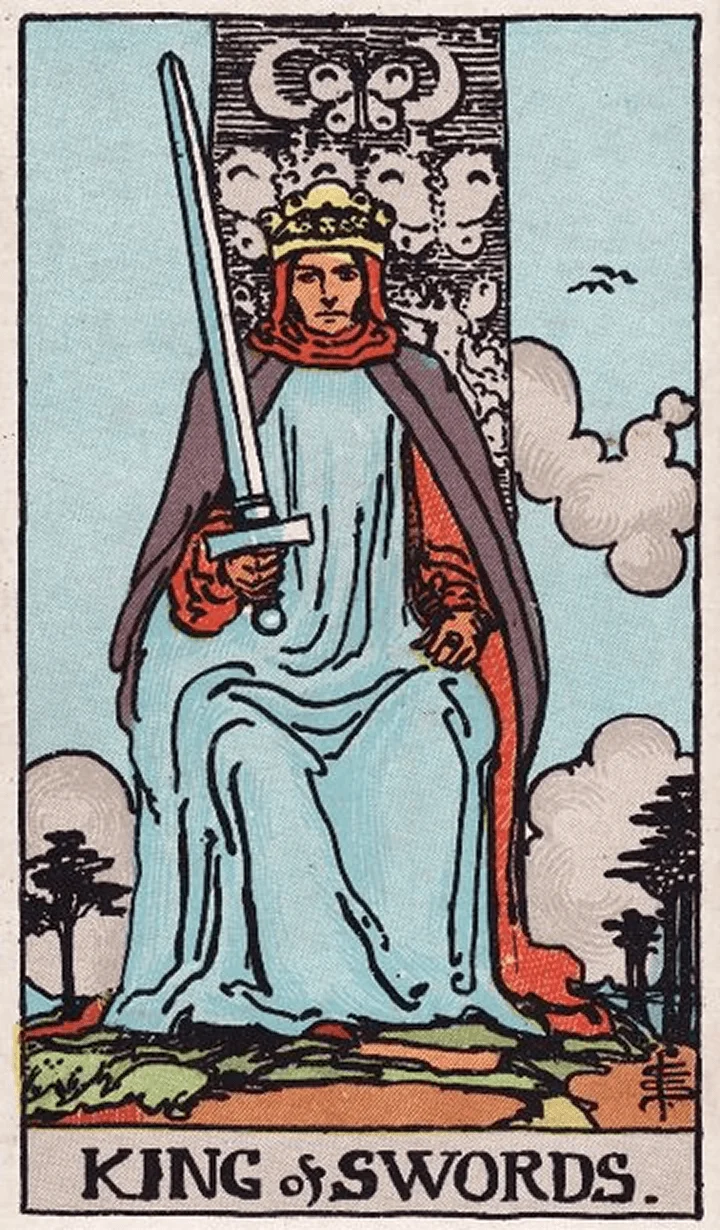
Four of Swords
This card announces a timeout like a referee on the field. Its main message is the futility of struggle at the present moment. Forcing events or confrontation with other people is not only inappropriate now but practically impossible. All attempts to sharply change the existing order of things will lead to nothing. This card always implies a delay.
This card announces a timeout like a referee on the field. Its main message is the futility of struggle at the present moment. Forcing events or confrontation with other people is not only inappropriate now but practically impossible. All attempts to sharply change the existing order of things will lead to nothing. This card always implies a delay.
The Four of Swords is a card of peace and detachment; it absolutely excludes fuss. Its main meanings are solitude and isolation, exile and retreat, postponement and temporary withdrawal. In affairs – no progress. Its main advice is to use this time to rest, think over recent situations, restore strength and health, and plan the future more wisely. This card reacts exceptionally accurately to a state of incapacity – in the most varied senses and manifestations, from subtle psychological to quite medical cases.
The Four of Swords is conventionally considered if not a 'bad' then a 'not particularly good' card. The reason for this assessment is most likely that the consciousness of Western man is generally very fussy; a state of inaction and contemplativeness is alien to him and acts depressingly – what kind of prostration is this? Our consciousness is overall oriented towards more or less productive activity, circulation in the flow of events and occupations, acceleration of the course of affairs; it constantly requires some 'action,' like a squirrel in a wheel.
Each Arcana carries its own experience and lesson. In this case, it's the experience of a squirrel that has fallen out of the wheel (sometimes – literally into a stupor). For most people, this is displeasure and shock, and only in rare cases do they rejoice at this card as an opportunity to detach, collect their thoughts, be alone with themselves, and catch their breath. It is a precious respite, a much-needed timeout now, a granted refuge from the hustle and bustle, even if the person themselves painfully experiences it as exile, what is called a retreat. But those who are amidst heavy labors usually perceive the Four of Swords as manna from heaven. Not in vain was this card called 'the minor mercy of Swords' in the old days – they are at rest. This is planning actions in hermitic solitude, preparing the consciousness for a new turn.
The Four of Swords is a card of stagnation, interrupted activity, and forced rest. In this meaning, it resembles the Hanged Man card, the difference from it being that it is connected with specific events: the obstacles or difficulties indicated by the Four are usually simple and understandable, and overcoming them does not require us to overturn all the foundations of life. This situation is akin to illness, which also constitutes one of the card's meanings. We are forced to interrupt active activity, take a pause. Whether we will suffer or try to use this pause to sort ourselves out depends only on us. At the same time, it's clear that we can use the pause for work on ourselves, but we would hardly arrange it for ourselves voluntarily.
The Four of Swords is never a passing or accidental card. It is always a strong sign. Often it appears after a period of confusion and stress when a person simply needs to 'comb themselves,' rest, recharge, take care of themselves (and ideally – go on vacation). It is precisely a timely departure from the field that allows one to return to it, and the Four of Swords clearly makes it understood that solitude and calm are most needed now. But for the person, this state often turns out to be unplanned and is therefore perceived as an annoying dependence on circumstances.
The card says that since there is nothing in the external world now worth the querent's efforts, it makes sense to wisely use this period for internal integration and restoration. The surrounding cards will also provide much information about what preceded it and what will follow.
Under the Four of Swords confidently go reflections, planning future actions amid external passivity; in rarer cases – a couple of sleepless nights over some project, with the disappearance from the 'radar screens' of others. Sometimes the card says that the querent has encountered some problem over which they will have to think hard, using all their mind and life experience.
Traditional meanings of the Four of Swords – exile, confinement, banishment, also refuge, shelter.
Meditative and inert. Possibly, the person is simply ill or tired and therefore has lain low. But it can also be calm, useful reflections alone with oneself, a creative pause. 'A productive exile,' which becomes a period of restoring strength and preparatory work for the future, deep consideration of questions.
A person of the Four of Swords may seem constrained and awkward, alienated and depressed, exhausted and weakened; they are characterized by physical and emotional isolation, a need to shield themselves from the external world.
Abstraction from problems and fuss, withdrawal from corresponding emotions, return to oneself (especially in combination with The Hermit). Contemplation, solitude, restoration of internal balance. Meditation (its forms can be very diverse), rest, spiritual practices. According to this card, a person withdraws from pain and struggle to rest and heal. Like all Fours, it carries an impulse of stabilization and stopping. The Four is preceded by the bitter Three of Swords, so most likely this is recovery after considerable stress, pain, fear, confusion, something that exhausted the soul and body.
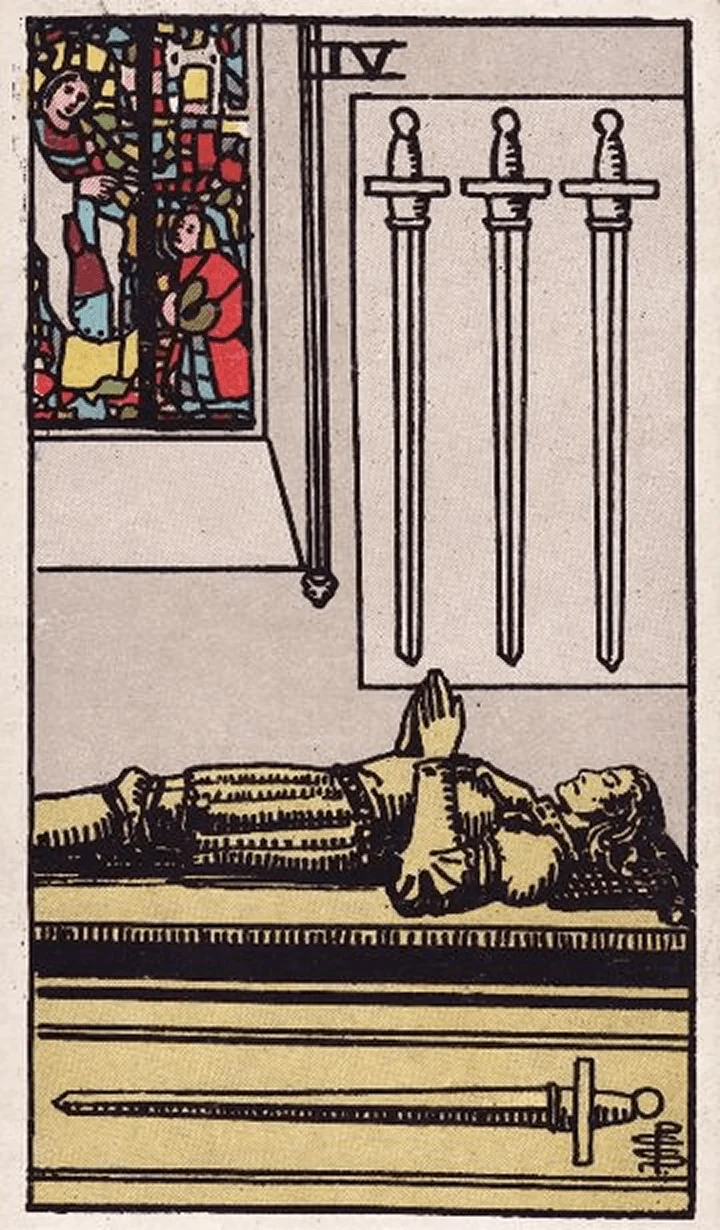
This card has a special relation to church and temples. It can describe the state of a person seeking atonement, forgiveness, communion, sincerely repenting, contemplating their past life, and developing a main line for the future. This card 'loves' people who have battle incarnations in their karmic asset and now live a markedly quiet life, with an emphasis on the water trigon of houses in the horoscope. In this regard, the images of the Waite deck are striking in their 'hits.' The wave, on the crest of which the soul once was, has receded, and they are temporarily left without strength and without active striving for a goal. Characteristically, the halo of Jesus on the stained glass window, under which the knight rests, contains the word PAX – rest, peace. And yet, Pax is not Requiem aeternam. It is rest, not death. It is the mystery of forced rest in solitude, self-knowledge, and renewal through silent internal suffering. The temporary sleep of a once restless soul, a latent period ('Sleeping Beauty').
I cannot help but recall the words of Anuki at Peggy Guggenheim's grave in Venice: 'Here rests Peggy Guggenheim… Yeah, rests... Knowing her – she'll rest, and then give everyone hell again!' That – is the mystery of the Four of Swords.
This is one of the cards that shows that internal state of consciousness when one has swung the 'sword' of diverse activity enough – it's time to think about the soul. In astrology, this is the 12th house. Through the 12th house, a person contemplates and comprehends past experience and their place in the world, and their external activity is noticeably limited so that nothing distracts them from this essential occupation.
They are provided with place and time to be alone with themselves, see the true essence of past situations, and prepare for upcoming events and experiences. The 12th house is a place for healing old wounds, redeeming karmic debts, and atoning for karmic crimes (not in vain is the previous Arcana the Three of Swords, Lord of Pain inflicted upon us or by us). This confinement can be internal, spiritual, or external – the Four of Swords is one of the strongest indicators of hospitalization and imprisonment.
Well, Prison, Hospital, Monastery – that's how the 12th house was described in old astrology. A forced, prolonged pause, 'confinement,' a monastery of the spirit – you won't leave until you've atoned. Higher powers 'laid you down' for the sake of peace, tranquility, restoration, and purification of consciousness, for preparation for a new chapter of life. The symbolism of the Arcana is often perceived rather negatively; the person makes unsuccessful attempts to 'break the ring,' 'break free,' but no such luck.
The true obstacles are within; external circumstances are merely a reflection of this. Both the Four of Swords and the 12th house symbolize a powerfully protected magical space. It is not given to the person from above for nothing, and not for nothing is it so well protected – the soul passes through here the school of its own sufferings; it is a tomb and a cradle simultaneously, a place of accumulation, concentration, and transformation; within this closed space, a very important transformation must occur.
Let's recall the previous Mystery – it is the Three of Swords. In the Four, liberation from suffering occurs; grief heals itself; cosmic consciousness concentrates on the personality's main problem, the primary pain. It is precisely this that locks the person up, to avoid premature defeat (and the ego may protest and rebel). Whether we accept the lesson of the Four of Swords in full or insist on early release depends on what role will become ours on the next Arcana – the Five of Swords. Whether we will be the one who achieves victory in the coming battle because we have gained spiritual maturity and strength, or the one who suffers defeat due to unreadiness and rashness with which we hastened to engage in a new fight (or drama).
On the Arcana, we see a knight lying on a tombstone with hands folded in prayer. The three swords above him correspond to the fourth, fifth, and sixth chakras – according to Masonic tradition, their points indicate the head, throat, and heart, which correspond to the wounding sites of the builder of Solomon's Temple, Hiram Abiff. These three chakras also correspond to the sins mentioned in the traditional formula of repentance: cogito, verbo et opere ('in thought, word, and deed'). Jupiter in Libra teaches mercy and justice, harmony and impartiality in evaluating events, in short, everything that our hero lacked so much in the past.
On a metaphysical level, the Four of Swords symbolizes a constructive deed, not inaction at all. A hermit, locking themselves in their cell and immersing themselves in self-contemplation and prayer, is not idle at all – they are very busy. By the way, we all know very well that in a state of intensive internal occupation (concentration on some thought or feeling), external occupation is unproductive – everything literally falls out of one's hands. This is 'work in an hour of peace' – an internal search in the silence of a cell. The card's symbolism is such that the attention of the one lying is directed to the three swords (spiritual, divine: they can also be interpreted as the 'Three of Swords' – sufferings experienced or caused in the past, realized mistakes), while the fourth sword (earthly power) remains inactive.
In the space of the Four of Swords, a person takes some exam with themselves. At the level of Mercury, the stabilizing Four of Swords contains all the regularity of the world's cause-and-effect structure. Everything is conditioned by thought. The same causes have the same effects. The card indicates a connection with an inner mentor, guide (one of Mercury's roles is psychopomp, 'guide of souls'), mediumship, access to some important energy-information channels. This is a retreat, 'a planet in exile,' the need to reason, work through, plan. One must use this confinement to come to one's senses, analyze experience, and enter a new phase without repeating past mistakes.
It is believed that the card corresponds to the third decan of Libra, which most fully represents the Libran idea of partnership – the idea of harmony in human relationships as an analogy of higher laws. This decan is characterized by concepts of justice, goodness, and morality, as well as calm optimism, a sense of humor, and attentive attitude towards people. This decan is ruled by Jupiter, which endows those born in this decan not only with the aforementioned virtues but also with conformism (that case when judgments are based solely on social norms, and the principle 'as above, so below' is taken too literally).
This decan is also inclined to see only the highest harmony in the world, often closing its eyes to the fact that truth has not yet come into the world, and to make the world truly humane, much work is needed. For representatives of this decan, to not become a traitor to their own ideals, they need to listen more often to the inner voice of their own conscience, but in order not to repeat Don Quixote's path, they must concretely comprehend the realization of their ideals. After an unsuccessful attempt to achieve the number Three on the level of matter and, 'landing,' or more accurately, crashing to the ground, the Force (understood metaphysically) finds an acceptable compromise in the form of a reliable and practical Four.
It is, of course, limited, but at the moment this is not particularly important, as it's about a temporary respite before a new thrust. At the level of the Four of Swords, a kind of rest occurs, healing after the struggle of delusions associated with the Three of Swords. The ideal, of course, is not achieved, God could not be brought down to Earth, but an idol has been carved, and the primary sympathetic connection between the deity and its earthly reflection is already established. This is a moment of centering, clarity, spiritual purification, restoration of balance.
Light and shadow (advice and warning)
Advice: Don't stick your neck out, calm down, lie low. Take care of yourself, make a stop, and restore balance. Give yourself a rest. Critically review your goals and plans, weigh your strength once more. Refrain from active and chaotic actions, from expending any resources – financial, nervous, and so on. Now more than ever, circumspection, caution, economy are needed. It's useful to conduct self-analysis for healing emotional wounds. Calmness and a hermit period of being are indicated. 'Taste silence,' set aside time for a break, finally get some sleep. In due time, everything will happen by itself. Warning: Not the time to sleep! Delay is like death. Sitting (lying) idle will impoverish life to an indecent degree. At the same time, the card may speak of the need to pay close attention to one's health to avoid serious problems in the near future.
Detachment from problems related to money and property. The card is especially indicative if it is known that the person bears financial responsibility. Waiting for better times, lying low during a crisis period. Material losses.
At the same time, the card is often attributed with good economic thinking and the ability to make correct, balanced decisions after careful analysis. Among its meanings are: great knowledge concerning material matters and the ability to use it to increase wealth; using accumulated experience to improve the material situation; the ability to manage one's property, correct calculation, realistic assessment of profit and loss, prudence and foresight, economical actions; a decision made after careful analysis of available information.
This is a card of temporary solitude, temporary detachment, and temporary hermitage. These are precisely temporary phenomena, but usually quite prolonged, and one should not expect their quick end. The card can describe three qualitatively different states: 1) voluntary stay in one's personal space, a timeout the person took themselves to put themselves in order; 2) forced isolation, when they objectively lack opportunities to change anything; 3) internal confinement, for which the person finds no explanation; they are as if separated from the world by a glass wall, which has rather bored them, but for some reason it turns out to be impossible to break through, and at this stage such is the will of karma.
And karma, as is known, is rooted in the soul's past deeds. Sometimes the card indicates that the past has a very great power over the person (and we can be talking about events and attachments of this life, as well as more distant times and connections). They profess solitude and abstain from building relationships because they are there, and ghosts of past feelings visit their soul like guests on Solaris. Sometimes it is the coldness of 'once bitten, twice shy' – the person is paralyzed by their fears, caused by past difficulties in relationships, disappointments, pain, betrayal (usually, some additional indications in the spread are needed for this, and certainly The Devil, The Tower, Five of Cups, Three and Five of Swords are indicative). They have given up, renounced their feelings, 'buried themselves alive.'
But they are not dead, and they should not say 'never.' This is not forever, even if for a long time. This is exhaustion from stress, failures, quarrels with a partner. At the same time, the Four of Swords gives an opportunity after a breakup to more dispassionately evaluate the relationship and the decisions made then. The Four of Swords gives time for reflection and warns: until the person analyzes and reconsiders their past actions, the future will remain 'under lock and key' for them.
Under the Four of Swords, in silence and external stillness, the restoration of the tormented soul occurs, the healing of wounds by the almighty healer – Time. However, other healers can help – for example, a good psychotherapist. Being alone, the person restructures themselves. They will build relationships differently when the time comes for it. Banzhaf writes: 'This period of turning inward can lead to a beautiful peaceful union, to the formation of a space in which both partners will have the opportunity to express their feelings.' This pause in personal life, during which nothing happens, is essentially heart surgery under anesthesia, followed by recovery, awareness of some lesson.
Lack of sex, a period of refractoriness, unexcitability, exhaustion. 'Nothing is happening,' a forced pause, something very earthly remains inactive, complete 'five and a half.'
This is an indication of a 'living corpse' type of relationship – seemingly existing, but with alienation and coldness evident. Problems aren't even discussed. A breakup looms without a scandal (due to the lack of emotions necessary for a scandal).
Some authors indicate that this is a card of truce. Well, for relationships where people are used to scandalizing and fighting, this very well may be the case.
This card can indicate the absence of any feelings, unwillingness to show initiative and take steps towards. The position depicted on it is, to put it mildly, passive.
A prolonged illness, or even a stay in the hospital (generally, this card is an indicator of hospitalization). Loss of mobility for some reason. This could be an attack of sciatica, a serious operation, paralysis, coma. In an environment of clearly negative cards (and if the essence of the question implies such a risk), it can also indicate death (traditional meanings – 'coffin, grave').
Complete exhaustion of strength.
Under the Four of Swords goes the early phase of motherhood, when the woman is not yet fully physically recovered from childbirth and is completely absorbed by the infant ('dead to the world').
Recovery period. Rest after illness. Rest (passive and solitary). Slow recovery of strength. The Four of Swords can be considered a card of healing – but such that happens little by little while the person is in prostration.
Rarely, it can indicate depression and suicidal tendencies, as well as damage, a clear energetic-informational disturbance leading to loss of vitality.
Sometimes the card carries a positive meaning of ending a prolonged isolation – this is a good indicator for a person to whom the Four of Swords has repeatedly appeared upright. But this does not happen so often. The period of peace and calm is coming to an end; ahead lies the necessity to return to current affairs. This could be release from confinement, recovery after a long illness.
Resumption of actions, return of previous interests, but most often – all this is untimely. The best this card can give – very restrained and cautious forward movement (which can be valuable after a period of complete stagnation), and this must be correctly understood. The reversed Four of Swords is not The Chariot! Progress on it is comparable to the progress of a patient who managed to be discharged from intensive care and is already able to walk to the toilet on their own. Everything is known by comparison, and the possibility of such a walk can be a global breakthrough.
Delays, lags, sloppiness or confused thoughts, inability to mobilize oneself for something. This resonates with the feeling of a person suddenly pulled out of meditation. Something hinders the much-needed rest now, does not give peace.
Insomnia, bad dreams.
A short illness.
In the reversed position, the Four of Swords card means untimely action and warns that actions must be very cautious and planned. It's time for the person to stop and think, but they rush into battle, driven by a desire to restore what was lost. 'The right action at the right time in the right place and with the right people... leads to the right results' – the reversed Four of Swords symbolizes neglect of this principle. The sounds of Cancer and the planets associated with it – the Moon, Jupiter, Saturn, Mars – are heard. Mars in Cancer is in its fall, so the action as if freezes, goes into depth, turns inward. The Moon symbolizes restoration and motherhood. Jupiter, symbolizing the protective aspect of fire (the bright tomb), in the reversed Four of Swords can give such a negative manifestation as tyranny.
Greed, envy, avarice, petty jealousy can upset plans, cause minor failures.
Traditional meanings – foresight, restraint, economy, wise management, gradual replenishment of losses, testament.
With The Magician – awakening to activity
With The High Priestess – emphasis on calm rest, detachment, contemplation, the need for self-work in solitude
With The Hermit – going to a monastery (can also be to an internal monastery of the spirit)
With The Wheel of Fortune – incomprehensible rapid events
With The Hanged Man – radical reduction of activity, huge emphasis on atonement, spiritual restructuring
With Death, Ten of Swords – possible threat to life, dangerous illness
With The Tower, Four of Pentacles – prison.
With Eight of Wands – a move will be made, this card weakens the influence of the Four of Swords
With Ten of Wands – taking on an excessive burden undermines health and will end badly
With Knight of Wands (for a woman) – will be abandoned.
With Four of Cups – contemplation, seclusion, risk of depression
With Six of Swords – a quite funereal combination, meaning of refuge and shelter (possibly the last).
With Eight of Swords – life abroad (again, the connection of the 12th house with emigration is traced).
With Seven of Pentacles – intensifies the meaning of re-evaluating one's activity, comprehending achieved results.
Reversed with The Empress, Death, The Tower – danger of ruin.
Reversed with The Star – prison.
Cemetery
The interior space of a temple (in which tombstones were often located, e.g., Temple Church in London)
Andrei Tarkovsky's film 'Solaris'
Cards from the same group
Ace of Swords
Two of Swords
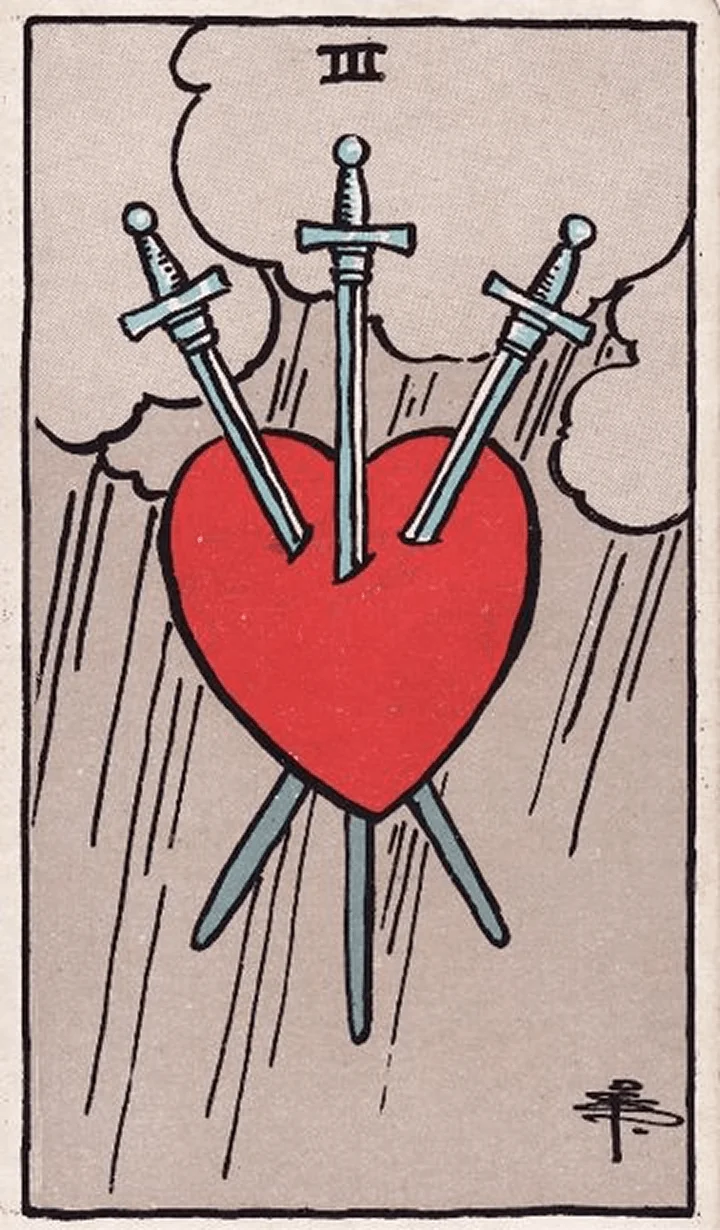
Three of Swords
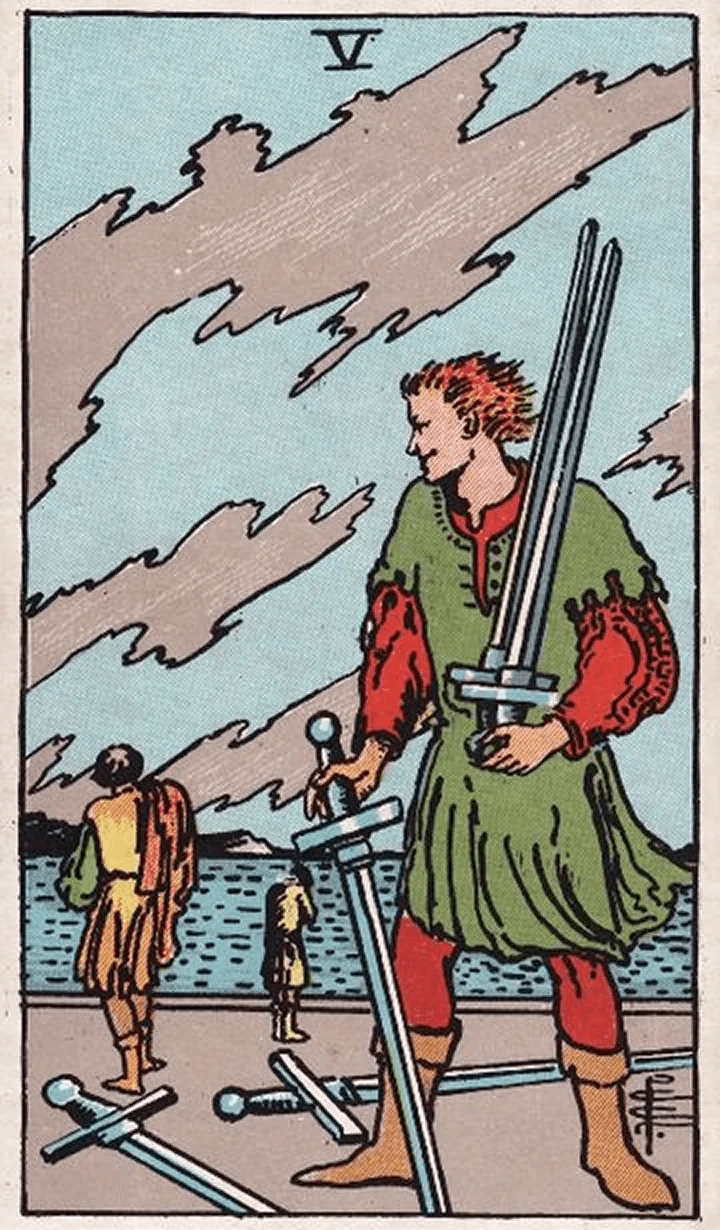
Five of Swords
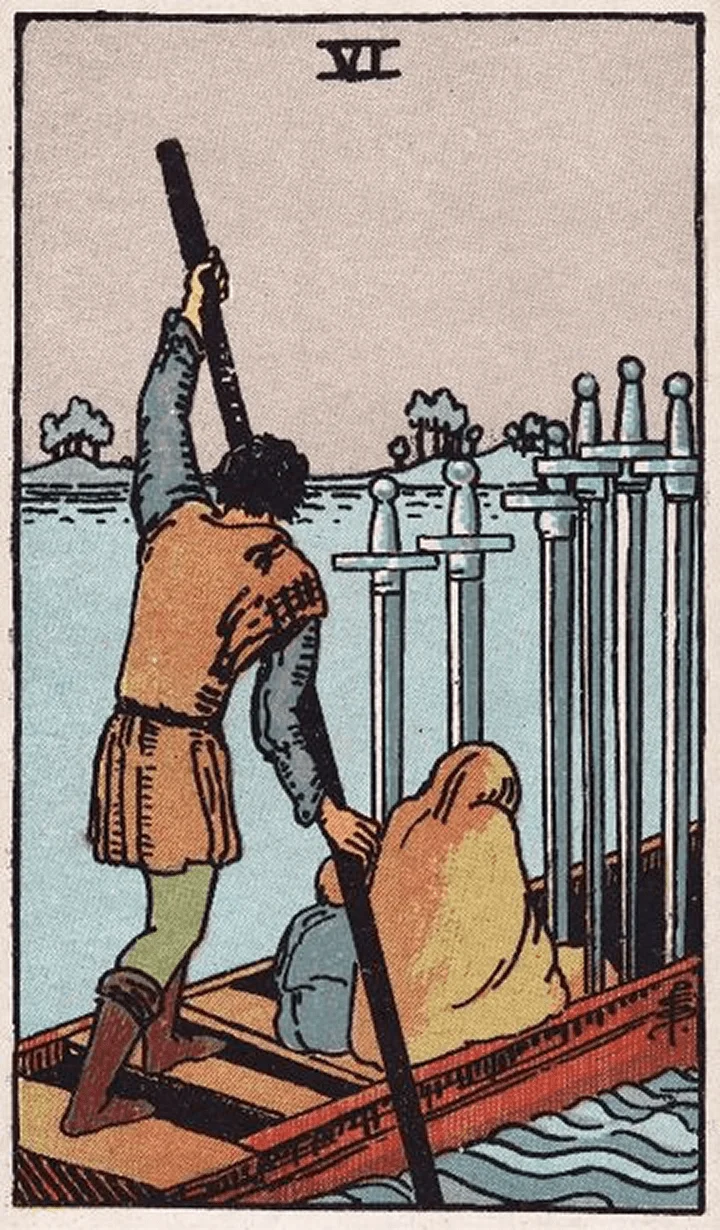
Six of Swords
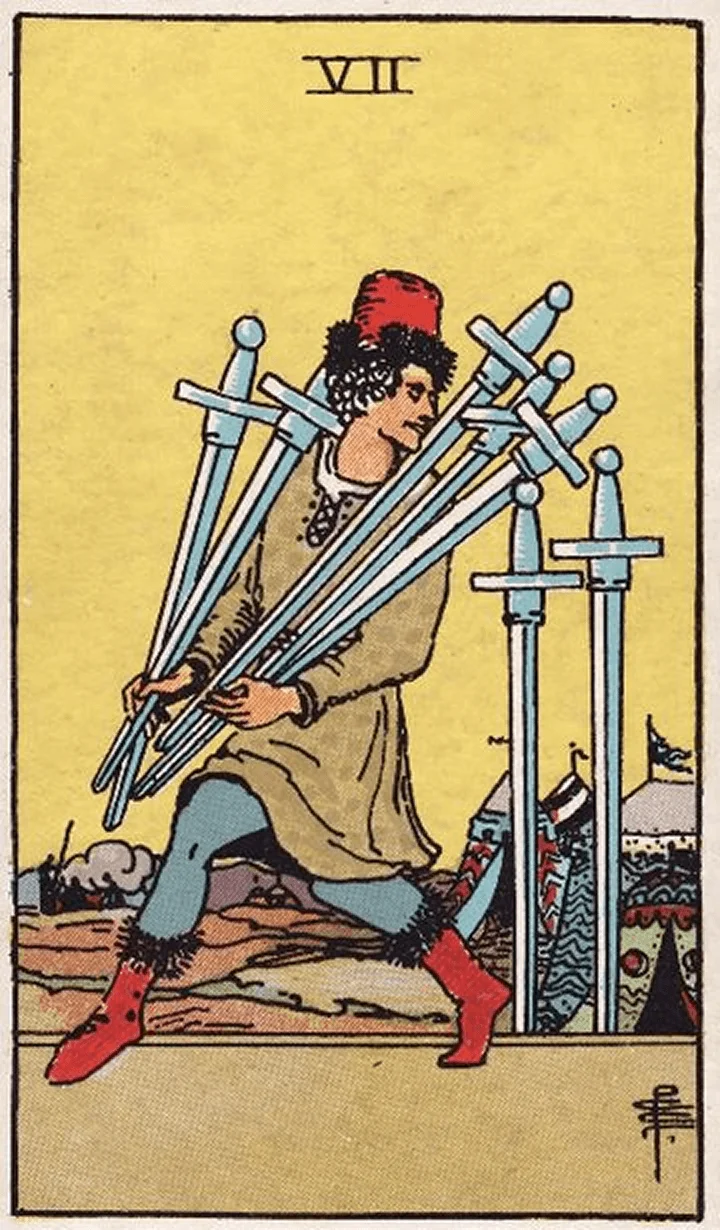
Seven of Swords
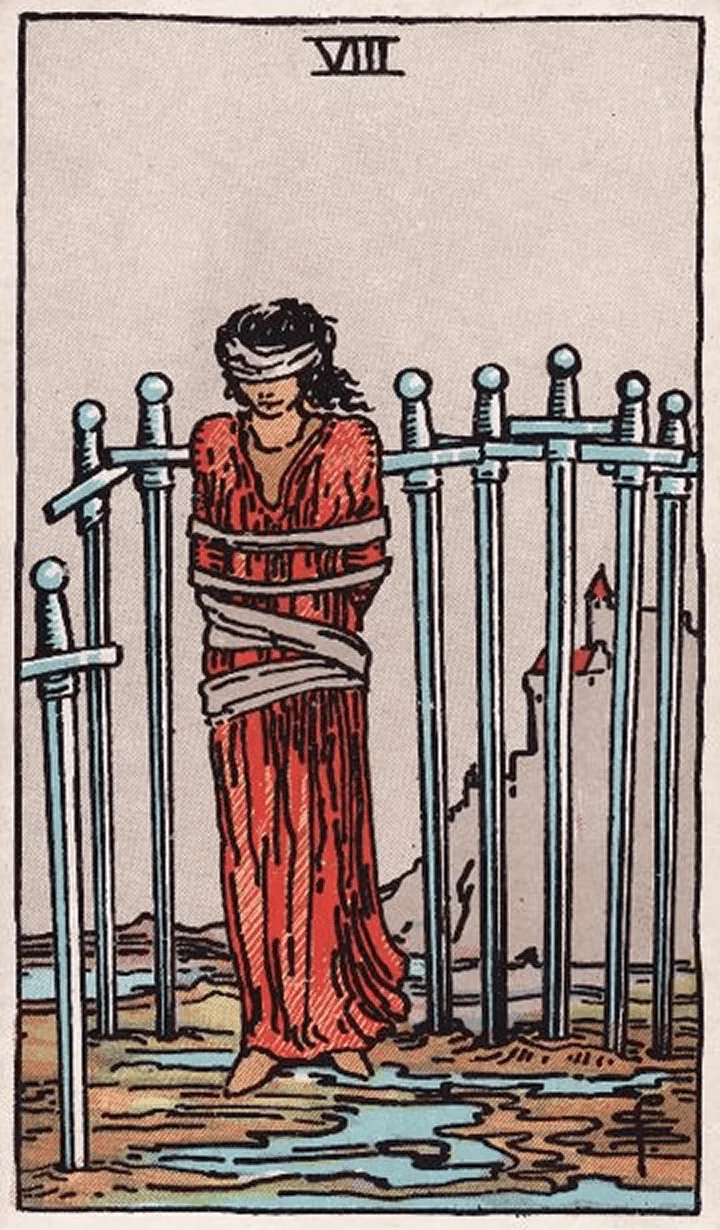
Eight of Swords
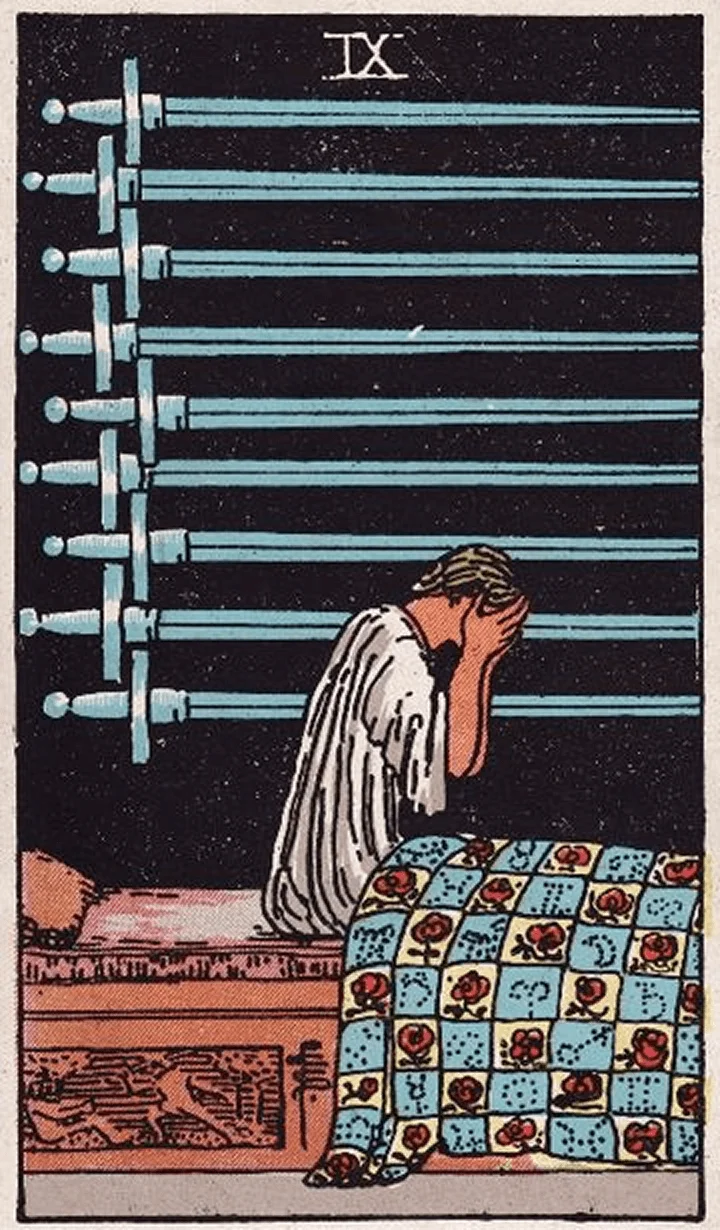
Nine of Swords
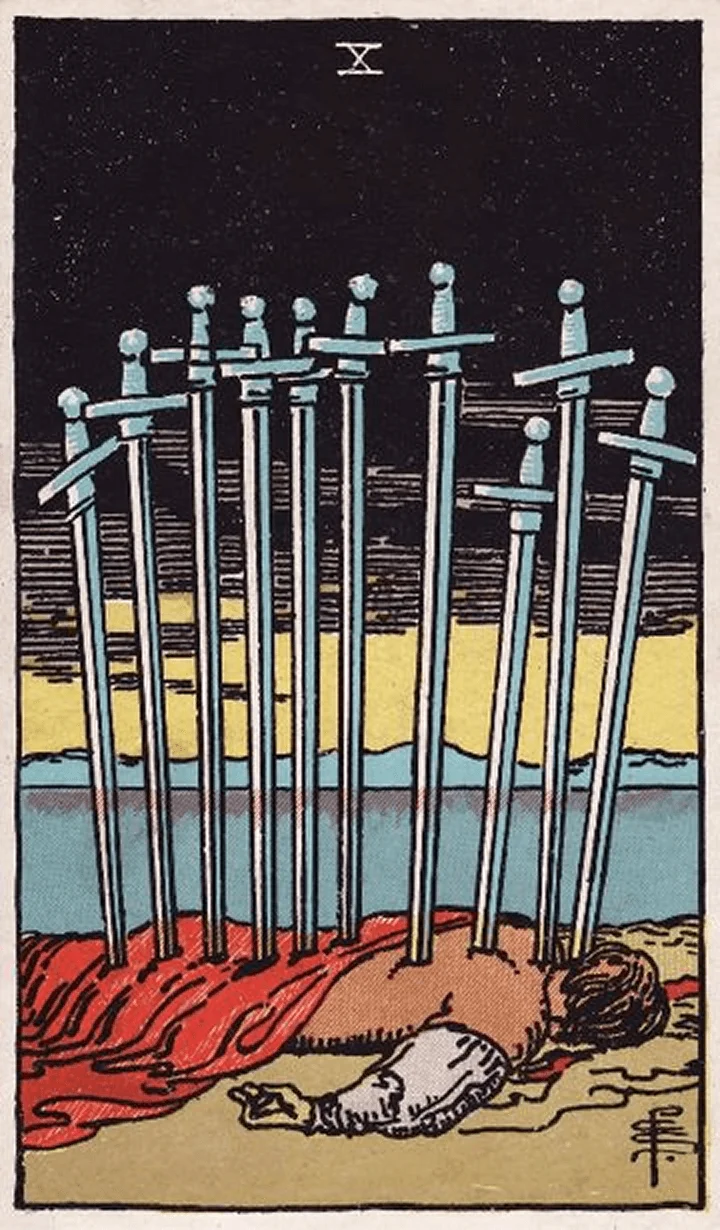
Ten of Swords
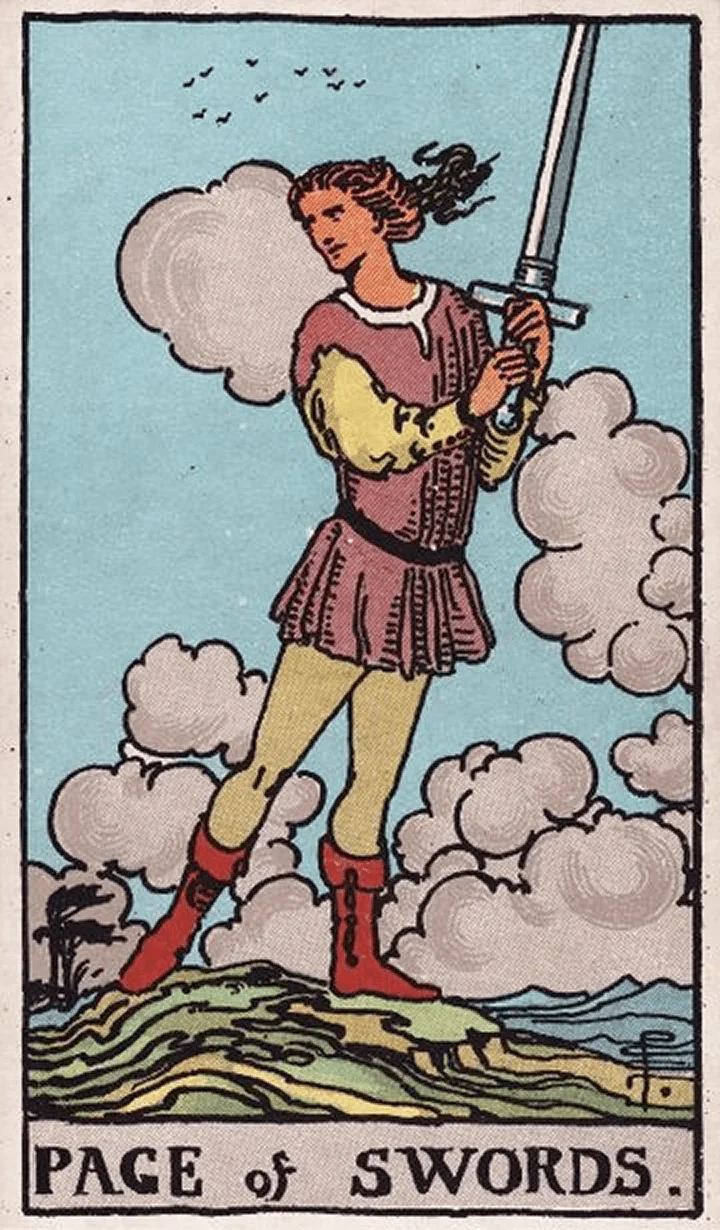
Page of Swords
Knight of Swords
Queen of Swords