Knight of Wands
In the modern understanding of Tarot, Court Cards are usually considered as aspects of the querent's own character or of those around them, but the traditional meaning of the Knight of Wands does not relate to personality at all. It is - separation, departure, leaving, flight, desertion, absence ("someone on the run"), relocation, emigration, change of address. In spreads, it indicates an absent person, a personality capable of changing the querent's situation, and that the events indicated by other cards have already begun.
In the modern understanding of Tarot, Court Cards are usually considered as aspects of the querent's own character or of those around them, but the traditional meaning of the Knight of Wands does not relate to personality at all. It is - separation, departure, leaving, flight, desertion, absence ("someone on the run"), relocation, emigration, change of address. In spreads, it indicates an absent person, a personality capable of changing the querent's situation, and that the events indicated by other cards have already begun.
In the most traditional version, the card foretells a trip, business trip, journey, or adventure. It can also simply be an escapade for fun. The Knight of Wands disrupts routine with his activity and gives settled people a wonderful opportunity to shake the dust off their ears. Perhaps it is for this reason that the card has a clearly not the best reputation in old interpretation books. When life flowed more measuredly and decorously, the appearance of the Knight of Wands foretold "troubles," which in themselves were something out of the ordinary.
But even today, this card foretells a state of highest activity, stress, haste, bustle, a captivating flow of events, when time is literally breathing down your neck and you have to do everything at once because we are suddenly required to do just that – "everything and at once." A hot, feverish time, a period of turmoil and tension, but you won't be bored.
Under the Knight of Wands comes a flash of enthusiasm, an infusion of fresh strength. Energy, initiative, readiness to act, the spirit of a pioneer. His element is storm and stress, impulsiveness, and spontaneity. If he appears, readiness for a leap is evident. The main strength of the Knight of Wands is the unquenchable desire to move forward. How this will manifest and with what result will be suggested by other cards.
It can be a significator of a person who brings changes into our life, and very quickly. Here there is enormous inspiration, ardor, enthusiasm, readiness to get moving, and willingness to move mountains, but... the Knight of Wands is a sprinter; he doesn't last long (unlike him, the Knight of Pentacles is a marathon runner). This characteristic of his must be remembered, no matter what the matter concerns. But still, the inner energy of this card is capable of setting in motion surprisingly large and dense layers of existence and moving real glaciers. The Knight of Wands brings a fresh stream into the most deadlocked and musty affairs. In the broadest sense, this card brings news of a change in the current position and situation ("perestroika"), one only needs to apply this interpretation to the context of the situation.
Under this card, the factor of time is never taken into account. This is expressed, firstly, in that everything happens very quickly. Immoderately fast. And secondly, in that everything happens much slower than it seems in the heat of the Knight of Wands. He thinks it's a five-minute job. In reality, it requires two days, if not more. So he lives – eternally rushing time and eternally failing to keep up with it.
Adventurous! The worn saddle creaks again, and the wind of wanderings blows in your ears. The Knight of Wands gives courage, bravery, an optimistic approach to life, and self-confidence. In this sense, he has a strong will – he knows how to inspire (but not restrain). He is confident and knows what he wants – "everything and at once!".
The Knight of Wands is a very independent, charismatic, and creative comrade, a changeable and impulsive nature. A daredevil, adventurer, troublemaker, a "wild but glorious youth." Obligations and limitations repel him no less than The Fool. The card indicates that the person is in search of new impressions, possessed by a thirst for new experience and a huge desire to test his strength in action and then say "I did it!" Why, for what, at what cost – all these questions are taken out of the equation. His classic image is a brave man, a daring young rake (possibly of the female sex), attractive and enthusiastic. He makes an excellent impression, ignites and inspires, but again, one must remember that he is a sprinter. His brilliance won't last long. Most of all in the world, the Knight of Wands loves excitement, an adrenaline rush. Free fall, extreme surfing, racing cars, unbridled sex, jumping motorcycles from roof to roof… oh, this youth, when will it finally end?! (remark from a King of Swords surgeon, stitching up the daredevil once again). His trouble is that actions performed not at a high energy level do not interest him by definition; they cause boredom. His receptivity to subtle vibrations and low-energy phenomena is negligible, and mastering the watery (intuitive) aspect of fire is still ahead (the next step – the Queen of Wands).
The Knight of Wands speaks of achieving a very active life mode, when enthusiasm, energy, enterprise come to us, we boldly move in all four directions and bravely meet any events and turns.
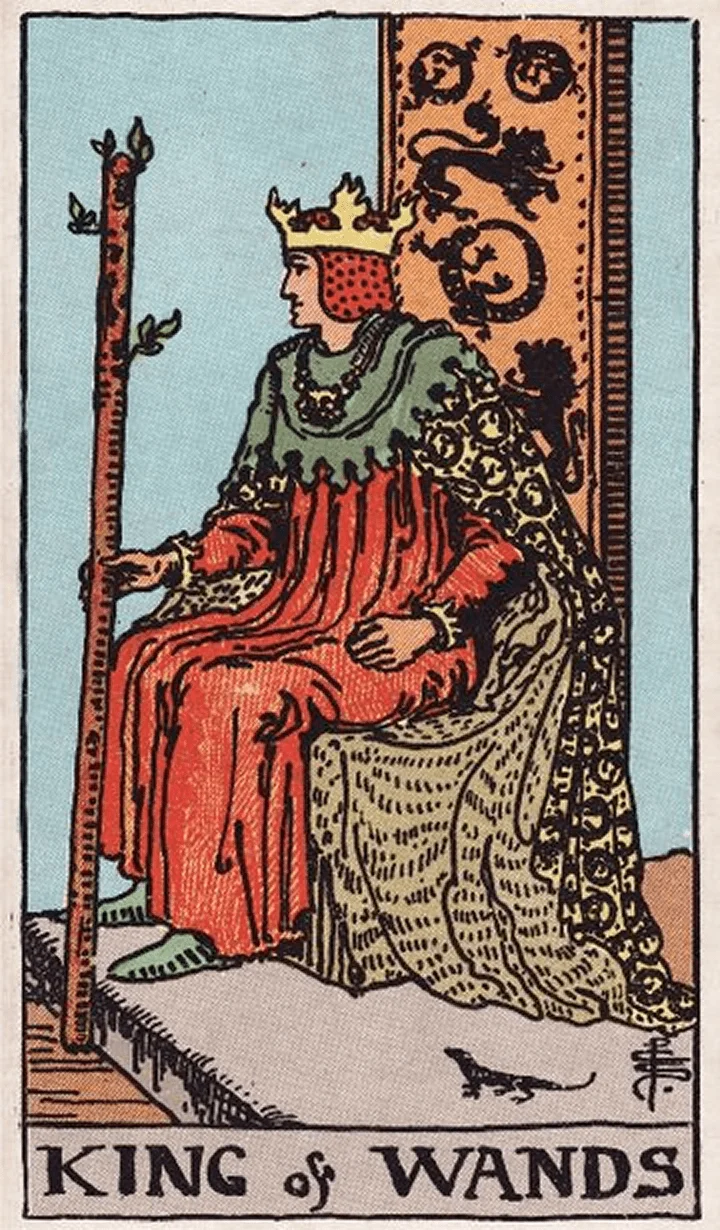
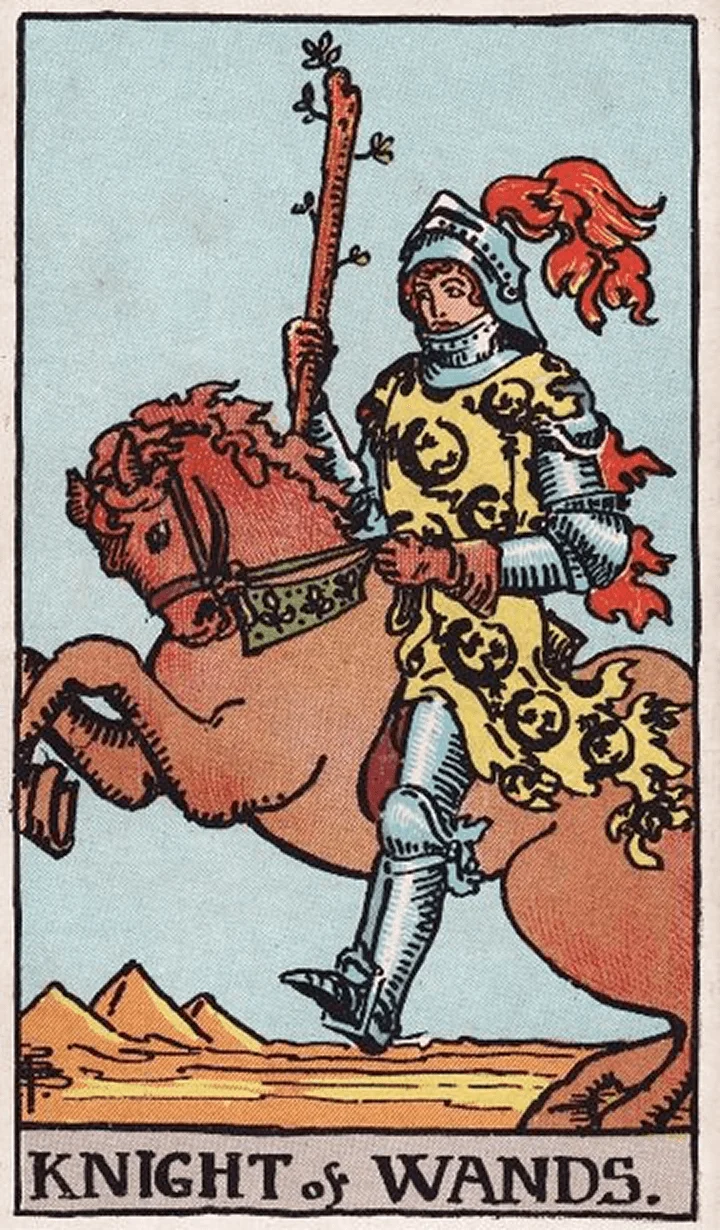
Alchemically, the Knight of Wands personifies fire literally choked with oxygen. This is the airy aspect of fire, the path from darkness to light. It is a feverish state of spirit. The heat blazing in the heart uncontrollably stirs and drives one to search for new impressions. In this state, it is literally impossible to sit still. Therefore, in the broadest sense, it carries the meaning of changing position or location, movement and journey towards the unknown. The fiery coloring of the card, the scarlet plume associated with the image of a burning torch, pyramid-shaped hills, salamanders on the sun-yellow cloak – all are vivid indications of the fire element. Yellow is the color of the sun, correlated with the energy needed for activity in the material world. In Hindu tradition, this color is associated with the third chakra, which is the center of will. Desire and will are presented here in an exceptionally intense form; they require ultimate freedom in any sphere; when annoying obstacles arise, hot-headedness, intolerance, and recklessness easily emerge. The conscious mind must realize the creative self and acknowledge human limitations – this is the highest task of the Arcana. In general, he evolves towards the King of Wands (through the "watery" aspect of the Queen – developing more accurate sensitivity concerning both reality and the inner impulses of other people, and gaining an understanding of whom and what can be inspired). Progressing on his path, he gradually gains the determination to truly persistently pursue his goals and lead people, awakening in them not only admiration but also a sense of belonging.
The Knight of Wands is a reckless and seething opponent of everything outdated and tiresome. He seeks out all opportunities to perform feats, correct what is wrong in this world, or simply demonstrate bravery and strength of spirit. He is generally directed towards the same as the King of Wands, but he lacks stability of motivation (if the King is "fire of fire," then the structure of the Knight involves unstable, changeable, "windy" air); moreover, he noticeably plays to the audience to a greater degree. The King's fire can launch a rocket into space; the Knight's fire can burn down half the town during a New Year's fireworks display. However, his flame is not empty or calculated merely for the public. It is the uncontrollably proud and ardent Knight of Wands who cherishes such concepts as honor, valor, nobility, and glory. He cannot disown them with logic (Swords), subordinate them to practical considerations (Pentacles), drown them in emotions (Cups), because he experiences them in a completely essential way, considering them something like a higher duty. It is precisely the Wands that urge one to engage in unequal battles without retreating a step. Swords are not prone to such heroism and do not consider such behavior a glorious achievement at all. Why, if there is no chance? Retreat for now, you'll get even later… Swords do not understand reckless frontal attacks – it is the Wands that drive them (the prototype of the Luciferian rebellion). If they consider it a matter of honor, it is impossible to persuade them to take care of themselves. In such situations, they carefully keep their honor intact, for their enemies, from those who love them and to whom they are dear.
Astrologically, the Knight of Wands represents the characteristics of the fire signs: Aries, Leo, Sagittarius.
This card can be a mediator between the 'switched-off' and 'productive' states in life precisely due to its specific strength and consciousness.
The image of Wands noticeably varies from deck to deck, sometimes even within one. Turned, finished, decorative Wands symbolize already achieved success. Wooden staves from living wood, with leaves or flowers – an image of continuing growth, which never ceases. Heavy clubs with a thickening at the striking end – an image of instinct, the will to fight for success. Sometimes the image of the Wand is replaced by a burning torch. This is truly the 'fiery aspect of fire,' the element reaching its maximum expression and stability. In a negative sense, the King of Wands can personify fire, combustion, unbridled processes occurring at high temperature.
In combination with other cards foretelling changes, the Knight of Wands can report a change of position or even field of activity.
Vivid self-assertion. Frenzied activity – sweat in three streams, work boils in the hands, the ground burns underfoot. If there are other Wands nearby, then the card's number most likely corresponds to the number of various deadlines that have arrived simultaneously (the Ten of Wands means all ten). Excessive motivation, excessive "burning at work," which is clearly fraught with burnout.
Infusion of "fresh blood" into the organization, hiring new brisk employees. A warm atmosphere where cheerfulness, optimism, and enthusiasm manifest (but also impatience and a tendency to exaggerate). These are spontaneous negotiations, rosy discussions of wonderful prospects, a situation where everyone shines. What will be realized from all this and to what extent, how objective and realistically achievable all this is – that's another question (and, to be honest, in the situation of the Knight of Wands, no one particularly wants to think about it). The Knight of Wands rather answers the question "how?" than "what?". Under this card, it is easy to convince the whole world of one's brilliant abilities (for example, during a selection interview), but what will we do when the workdays take effect? The greatest danger under the Knight of Wands is to look like a successful person inspiring great hopes, but in reality turn out to be a juggler of soap bubbles.
Scattering of activity, contradictory tasks. Impulsiveness, recklessness, lack of patience – hence the turmoil, stress, desire to do everything at once (as a result, there is a risk of never doing anything, or close to that).
The Knight of Wands patronizes any exciting and "high-voltage" occupations with a pronounced energy component, where activity, speed, quick reaction, and high motivation play a key role. At the same time, under this card, there is no more difficult task than submitting to routine, following regulations, and observing minor formalities. Zeal and a fountain of non-trivial ideas are completely "shattered" by the necessity to work systematically and persistently day after day. Rebellion, revolution, experiments – that's fine. Based on this, for "peaceful purposes," the Knight of Wands is best seconded to represent the company's interests outside its walls, where each new client will be considered a challenge, or, at worst, placed in a department responsible for organizational changes or crisis management. He is also a master of clowning, amusing, and entertaining, and therefore indispensable at corporate events.
Theater, competitive sports, activities involving travel, organization of journeys and entertainment events. Entrepreneurs, traveling salesmen, variety artists, DJs, masters of ceremonies, athletes, PR specialists, advertising and hype creation specialists, paparazzi, sensation-seekers.
Advice: charge! Show courage, don't fear change. It's time to take a risk and challenge yourself, play with fire, give yourself the freedom to act on impulse, without thinking and waiting.
Warning: festina lente (hurry slowly). One shouldn't be overly active – too much firewood can be broken. Our shooter is everywhere in time, but in this case – he's been chasing after something far away.
Changes. Possibly, the appearance of new tempting options (compared to the current position).
The reversed Knight of Wands is considered an indication of unpaid loans, unsettled debts, money borrowed and a debtor on the run.
Adventurism and enterprise in love. One does not want to compare a person like the Knight of Wands to a match, although in some ways it would be very accurate. Rather, it is a handful of dry straw, instantly igniting and just as quickly burning out. Such is the fiery passion under this Arcana. The Knight of Wands is too much of a fidget to be relied upon. To conquer impromptu? Please! He grabs a partner like a child grabs a new toy, only to abandon it in a corner a minute later. So to speak, "loves hotly, leaves silently." He strives for new acquaintances but is much more attached to freedom than to those with whom he has hot flings. Constancy and responsibility are not for him, although the romance can be exciting and unpredictable. Under the Knight of Wands, a person takes the initiative, flirts easily, turns heads, arranges dates... the main thing is that he later remembers where, when, and to whom. This is a conqueror, storming a fortress he fancies without much thought. His frankness, demandingness, and pressure can stun a shyer partner into speechlessness (and silence will be interpreted as a sign of agreement). "Everything and at once" is what he needs in love, just as in everything else. The Knight of Wands is honest and noble enough, but you can see in his eyes that restraint is difficult for him, and delicacy and patience come at a high price.
Strong instincts, bright sexual temperament, sparks fly everywhere. Excitability and impatience; the person flares up like dry brushwood. This is precisely where "African passion" and wild sex on the first date are threatened. Solving the issue of protection will be difficult, but it is precisely here – absolutely necessary (firstly, the Knight of Wands is inconstant and careless, and secondly, he personifies situations in which no one thinks about the consequences, but that doesn't mean they won't arise). In intimate relationships, the Knight of Wands is as energetic as in everything else, and before kissing him, it makes sense to take a deep breath, since he is unlikely to provide an opportunity to catch your breath. Sex as an adventure and childishly immediate satisfaction of desires. It is worth warning that he is prone to cooling off the morning after a stormy night (regardless of gender), and he may not strive for a new date at all. The Knight of Wands likes to show off and strut. He is vain and self-confident. At the same time, he has so much life, recklessness, and charm that it's hard not to love him. A more irresistible and "unsuitable" partner for a person seeking reliability in relationships is hard to imagine, but it is precisely he who won't resist – the Knight of Wands brings a spectacular liberation from routine, which has become tedious to the respectable philistine tired of serving it. The Knight of Wands, in general, is like an actor in an action movie – he is secondary to the rapid action on the screen. He, like no one else, is capable of giving, even if briefly, such brightness and fullness of life, making one forget about problems, everyday life, and anxieties to such an extent that this alone is worth a lot. The paradox is that he himself as a personality will most likely not be very memorable, but the time spent next to him will be unforgettable. Precisely it will be remembered for a lifetime as one of the most dizzying and happiest.
The evolutionary task of the Knight of Wands himself is to move to the next level of development, by submitting to love (the Queen of Wands as the watery aspect of fire) and rising above himself.
Overall, this is a card of robust health, capable of withstanding great strain and trials.
The Knight of Wands is an internal combustion engine, and "his line of work" is fevers with high temperature, abscesses, rashes, burns, and sports injuries. It can also speak of unbalanced sexual energy, high blood pressure, tachycardia.
It is natural to assume that this card describes a state of confusion and turmoil where desires boil inside, having neither outlet nor application. Modern tarotology adds to this professional incompetence and problems at work (e.g., threat of dismissal).
A storm in a teacup, difficulties in implementing events, a sudden halt. Quarrels, disputes, debates, challenges, altercations, rejections and refusals, failed deals and negotiations about them. Strife, fight, discord, separation. Internal team rivalry, envy, hot-headedness, tense atmosphere. Disagreements, break of friendship. Parting, flight. Traditionally considered an indicator of an unsuccessful marriage, a failed marriage, associated with grooms on the run, departing husbands. It is also a card of jealousy and sexual hooliganism, like seduction on a bet.
Some person causing a lot of trouble and unpleasantness, a disorderly dilettante, a rowdy hooligan, or a desperate swindler. Possibly, he feels overlooked, dissatisfied; he simply has nowhere to put himself.
Interestingly, one of the traditional meanings of the reversed Knight of Wands: parties, factions, groups (including criminal, gangster ones). It carries the spirit of fundamental amorality (the main principle: to have no principles).
Sometimes the reversed Knight of Wands indicates burnout and stagnation. The passionate, brave, reckless, adventurous lover of adventures and flings loses all his confidence and begins to make and realize mistakes, not knowing how to correct them. Like the ashes left after a fire, he feels "scattered by the winds of fate," having lost confidence, having made a mistake, small and helpless.
It is also a significator of cremation.
With The Fool – a journey
Reversed with the querent's significator – bankruptcy (from an old interpretation book).
With The Wheel of Fortune – ruin (from an old interpretation book)
With the Six of Pentacles, Nine of Pentacles – an imminent departure.
Phoebus in the fiery chariot
Siegfried, who passed through raging fire to awaken Brunhilde
Jason, obtaining the Golden Fleece
d'Artagnan and all similar characters, merry fellows and brave men performing a bunch of feats without much personal gain, simply to do them
"Rebel Without a Cause"
The spirit of the Reversed Knight of Wands corresponds very accurately in content and manner of execution to the song "Ne me quitte pas"
Ravel's 'Boléro'
Cards from the same group
Ace of Wands
Two of Wands
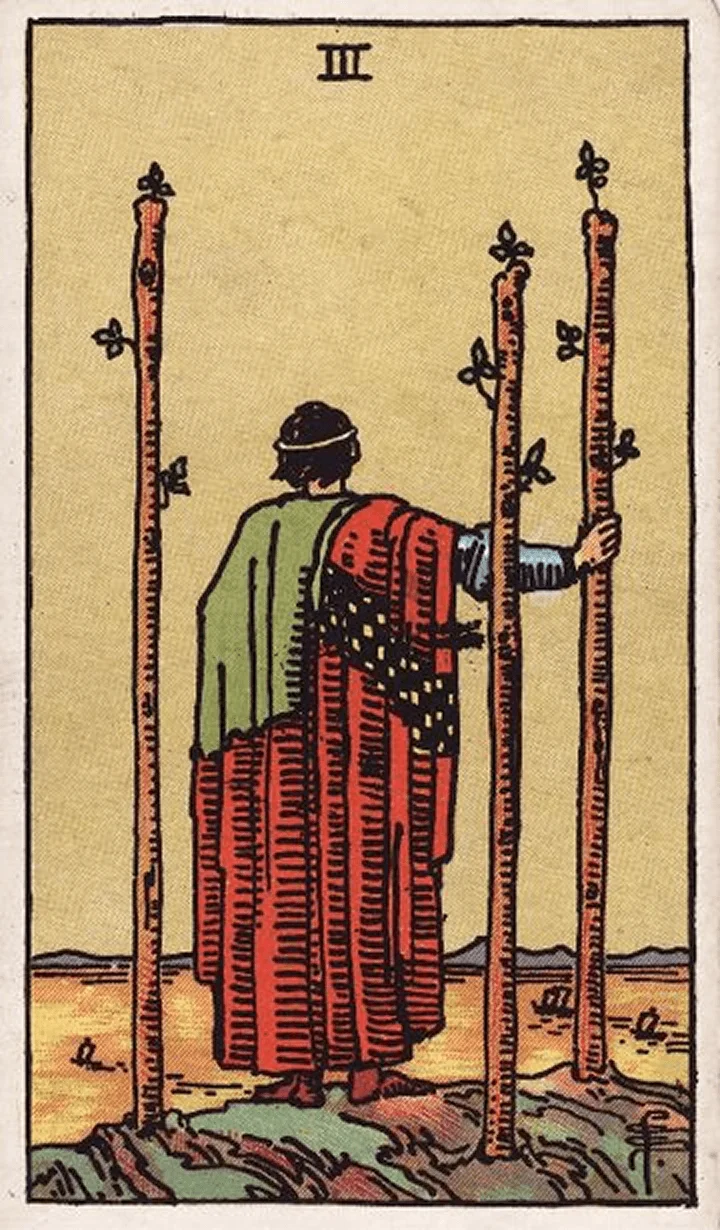
Three of Wands
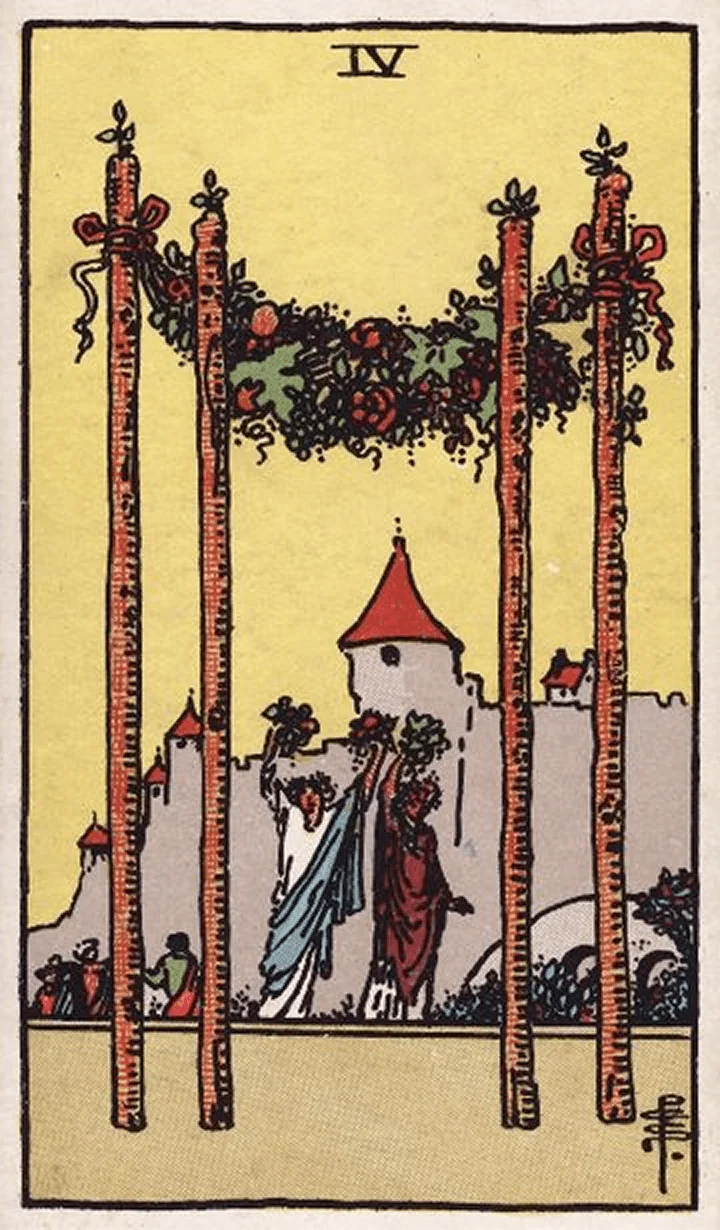
Four of Wands
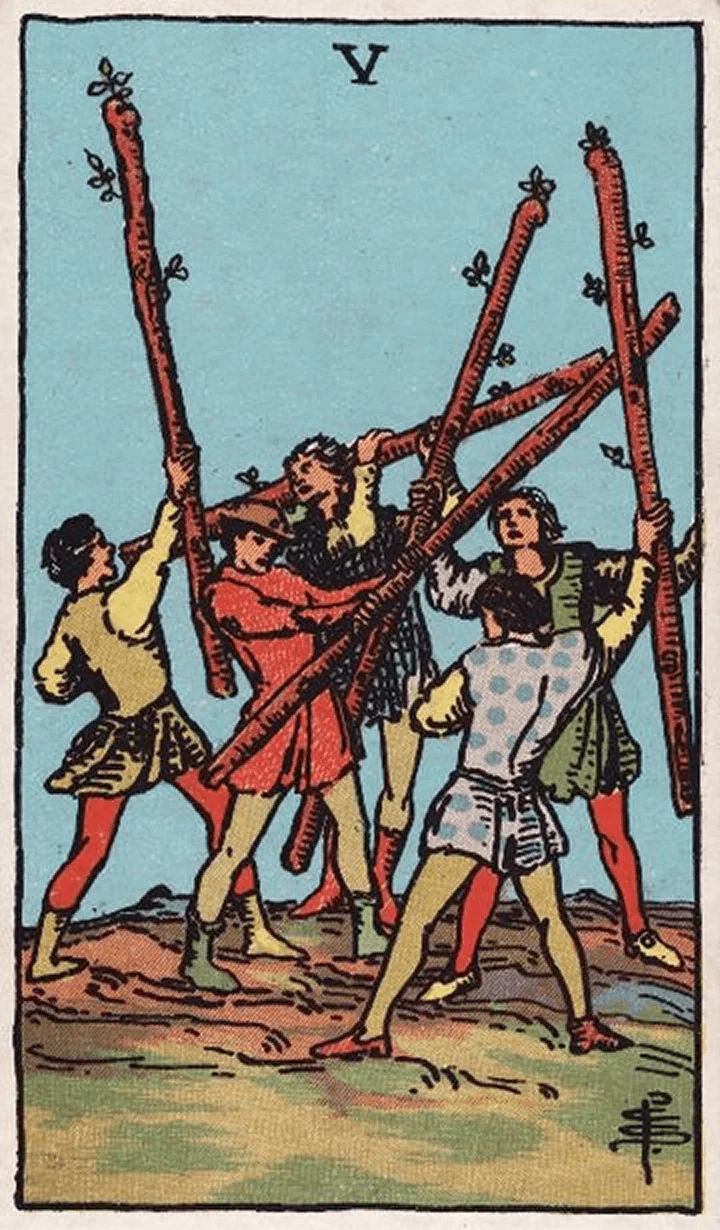
Five of Wands
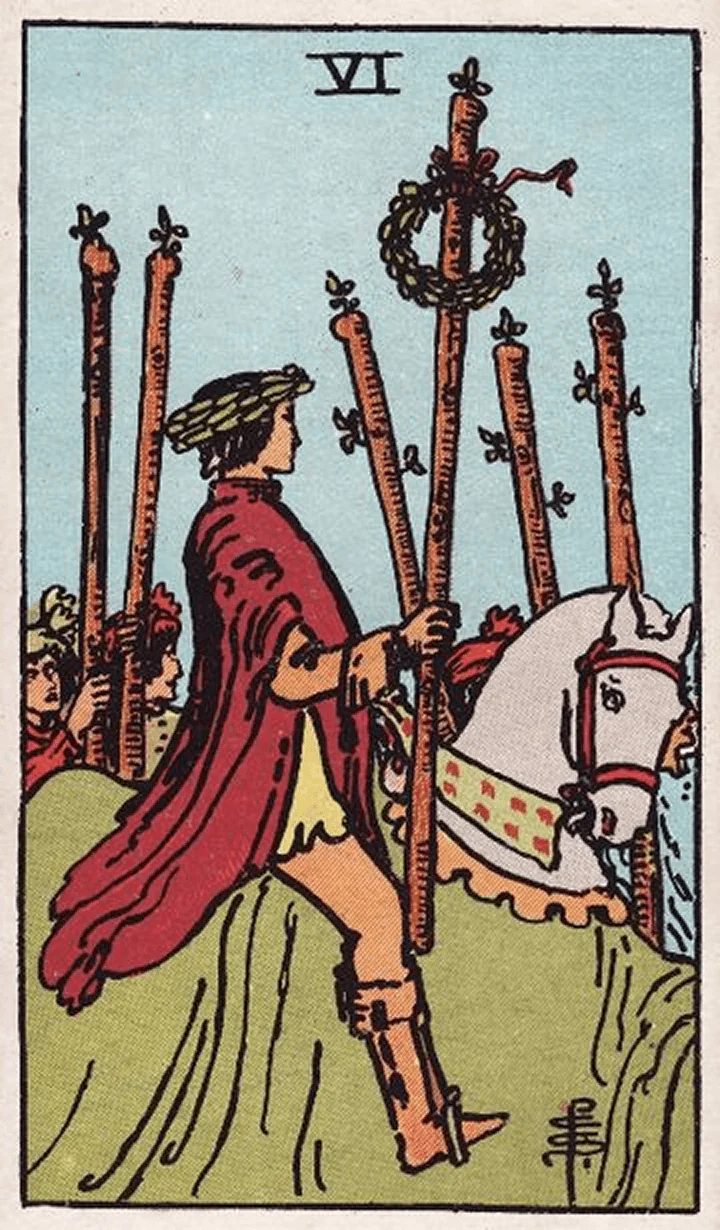
Six of Wands
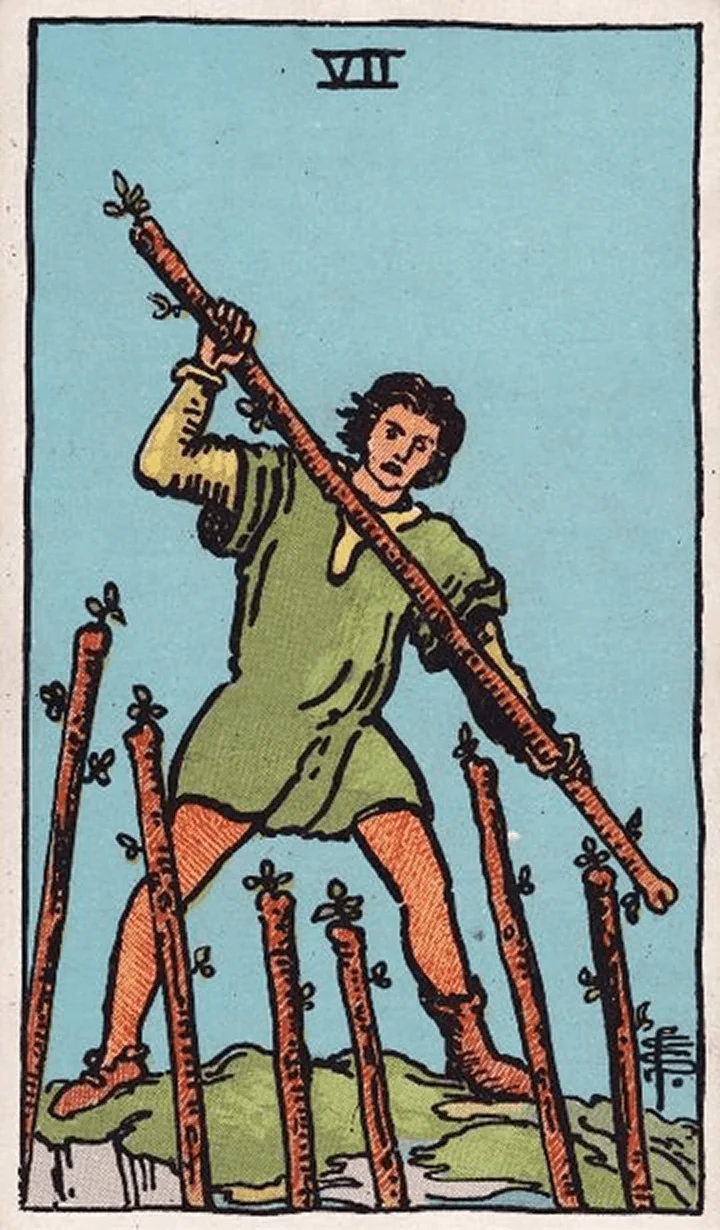
Seven of Wands
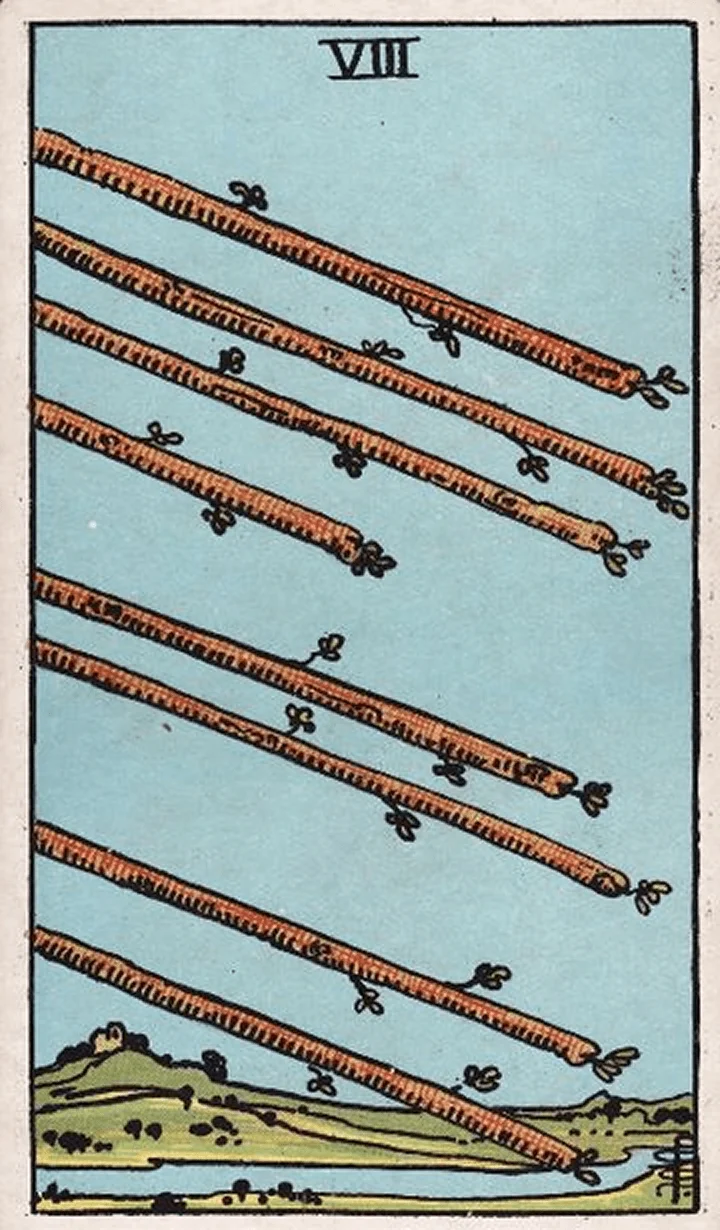
Eight of Wands
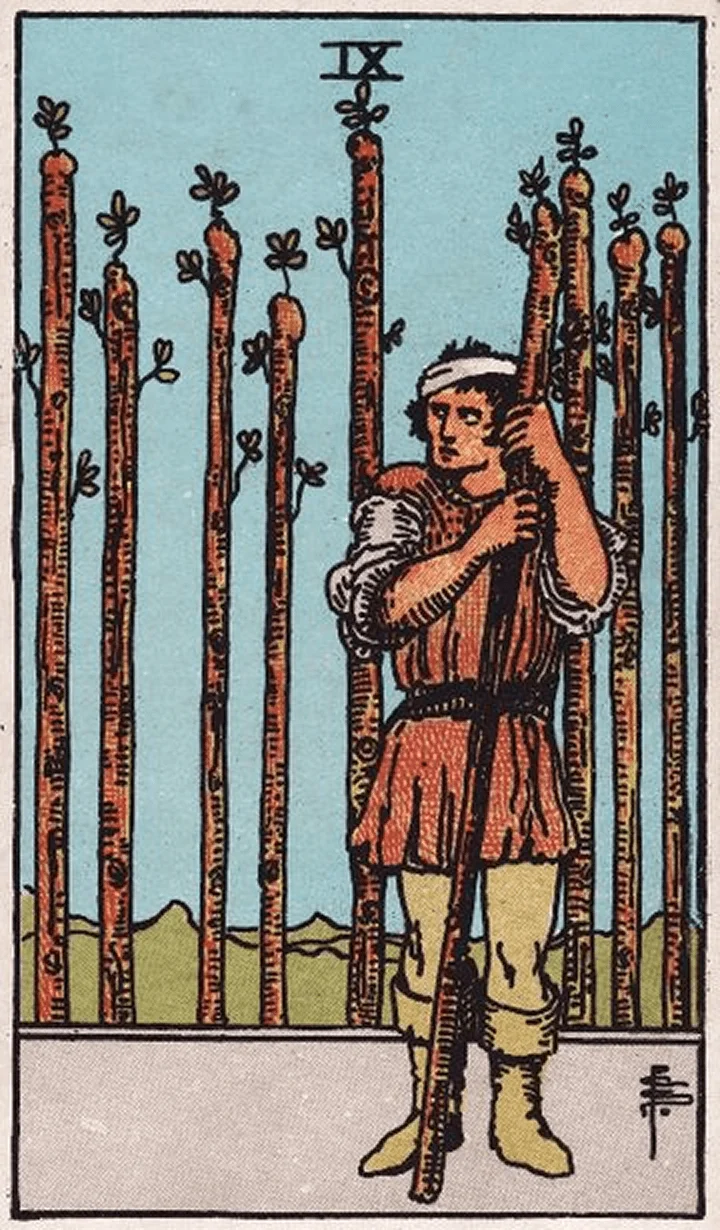
Nine of Wands
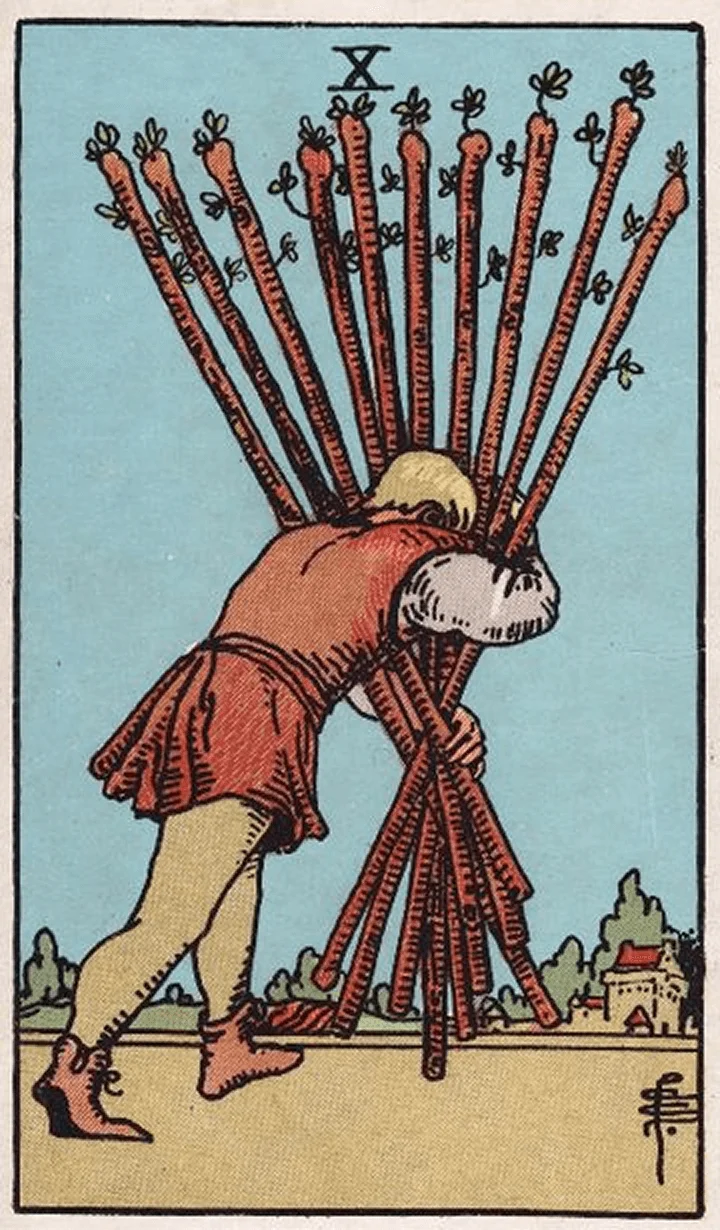
Ten of Wands
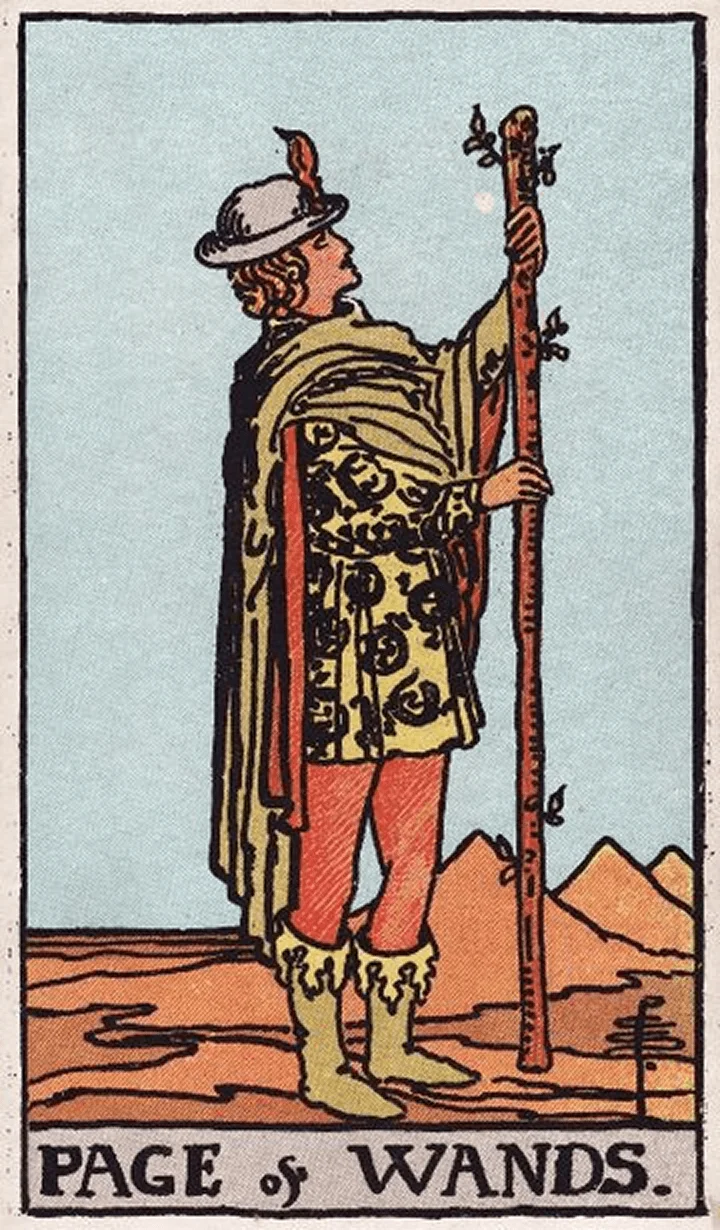
Page of Wands
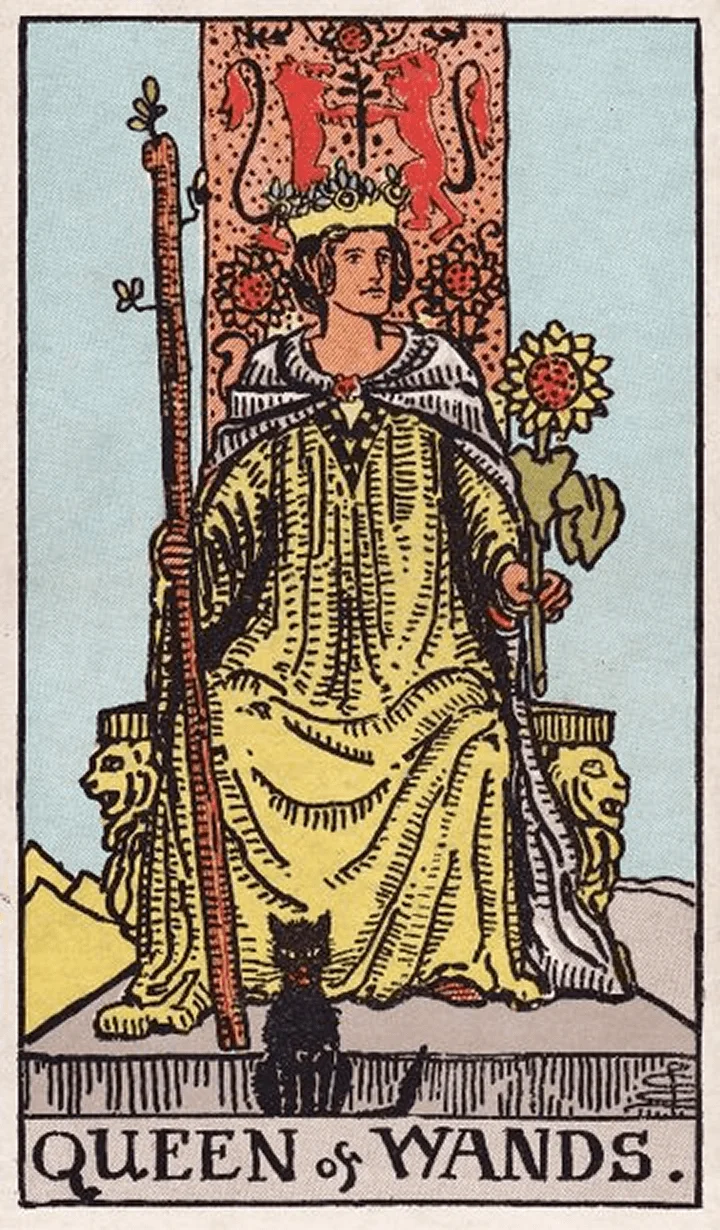
Queen of Wands