Page of Swords
All Pages personify opportunities opening on life's path, however, the prospects offered by the Page of Swords usually do not evoke enthusiasm. These are unforeseen complications. The appearance of the Page of Swords in a spread has long warned the querent that they must be ready for upcoming trials and the unpredictable treachery of fate. The atmosphere is intensifying; one will have to look for a way out of the situation, and for now, vigilance and readiness for any development of events are required. However, other cards in the spread may shed light on what that development might be.
All Pages personify opportunities opening on life's path, however, the prospects offered by the Page of Swords usually do not evoke enthusiasm. These are unforeseen complications. The appearance of the Page of Swords in a spread has long warned the querent that they must be ready for upcoming trials and the unpredictable treachery of fate. The atmosphere is intensifying; one will have to look for a way out of the situation, and for now, vigilance and readiness for any development of events are required. However, other cards in the spread may shed light on what that development might be.
Like all Pages, the Page of Swords points to receiving unexpected news. In accordance with their suit, it will most likely be precisely "food for thought." Perhaps it was precisely by the Page of Swords that Stirlitz received his unforgettable coded messages ("Yustas to Alex..."). By the way, in the old days, the Page of Swords was closely associated with scouts, spies, and secret spy missions. It's clear that in combination with unfavorable cards, one will most likely have to deal with nasty news. It may not be so much significant as precisely nasty and psychologically unpleasant, like news of someone's lie, a spread rumor, a petty setup. This information can be experienced as a serious "spit in the soul" or as "small splashes" – either way, there's little pleasant, as in this case it clearly won't be splashes of champagne. The predominant suit of the spread may hint at who and why is seeking a quarrel.
Traditional meanings of the Page of Swords – informer and spy, false friend, traitor, double agent, unreliable person. From a modern point of view, their appearance in a spread means that someone is closely watching the querent. This card also indicates the likelihood of a conflict being unleashed. It is a messenger of a critical, hostile impulse. It may hint that the situation is difficult to clarify due to an abundance of negative information not directly related to the matter (as divorcing spouses often find it hard to agree on simple practical issues).
However, there are types of spreads and questions where its appearance can only be welcomed. One of the undeniable pluses of the Page of Swords is activity and mobilization. This is definitely not a card of helplessness or sitting idle. The Page of Swords takes up the task, thinks about how to achieve their goal, enters into an argument, arms themselves, seeks help from their symbolic "sword-bearing" relatives... in short, takes action. They are always "in the know," "in the game," "in the flow." If you need to, as they say, "hustle," no one does it better than them. If you need the ability to be on guard and aware of danger – also good. Like all Swords, they offer to clarify the situation. Like all Swords, their sword is double-edged – it brings clarity on one side and conflict on the other. Combined with favorable cards, it means a fresh stream, thanks to which the true meaning of what is happening suddenly opens up to us, and even the most tangled affair becomes simple and clear. Most often, however, this happens through confrontation, a sharp conversation.
This card suggests using your head. At the present moment, there is every reason to judge the work done or the action taken, as indicated by subsequent cards. The results have already manifested; they must be seen and evaluated. The Page of Swords likes to mark situations where something is done in too much haste.
Somewhat malicious and intellectually mobilized. Critical mind activated, the will to overcome troubles, self-confidence. Some rigidity in relations with others may manifest – coldness, harsh actions to clarify the situation, no sentimentality, straightforwardness. This can be quite a positive card of rationality, businesslike attitude, agility, vigilance, toughness, slyness, grip.
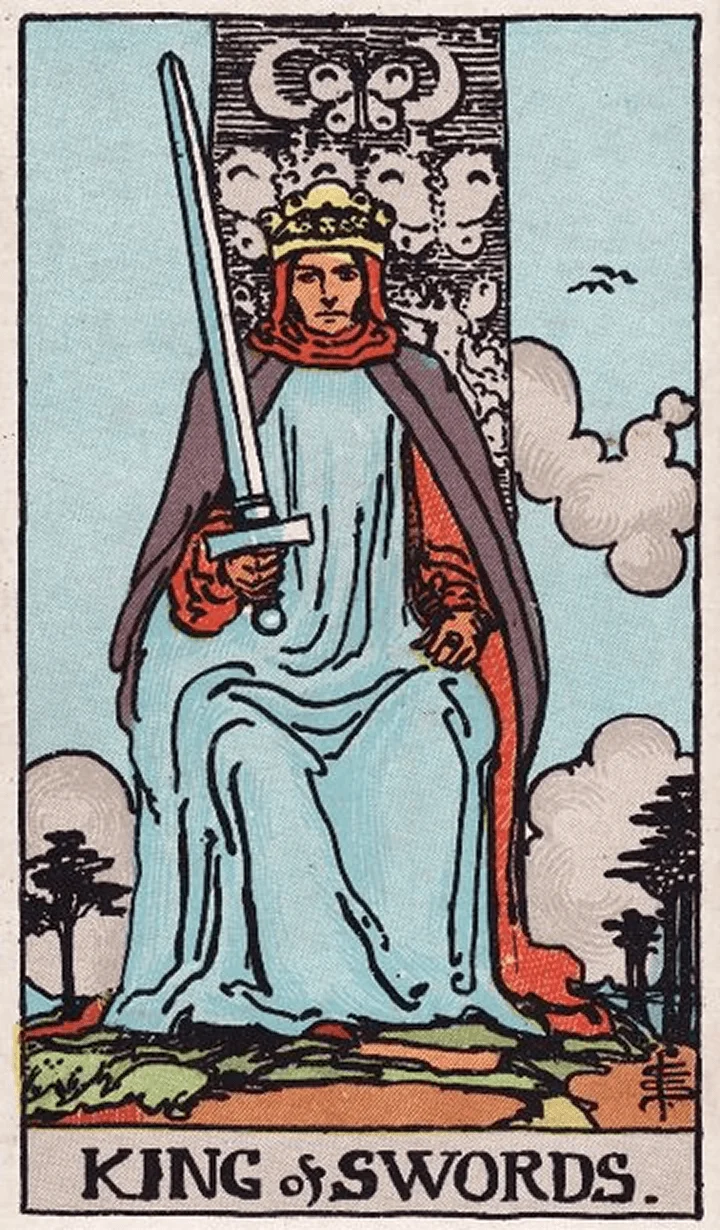
The younger brother of the Knight of Swords, the Page of Swords can also be described as amusing and intolerable. This is a sufficiently cunning and brave personality, actively acting in their own interests. They are characterized by insight to the point of excessive curiosity. Their ancient attestation – clever, treacherous, gloating, capable of harming the querent (even if you are not their enemy, they will do something guaranteeing enmity). Unlike their older brother, they are not yet ready to crush everyone who stands in their way – simply lack the strength.
Usually the Page of Swords is a person to whom everything is of concern. They have so much life energy that they spend it without thinking, both on themselves and on others (of course, without asking these "others" if they want such interference in their own lives).
Usually the Page of Swords represents a young person (regardless of gender) who is discovering the surrounding world and trying to understand the laws by which it lives. They are still naive, inexperienced, often they are studying somewhere and, most likely, occupy a dependent position. Sometimes it's simply an infantile person perceived as "promising." Usually excites maternal or paternal instincts in others, and many people readily patronize them (often, as they say, to their own detriment). At best, the Page of Swords radiates charming slyness, is witty, dexterous, graceful, resourceful. They don't need long preparation, thinking, deciding, and gathering strength to say something, propose, answer.
Like the Page of Cups, the Page of Swords can be an attentive listener. Since they give the impression of an informed and knowledgeable person, people often confide in them, tell them about their difficulties, and are interested in their opinion. It's very possible they will correctly assess the situation and give a not stupid piece of advice... which will be unpleasant to follow. At the same time, they will never forget who told them what, about what, and why, and will certainly consider how this can be used, if not right now, then sometime in the future. In the head of the Page of Swords, a true servant of their sword-bearing court, a "network" of data about those around them, their affairs, ventures, and relationships is incessantly being perfected (Facebook was also created by a Harvard student). The Page of Swords is not a dreamer. They are in a cuttingly dense contact with reality... as they see it. In this lies their cardinal difference from the Page of Pentacles, who is truly in contact with reality as it is. The Page of Swords penetrates, suspects, comprehends, models what is happening (who, with whom, why, and at what price), they assemble reality like a constructor, and don't mind demonstrating their assembly on occasion. Deep down, they are childishly proud of their constructions, which still lack the sharpness and brilliance characteristic of the elder Swords. Their achievements differ from the achievements of the King of Swords exactly to the extent that a witty tweet on a hot topic differs from a well-developed scientific theory. However, even a page's tweet can gain considerable popularity at court, and the subjects who read it may be many times more numerous than those who understand the King's theory well.
Instinctively, this character behaves like a "hanger-on." They attach themselves to power hoping to merge with it and feign friendship as long as it suits their interests. By nature a bully, nitpicker, and boor, a master of derogatory remarks and unfriendly jabs, the Page of Swords, nevertheless, is capable of playing the role of a flattering sycophant if they see direct profit in it. They cannot be relied upon as a friend ("Against whom are we befriending?"). They are a decent chameleon and a brilliant gossip – they know how to choose the place, time, and correspondent. Even if gossip is on the tip of their tongue, they will still think about where, to whom, and when to drop it for maximum effect. Essentially, the biggest danger associated with the Page of Swords is underestimating them. Due to their youth, it seems they don't possess the strength and ability to cause harm. People chatter in their presence without thinking and without taking them into account because they are a teenager or subordinate. Thus, generals guarding secrecy from colonels might whistle a military secret among themselves in the presence of an orderly because they don't consider them a bird of any significance. However, this bird can peck at a sacred spot quite noticeably. The Page of Swords loves to test their abilities, dreams of the crown of their symbolic parents and the horse of their older brother; they, like no one else, know how to rely on others, leak information to those more influential, and with their help insure themselves in case they are exposed. Why do they do all this? For the sake of an unscientific experiment. All Swords, in spirit, are researchers and experimenters. Will the scheme work? What will the reaction be? The Page of Swords is always childishly curious about the consequences of their actions. All interest will be lost for them if they never find out what came of it, how the game ended, and who came out on top. They are still too young to sit at the table with cards in hand themselves, but they have enough wit to mess with other players' cards.
In the old days, it was considered a card of adjutants, ambassadors, consuls, attachés, in short, diplomatic service employees, with a well-hung tongue and an amazing ability to wriggle out of slippery situations. At the same time, the person possessing such a skill is most likely "slippery" themselves.
The Page of Swords embodies that most important and hard-to-digest life truth that criticism is more useful for development than compliments. It may seem to us that we are underestimated, trying to belittle or corner us, but if we manage to look at the essence of the remarks without extra emotions, we will see an opportunity to change something, learn something, set a new bar for ourselves. And the more attentively and self-critically we listen to what is said to us (even in the heat of an argument and with a desire to offend), the more we will be able to extract for ourselves. Even biased critics can spur us on (and sometimes – precisely they!). Sometimes it makes sense to lose a battle to later win the war.
Each Arcanum is a mystery and a lesson of being. Here we encounter the fact that an enemy gives more to a smart person than a friend gives to a fool. The Page of Swords is that door of wisdom, passing through which we learn to value our ill-wishers no less than our admirers, and treat enemies as tenderly as friends. Because they teach us. Because they open our eyes to what we don't want to see but must, otherwise we cannot take a step forward. Looking back on the path traveled, we may find that we achieved more precisely when we were opposed. Perhaps "Stockholm syndrome" is not as paradoxical as it seems at first glance – people often intuitively feel that those who mistreated them did something truly invaluable for their development and inner strength, something those who love them would never do.
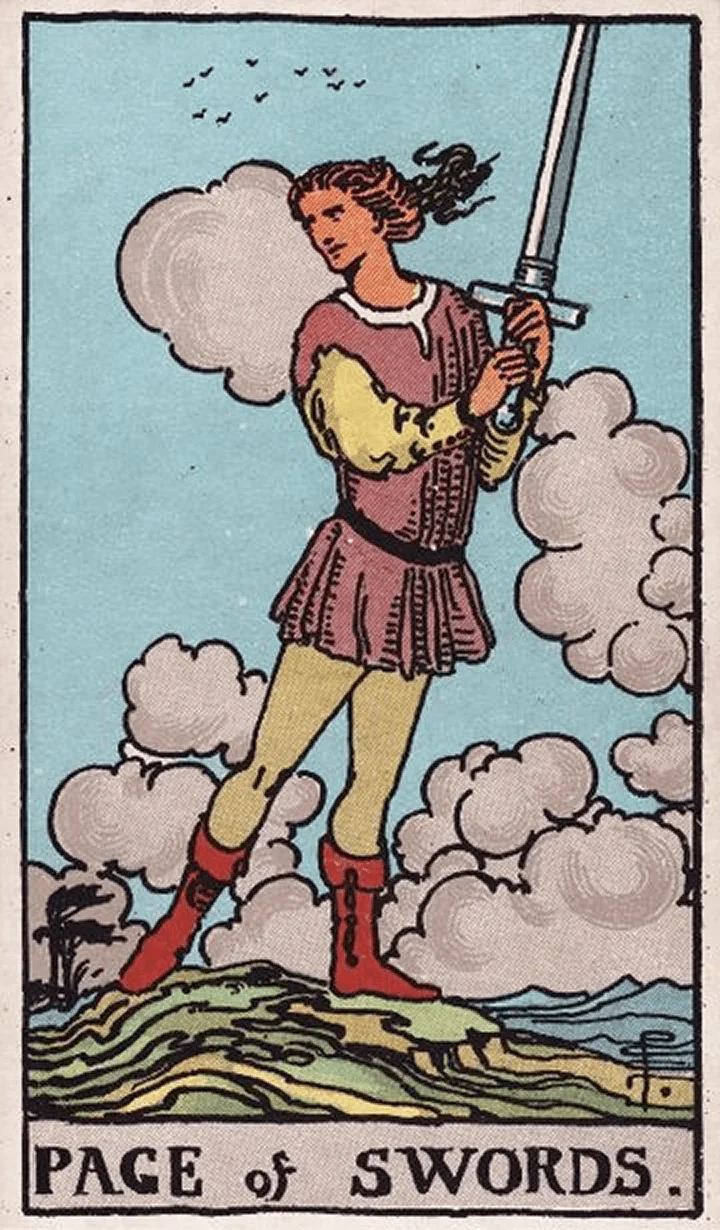
The card depicts a slender and flexible youth standing on rugged, bumpy ground with a sword in hand. He looks excited and wary. Threatening swirling clouds surround him. Ten birds dart in the sky, symbolizing a multitude of ideas and referring us to the mental "overcrowdedness" and radicalism of the Ten of Swords. He holds his sword exactly like a toy, and for now – with both hands (all other Sword characters are strong enough to hold it with one hand). The Page of Swords looks around warily, ready to meet and repel an attack. He awaits it almost with impatience, for he knows its value. No pain no gain. The Page of Swords is logical and "metallic." At the same time, a spirit of irrationality is felt in them (just look at their hairstyle and ballet pose). The modern mystic Pir Vilayat writes that the Page of Swords is the acquisition of painful understanding leading to development. "You feel that your being has been preparing for this moment for a very long time. Most likely, it was a long incubation period during which you were dissatisfied with yourself because you consciously felt a huge number of hidden inner possibilities that you could not use. And suddenly there is a breakdown of the barriers of consciousness, and you gain access to them."
The Page of Swords is a newborn thought. Like any thought, it seems to itself divine and immortal (and most likely is), and due to its childishness behaves arrogantly. This thought is not yet clear that ahead lies a certain path of development, and there will be a big difference between what it represents now and what it will become in time. This is a thought that for now exhausts itself. If we proceed from the old maxim "the more I know, the more I don't know," because as the circle of knowledge expands, the boundary with the unknown lengthens, then the Page of Swords is the central point of the "circle." They are like a student who has grasped the first concepts of a new course but cannot yet even roughly imagine the volume of all they don't know (and what they will theoretically need to know by the exam). At worst, the Page of Swords thinks they already know and understand everything. Natural quick-wittedness tempts them to overestimate their abilities and substitute knowledge with guesses. Most modern information technologies designed for the mass user are built on the Page of Swords (the earthly aspect of air in action) – they assume intuitive mastery, without long reading of instructions, user manuals, and the like. One need not know. You'll figure it out somehow!
It is difficult for a "newborn" thought, with all its conceit, to maintain a stable position. It abhors frameworks. The Page of Swords is often described as an unprincipled opportunist; in reality, however, the changeability of their position and attitude is the result of incessant analysis and reassessment of reality. They rebuild the picture not once a year, not on major holidays (i.e., life crises), not because of unexpected events, but constantly. Most people, having once spent energy analyzing a situation and creating their representation of it, are unwilling to spend energy on this labor again. As a result, they are known as people of certain views and "firm principles." The Page of Swords rebuilds their worldview non-stop, in real-time, as is possible only with a youthful soul. Accordingly, their "principles" are subject to constant updates. In this sense, one shouldn't rely on them – they are valid only until the next upgrade. The Page of Swords will adapt to a new order, new religion, new system, new social realities of any level. Naturally, this doesn't evoke sympathy from those who can't keep up and generally don't welcome the "new." Ziegler writes: "When intellectual renewal (air) meets reality (earth element), the altars of old ideals collapse. Every change, every inner conflict gives smoke and ash (bad moods). However, the smoke will soon settle, leaving room for clarity." The Page of Swords is decisive and aggressive when facing practical problems. They give them battle (i.e., rush to solve them) with all the more excitement, the more absurdities, contradictions, paradoxes, and riddles they contain. At worst, the Page of Swords manifests disharmonious Mars, immature destructive outbursts of energy (aggressiveness, adolescent belligerence, ambitions, a sense of superiority, cruelty, conflictiveness, etc.).
At the same time, like all Sword Court cards, the Page of Swords serves the realm of clarity and truth. They rebel, conflict, expose, overthrow, provoke, nitpick, insult, and bring to light for them – clarity and truth. For those who understand this, or serve the same ideals themselves, the desire to strangle them disappears. In its true, higher mode, their rebellion is valuable, constructive, and creative. Ziegler writes that the Page of Swords can be compared to the actions of Jesus driving the moneylenders out of the temple.
Will have to criticize someone, bring reason and clarity into something (preferably not bitterly, not hostilely, and not mercilessly), make correct inferences without barbs... or become their object. Possible sarcasm, excessive criticism, ill-will, bitterness, mockery, bias. This card manifests disputes, provocations, lack of manners, and in this sense, rudeness. Patronizing all sorts of verbal duels and disputes, the Page of Swords is not a bad card for exams (at least, the head doesn't refuse to work, and memory doesn't leave quietly). Yes, tricky questions and criticism will most likely take place. But at last, something will be understood. As is known, an exam is the last opportunity to learn something. About the Page of Swords, one can equally truthfully say "The tongue will bring you to Kiev" and "My tongue is my enemy." With this card, one can either successfully wriggle out of a difficult situation by talking one's way out, or blurt something out without thinking, which one will later regret.
Under the Page of Swords fall information search and presentation of one's plans, sober analysis of facts, and, among other things, making not the most pleasant decisions. This card can describe a nervous atmosphere at work, full of anxieties, fuss, some provocations, insinuations, and petty intrigues more befitting kindergarten pupils than people who have something to do. Under this card, backstage intrigues flourish, struggles for position, clarification of relationships, exchange of barbs, power games, and all sorts of protest actions like boycotts and "office revolutions" take place. Normal work gives way to gossip and backbiting (all this might look like "personnel training events"). By the way, the Page of Swords loves all sorts of novelties, modernizations, information technologies, and the introduction of advanced work methods, communication, and data management into an organization's life.
The Page of Swords may describe the necessity to strain all one's mind to compete with rivals, and at worst – much ado about nothing, fruitless activity.
The Page of Swords is a capable assistant who wants to learn something. They strive for flawlessness but haven't achieved it yet. A well-hung tongue and the ability to grasp on the fly make them a valuable employee, though their boundless loyalty should not be counted on, and access to company secrets should still be limited.
The Page of Swords is good for professions requiring knowledge of foreign languages and the ability to stay informed about constantly changing affairs ("as on the stock exchange"). Not a single fleeting signal will pass them by. This is a card of nimble assistants, indispensable aides, dexterous errand-runners. The Page of Swords might be a TV or radio host or a specialist in advertising, product distribution, and information.
It covers any occupations requiring quick reaction, coldness, and concentration, clear performance of functions with a minimum of emotions. They can describe the work of a detective, auditor, diagnostician doctor, as they love to "dig" and find out details. They are excited by mysteries, tracking, searching, the possibility to establish, discover, uncover, or expose something. In traditional interpretations, it also figures as an indicator of an artist. The Page of Swords loves to observe, watch, gather information. They can be a researcher or a researcher's assistant, a student, an investigative journalist, a blogger who doesn't mince words, a translator, a steward, a courier, a traffic police officer, an inspector, a security guard. They enjoy calculating, counting, developing schemes, and can do this even just out of nothing to do, amid routine work that doesn't involve any mathematics. Sometimes they might calculate their way to something resembling statistical patterns in that very routine work, and then happily optimize it (or think of a way to circumvent the rules). The Page of Swords may point to outpatient surgery, professions somehow connected with the use of piercing and cutting objects, also to aviation, military affairs, and intelligence in their lower echelons, to police and legal proceedings.
They also patronize martial arts and such sports where great importance is attached to dexterity, concentration, thoughtful tactics, all sorts of "schemes," counter-techniques, and "moves" against an opponent.
The card's advice: Show vigilance, use your head, and keep your wallet close to your heart. The Page of Swords practically acts the same in the "advice" and "warning" positions, because – it warns! And this is precisely that "forewarned is forearmed." The alarm should be set, the phone "password-protected," the receipt checked, the email address double-checked before the "send" button is pressed. Another piece of advice from the Page of Swords: exercise analytical abilities, solve puzzles, take up studying something new, increase erudition. Often, advice to intervene as the Page of Swords leads as a result to The Magician – the situation becomes controllable.
The card's trap: excessive trust in one's own ideas, while they are superficial, immature, and only partially cover the essence of the matter.
Like all Pages, the Page of Swords suggests the querent can expect some news related to money. The nature of this news may be revealed by other cards in the spread. In the most general sense, the Page of Swords may mean the need to take up calculations, analyze the financial situation. Possibly, some plans will be changed or revised after this. Most likely, the Page of Swords will force one to give up something, but it's for the better – in business matters, their head works perfectly, and the decisions made may turn out to be rational.
Swords always suggest solving difficult tasks, and the Page of Swords, like all other Pages, points to an immature attitude towards the connection between two people. In this case, the emphasis will be on selfishness and rationalization, irritation and sharpness. Quarrels and clashes are included. The Page of Swords loves streams of reproaches, slaps (physical and moral), attacks, and utterly pointless and endless verbal squabbles, insisting on their own, as they say, on principle. "There is rapture in battle!" For the Page of Swords, insisting on their own means exactly the same as for a teenager – proving their authenticity and selfhood. It's an existential question! And not at all some trifle (like which movie showing to buy tickets for). A partner who has already passed these thresholds in their spiritual development cannot look at these "triumphs of will" without anguish and boredom. The Page of Swords gets angry, offended, embarks on vengeful provocations ("I'll teach you a lesson!") and at worst behaves completely inappropriately, throwing hysterics with wrist-cutting. Sensing a threat to the relationship from outside, they are capable of childish-foolish gestures, impulsive, rash, just to clarify the situation (setting up some surveillance, rendezvous, ambushes, and traps, making scenes at the workplace, hacking email, and so on).
The Page of Swords may indicate a rival in love, gossip, or the very situation of suspicions of infidelity arising.
The Page of Swords may indicate an exacerbation of old disagreements, as well as a habit of projecting one's own problems onto a partner ("shifting blame from a sick head to a healthy one"). In spirit, the Page of Swords is an unhappy, wounded child who, for example, grew up prematurely due to their parents' divorce. Their emotional world is permeated by cold winds and drained of love and closeness due to disappointment even before they take their first steps into the big world. But they are perfectly aware of duplicity, infidelity, deceit, cruelty, separations, and ultimatums. Unconsciously (and sometimes consciously), they are prepared precisely for such developments, are on guard and fully armed.
The Page of Swords is not the most pleasant partner, skilled at spoiling relationships, as they are set on destruction, not creation. But they have a sharp mind and a combative character, and overall they crave development. They sometimes think about existential questions, albeit in a teenage spirit, and they seek their identity. When getting acquainted, the Page of Swords always assesses emotional risks. Moreover, they do this almost by mathematical calculation, estimating what can be expected from the person and inserting their coefficients into the formula. Of course, they too can miscalculate, but generally they are not fooled by superficial sighs, poems, complaints about life, and minor romantic gestures. They look at the root, though not yet as penetratingly as their "sword-wielding" parents. They are interested in facts, actions, deeds, and results, and it is by these they evaluate what is happening, and very quickly. They despise naivety and sentimentality. One cannot say they are unhappy in love – just like the Knight of Swords, they usually don't know what it is. Even if they happen to talk a lot about it (they generally like to chat and "shine" with some mocking theory), what it means to feel it is practically unknown to them. The Page of Swords can be envious and jealous, but this is conditioned only by the suffering of their own ego – they don't like it when someone surpasses them or tries to take what they considered appropriated. In love, they behave the same way as when solving a mathematical problem (and, for example, may take up conquering on a bet, within a certain timeframe). Their behavioral model in love corresponds to their model of rational thinking. Need it be said that by trying to analyze and rationalize the movements of their heart, they risk outsmarting themselves. They simply make the wrong choice and then deal with the consequences (sometimes through divorce, symbolized in spreads by their symbolic parents – the King and Queen of Swords).
Like all Swords, the Page of Swords cannot stand suppression. Moreover, they are more rebellious and radical than their symbolic parents, the King and Queen of Swords. Ziegler writes that their "no" to any suppression is merely their "yes" to themselves. Like all other Swords, the Page of Swords is truly always faithful only to themselves. And this, in general, is attractive! The need for independence, of course, often makes them forget how important feelings are. They are capable of causing pain not only intentionally but also without realizing it.
They astonishingly combine confidence and vulnerability, audacity and chastity. If their feelings are nevertheless touched, they are capable of very rash actions and ready for any fight. The presence of any rivals or rival suitors, disapproving parents, and the like, and other obstacles doesn't faze them at all, and somewhere even spurs them on. Unlike the Knight of Swords, they might not physically fight off a loved one with their fists, but they will know how, if need be, to slander, discredit, and cunningly "bring down" other contenders, presenting them in the most unfavorable light, so that no one will even look in their direction again. If they are forbidden to meet someone, they will swim across seas, climb over mountains, fly in the luggage compartment of a plane... On principle. Although the Page of Swords is not devoid of self-preservation instinct, their next stage is the Knight of Swords, and one shouldn't forget that. The Page of Swords is precisely that type of teenager who might jump out of a window or cut their veins because of unhappy love. It is they who have enough inner coldness and resolve to settle scores with life.
The Page of Swords usually looks young, but is not a card of flawless health. May be an indicator of vegetative-vascular dystonia and similar not particularly significant but unpleasant syndromes of the "all diseases are from nerves" series. It may also indicate minor injuries and cuts.
In a reversed position, it traditionally meant illness, and especially a twilight state of consciousness, temporary clouding of reason, amnesia (memory loss due to injury), paranoia. The desire to see connections where there are none leads to anxious illusions and suspiciousness. It is precisely the reversed Page of Swords who might think that autumn leaves are flying after them in a flock not by chance.
The Page of Swords (especially reversed in combination with The Moon) may indicate speech difficulties, stuttering, pathological withdrawal, and, in the worst case, suicidal tendencies.
The reversed Page of Swords brings cunning tricks, schemes, and, naturally, obstacles in affairs. It may also indicate a loss of vigilance and inaction. The traditional interpretation says that in relation to the event indicated by other cards, it is appropriate to ask: did it actually take place? An interesting meaning of the card – misunderstanding of spoken words and written texts. Possibly, we read something not to the end or misinterpreted the meaning of a message, entered the wrong password, misplaced a comma, sent a letter or order to the wrong address. So to speak, translation difficulties.
Since ancient times, it was believed that in a reversed position, the Page of Swords manifests unfavorably, meaning quarrels and strife leading to no benefit, nitpicking about trifles, stormy debates and mutual insults up to a break in relations. It can speak of a sudden attack, defenselessness, being unarmed.
An inexperienced person, full of youthful categoricalness and ruthlessness, not yet realizing the significance of patience and diplomacy (which in the upright position usually are present and can be used). The reversed Page of Swords is more inclined than the upright one to tease, ridicule, cause pain; however, it's also important that no one loves them. They lose that degree of attractiveness they might have in their natural state. As a result, gossip, slander, anonymous letters, or rule-breaking become their only way to get anyone to reckon with them and acknowledge their existence. The card can speak of offenses, problems with the law, official bodies, but this will definitely not be a well-thought-out crime – rather something like ridiculous drunk driving with speeding and a subsequent altercation with the police. In general, the main motive for such behavior is the attempt of an unloved brat to get their portion of attention from indifferent humanity. This might be a good-for-nothing youth, a loafer, a perpetual student.
What's important is that if the upright Page of Swords can still cope with the consequences of childhood traumas, protect themselves, and somehow stand their ground (their entire posture on the card speaks of this), the reversed Page loses this ability and flounders in complexes, not their own master. They may try to assert themselves by causing pain, humiliating, slandering. This is the psychological dynamic of hazing – first suffered themselves, now let the next ones go through the same. Seeing their suffering in others as if from the outside and under their power, they free themselves. Something similar is also characteristic of the Knight of Swords, but on a larger scale.
Suddenness, unexpectedness, improvisation.
With The Magician (for a man), with The High Priestess (for a lady) – to suffer from carelessness.
With The Hierophant – marriage of a beloved relative to a person hated by the querent (from an old manual)
With The Tower, Five of Swords – monetary losses.
With the Eight of Pentacles – an unexpected gift.
Amazons, Valkyries, sylphs
Cards from the same group
Ace of Swords
Two of Swords
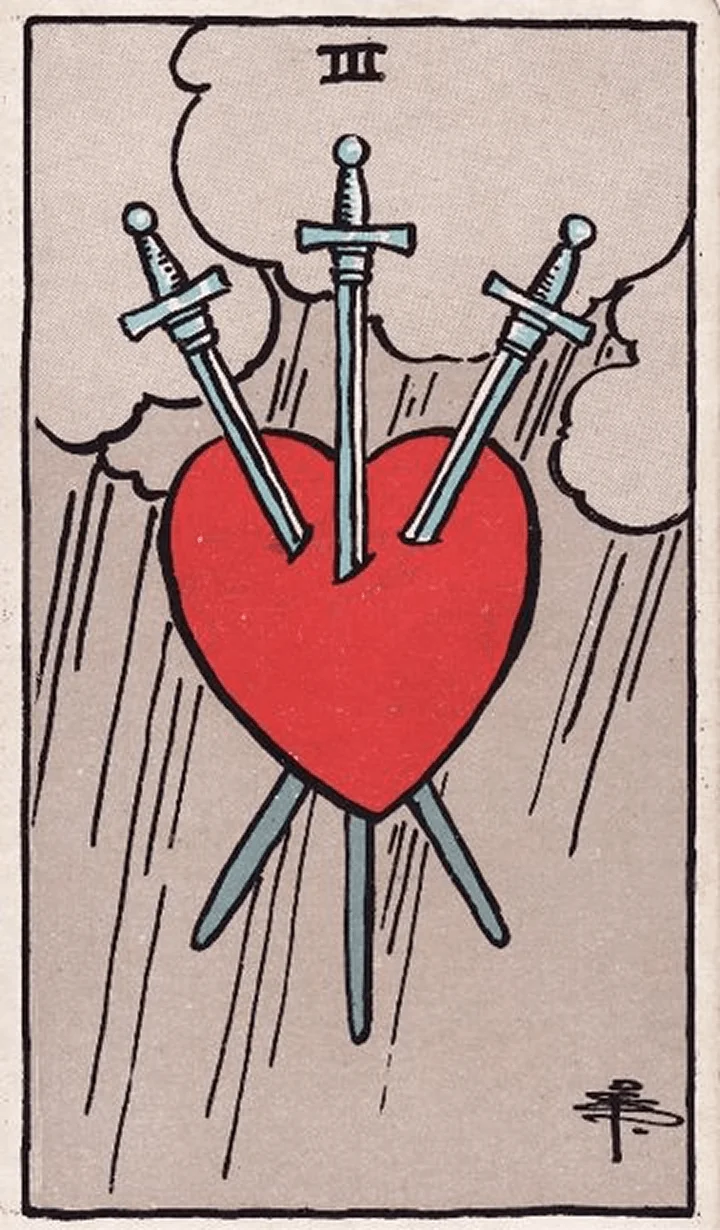
Three of Swords
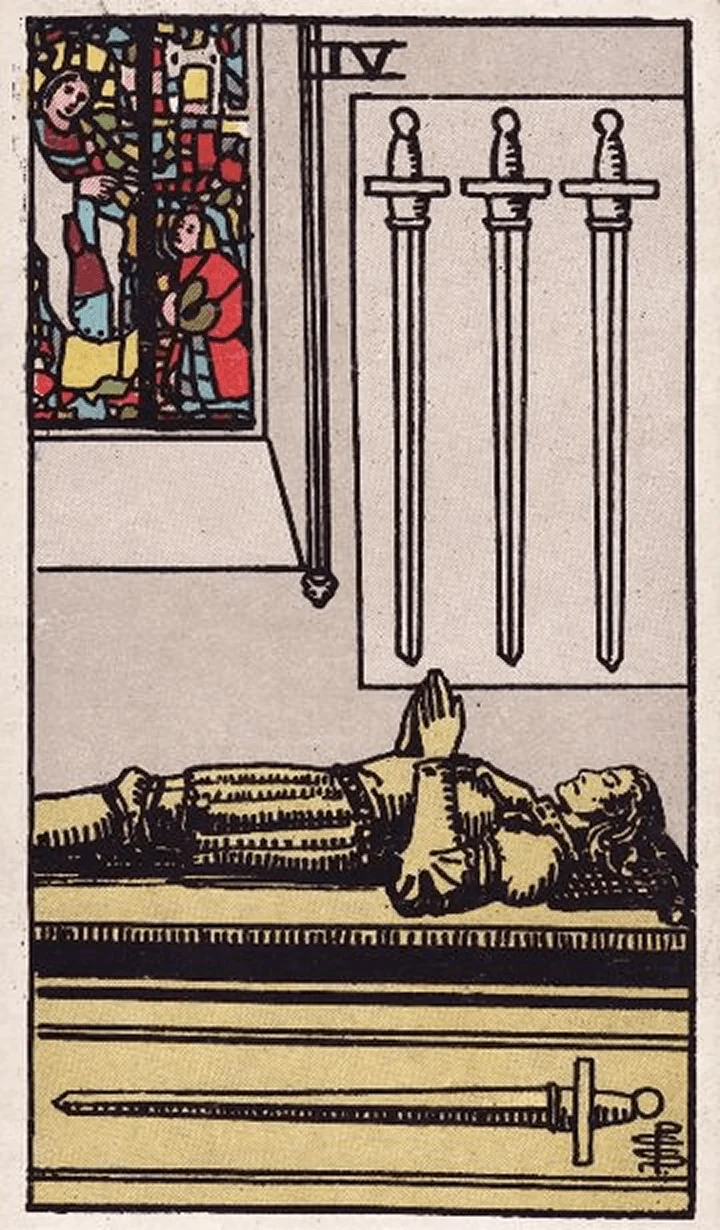
Four of Swords
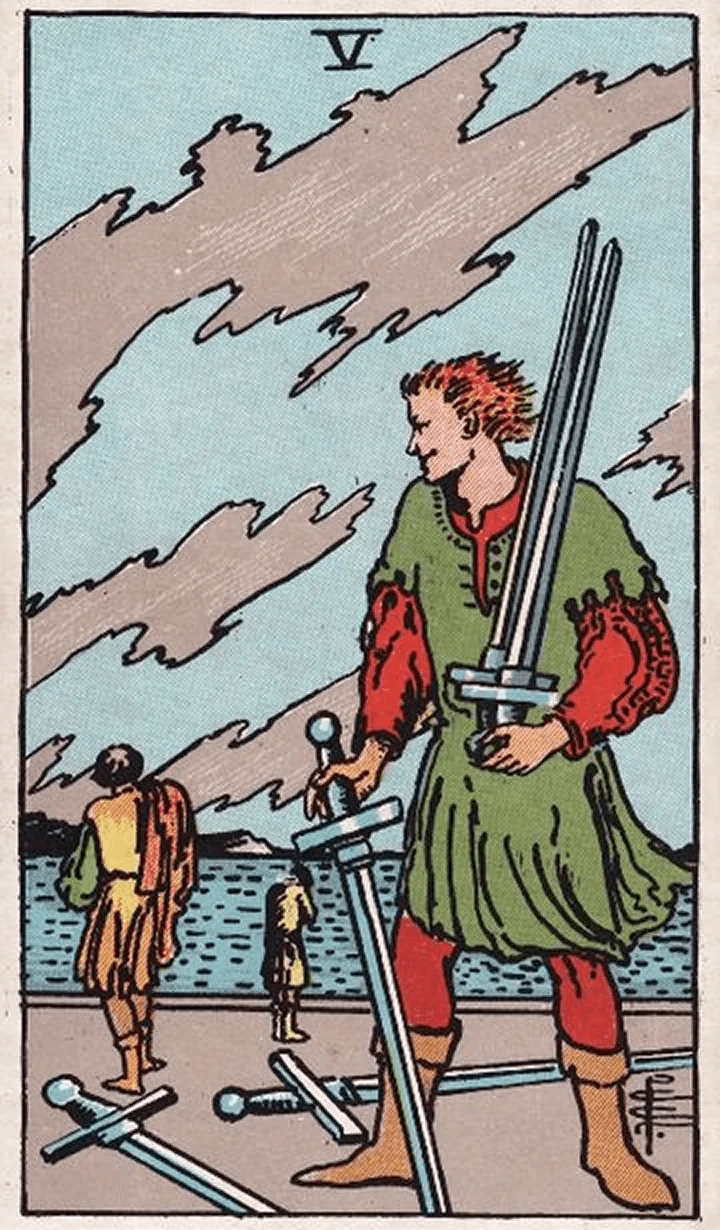
Five of Swords
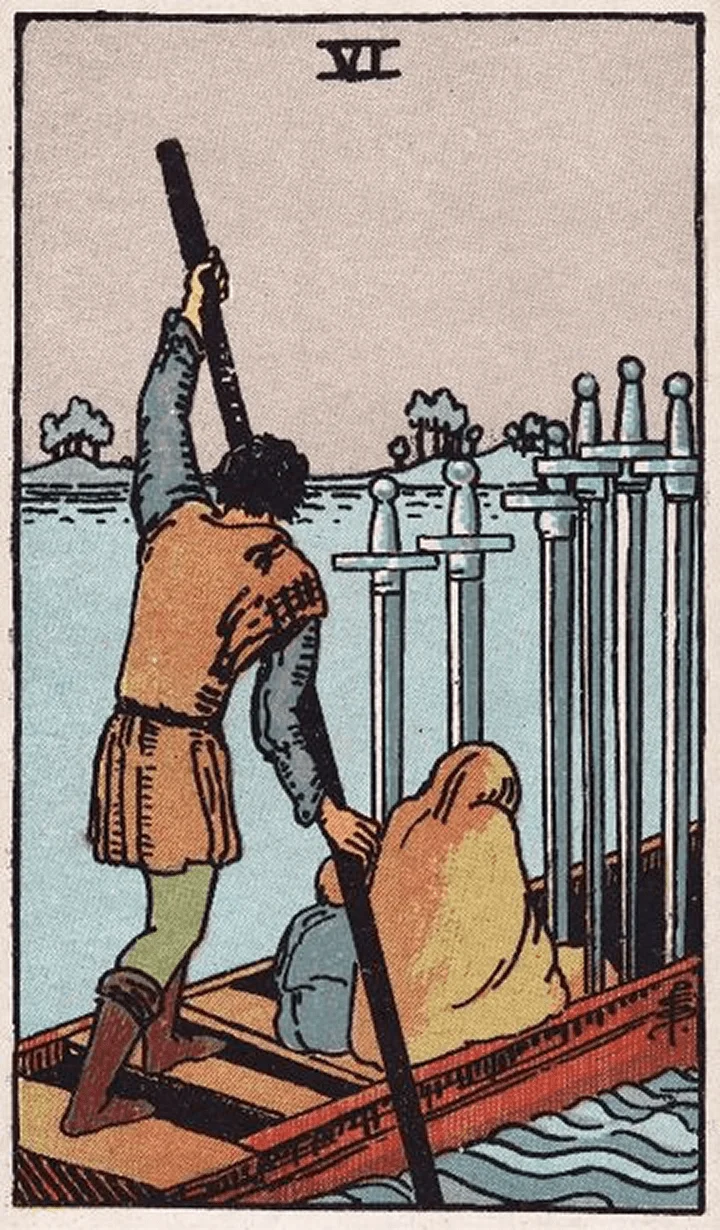
Six of Swords
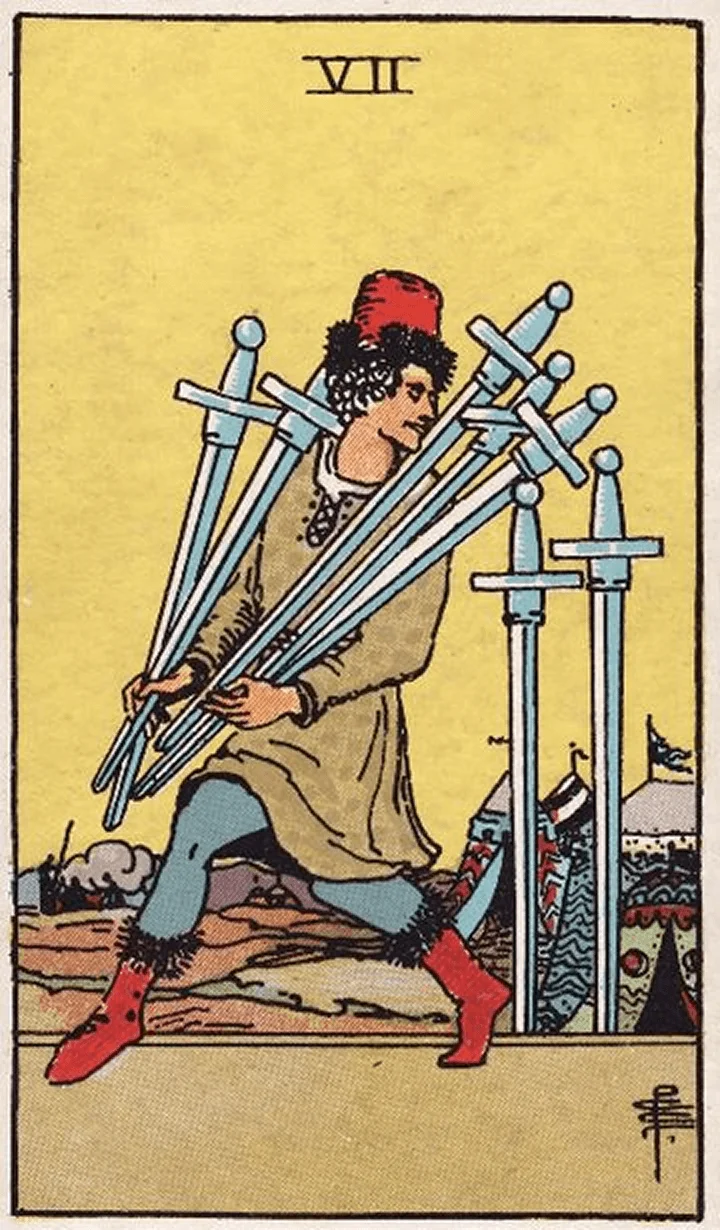
Seven of Swords
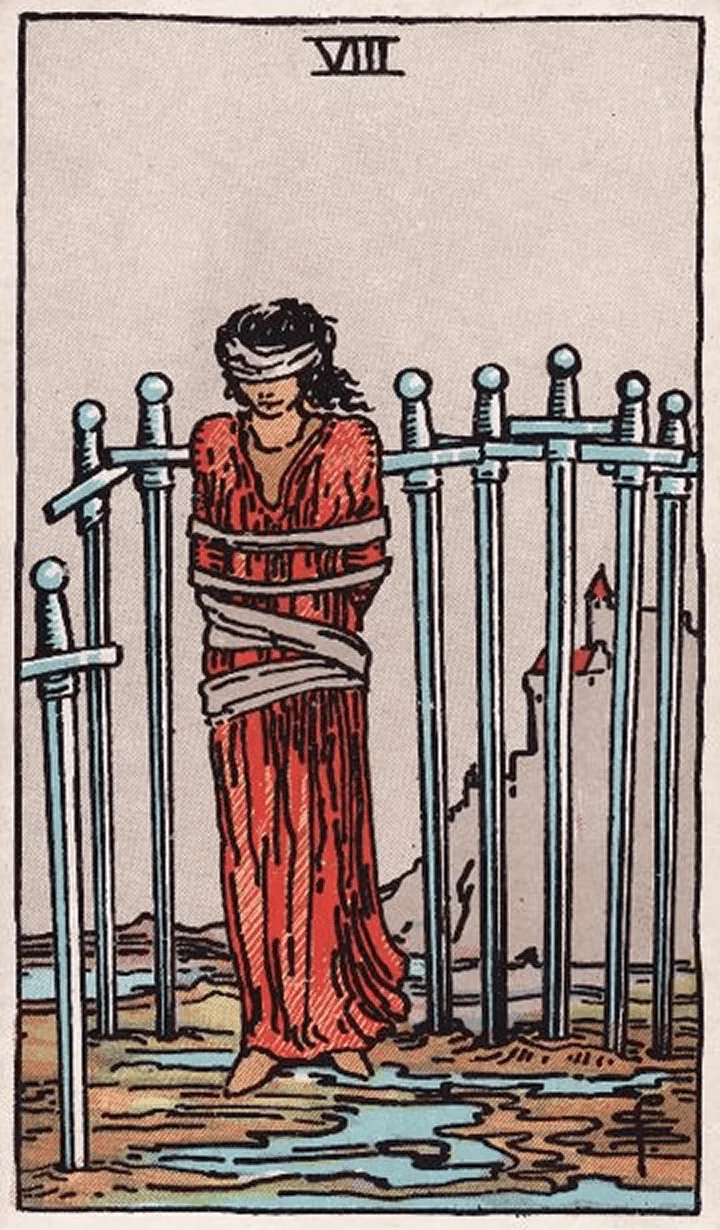
Eight of Swords
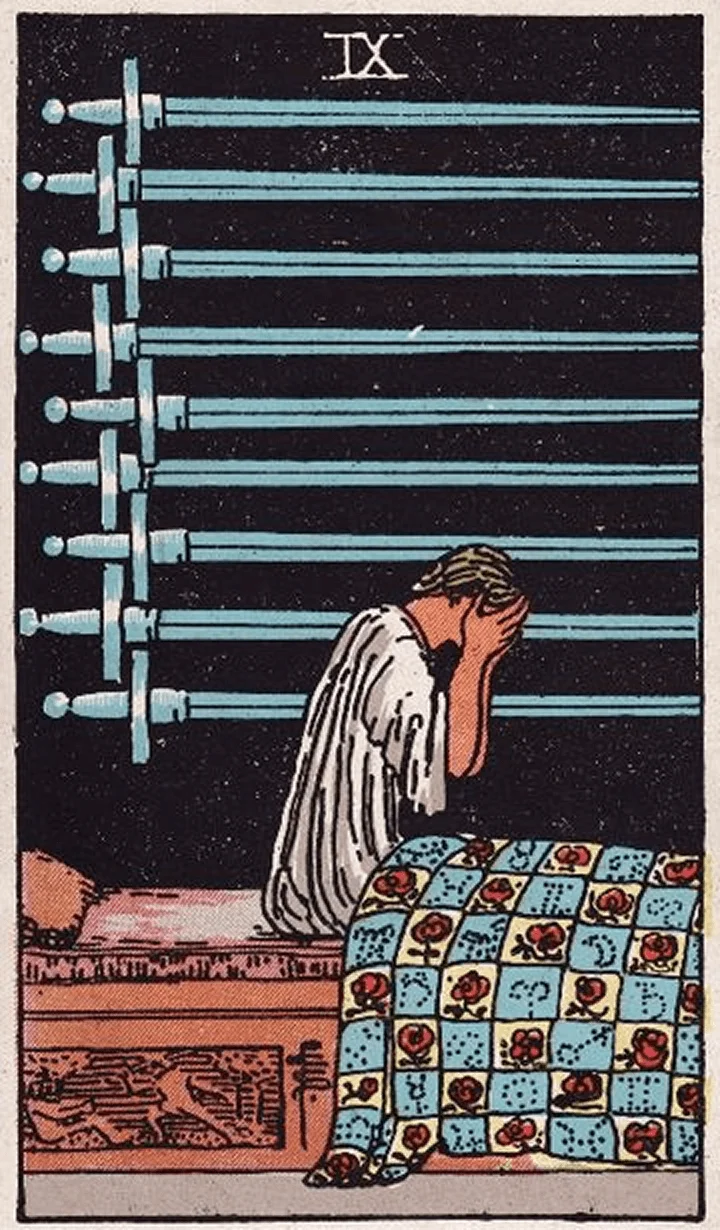
Nine of Swords
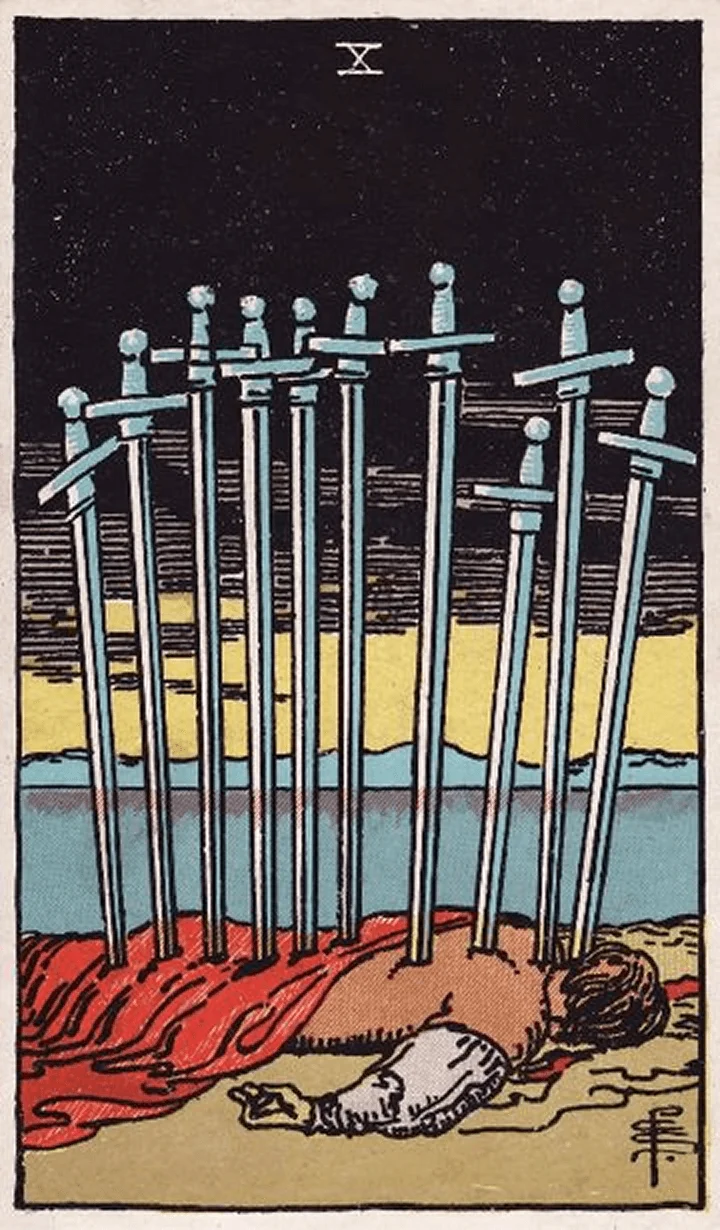
Ten of Swords
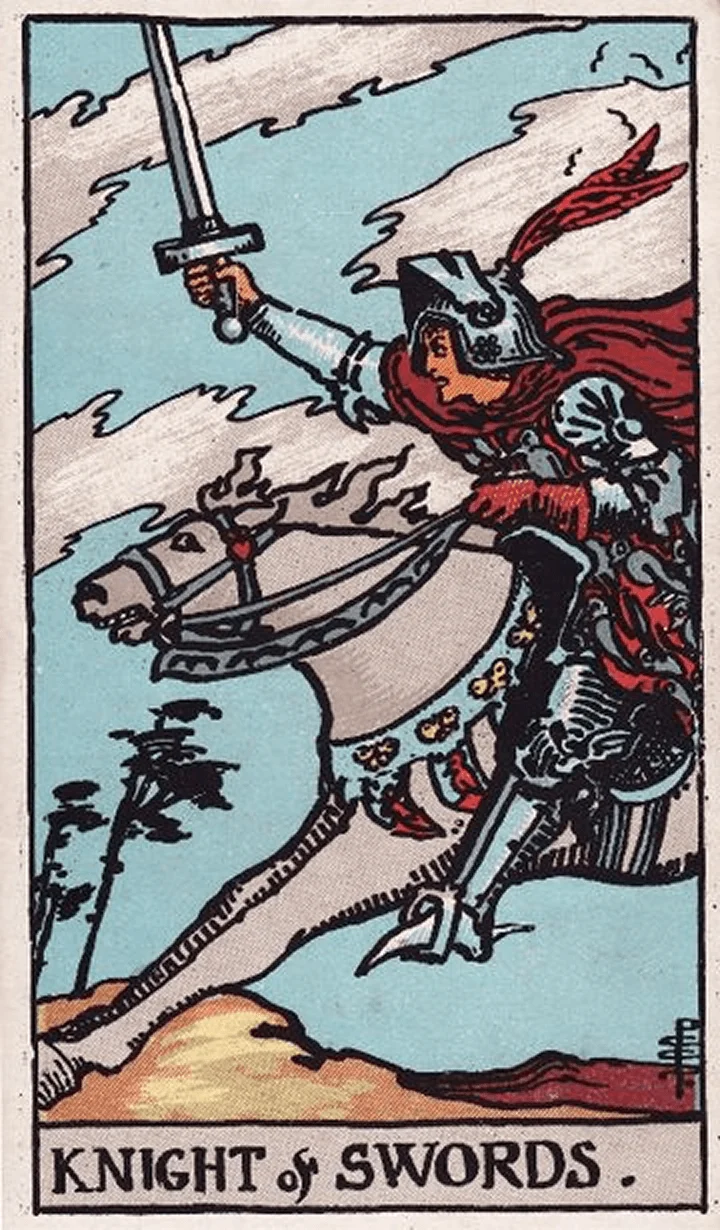
Knight of Swords
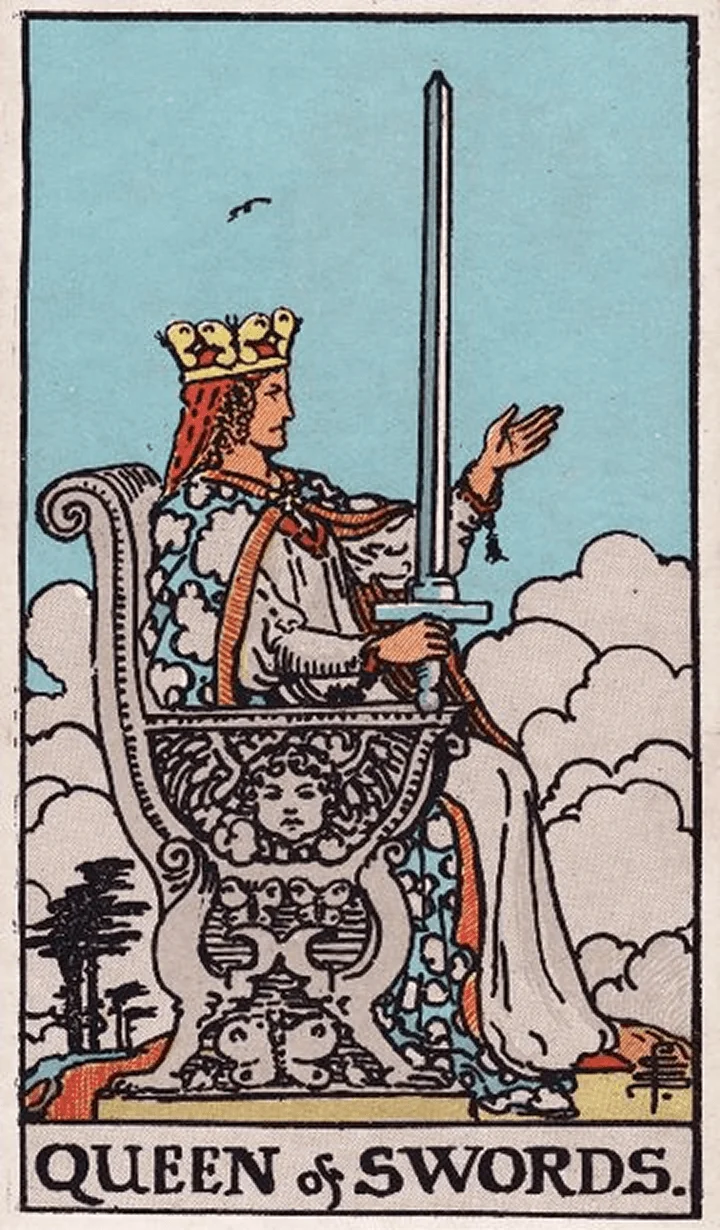
Queen of Swords