Six of Swords
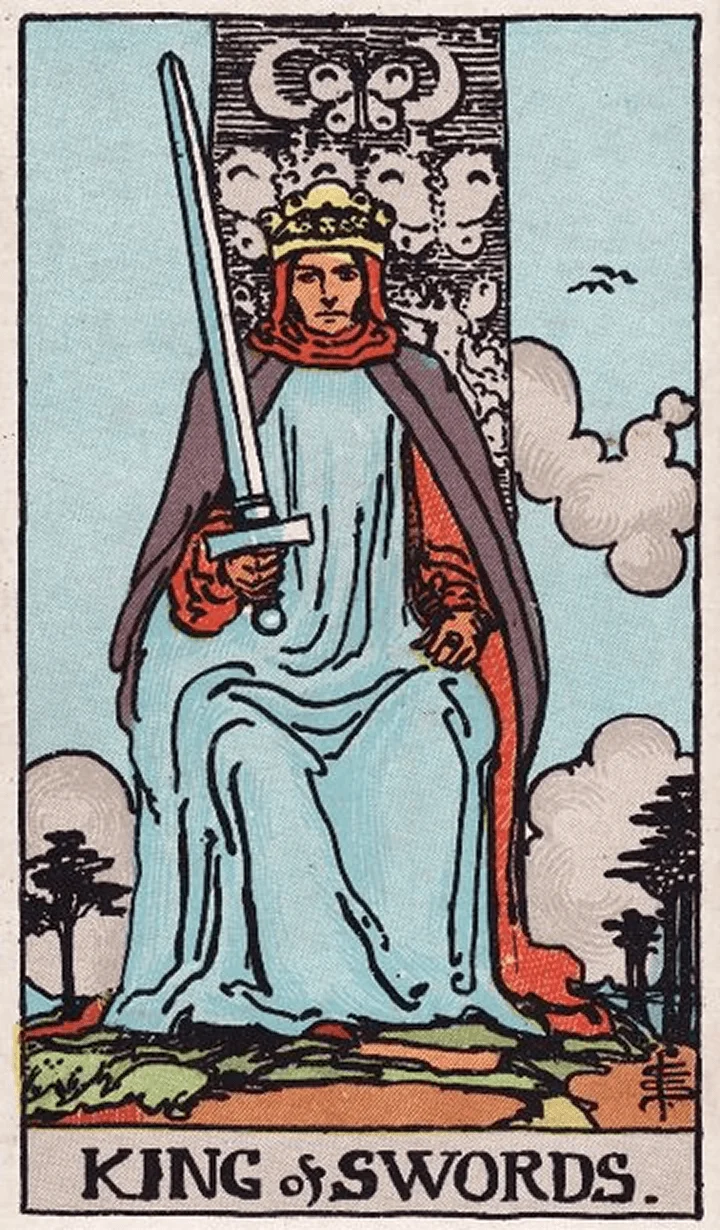
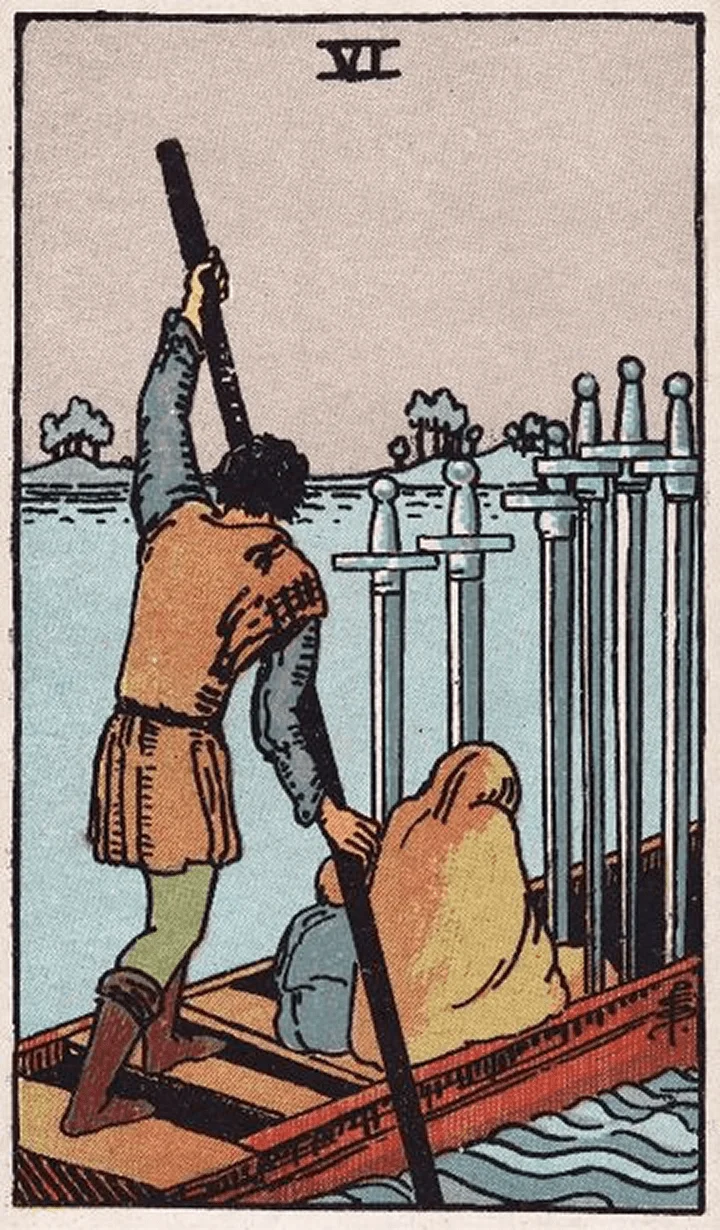
Interpreting the Six of Swords (where in theory the number and suit should describe clarity and harmony of mind) often causes difficulties for Tarot enthusiasts. Precisely that clarity and lack of ambiguity seems to be missing, and upon familiarizing oneself with the specialized literature dedicated to card meanings, confusion regarding the Six of Swords often only increases. And there's travel for you, and melancholy-uncertainty, and intellectualism, and almost departure to the other world... everything is mixed up. On the card, a person steers a punt, the path is devoid of dangers, external threat, the load is small, and the work is not a burden to the ferryman, yet the people sit hunched, in silence and sadness, and the river resembles the Styx. The combination of number, suit, and the stirring, liminal image of the ferryman in the boat and the cloaked figures leads to astonishing vagueness of interpretations, and the spread does not always help to determine the emphasis (even in terms of positivity or negativity).
Interpreting the Six of Swords (where in theory the number and suit should describe clarity and harmony of mind) often causes difficulties for Tarot enthusiasts. Precisely that clarity and lack of ambiguity seems to be missing, and upon familiarizing oneself with the specialized literature dedicated to card meanings, confusion regarding the Six of Swords often only increases. And there's travel for you, and melancholy-uncertainty, and intellectualism, and almost departure to the other world... everything is mixed up. On the card, a person steers a punt, the path is devoid of dangers, external threat, the load is small, and the work is not a burden to the ferryman, yet the people sit hunched, in silence and sadness, and the river resembles the Styx. The combination of number, suit, and the stirring, liminal image of the ferryman in the boat and the cloaked figures leads to astonishing vagueness of interpretations, and the spread does not always help to determine the emphasis (even in terms of positivity or negativity).
Perhaps the key words of the Six of Swords are – a way out of the situation. It carries an exit from a complex, tangled, or even dangerous situation, an escape from problems. This is expedient behavior for overcoming difficulties (what is called coping). This Arcana describes distancing from what is happening (from serious difficulties, which in the sequence of cards are symbolically described by the Five of Swords), restoration of calm and self-possession, the possibility of 'making a getaway' from where everything has become too tangled. These are new life prospects, new goals, and new means.
This card speaks of readiness to leave sorrows behind and head towards new life shores, even if the changes do not inspire much enthusiasm and there are some doubts about the chosen direction. Still, we begin movement towards new life landmarks – by free will and compelled by circumstances, but without great difficulty. Everything that at the stage of the Fives seemed lost, returns in the Sixes. As for the suit of Swords, this is safety and peace. Equilibrium can be achieved by finding a secluded bay, a quiet backwater, a reliable refuge. Sometimes, to find them, a person simply flees from a difficult situation. And other cards show whether they burn their bridges in doing so.
Under the Six of Swords, departure from serious troubles occurs – heavy work, difficult relationships, unprofitable business, and various mission impossibles (if the Ten of Wands is also nearby, then that's exactly it, and if the Seven of Swords, the departure happens with a degree of deception). This is a retreat from feverish activity, troubles. In the most positive sense, the Six of Swords in a spread informs that the period of stress is in the past and now everything will gradually begin to improve. Its presence says that now everything is beginning to change, there is some dynamics, a leveling out is occurring. The transition from one mode of existence to another – that is a fact.
The final result, however, is unknown. It usually concerns the forced necessity to independently follow the chosen path, about separation (and to some degree – liberation), about changing landmarks, and one must focus on the positive prospects of such a decision, mobilize all spiritual strength, calm down externally and internally, like the waters in the picture, and open up to new life lessons. At first it will be scary, but this will fill life with novelty, and the sadness will pass.
In accordance with most interpretations, the Six of Swords is a sign of a favorable resolution of the inquired situation, achievement of desired changes. It reflects a relatively harmonious stage of life, an atmosphere of relative peace and quiet after storms and bustle, relaxation after a tense period. Traditional meaning – 'success after turmoil,' 'finding a quiet harbor.' Secondly, under it indeed quite confidently go trips and journeys (especially of the restorative-vacation type, though there are business ones too, and metaphorical ones), change of scenery, place of residence, place of work, moving.
"A new shore" does not necessarily mean physical movement from somewhere to somewhere; it can be the discovery of something new in oneself, a change of spiritual landmarks, assimilation of new rules of the game, new norms of life, new values, or acquaintance with other cultures and religions. The Six of Swords is closely connected with learning (approximately to the same degree that the Eight of Pentacles is with work). Under it go all sorts of activities related to intellectual development – courses, exhibitions, reading, searching for information on the internet, generally the transmission of ideas, information, useful knowledge. Search for truth. This is the work of the mind, penetration into secrets, accumulation of information, awareness of further prospects, fair understanding. Creative mental activity, objective analysis, an attempt to plan an anxiety-inducing future.
This could be moving to another city, entering an educational institution (and especially if accompanied by a change of residence), joining a new 'club,' a new circle of people, mastering a new way of life, and most likely all this is for the better, even if the querent is gnawed by uncertainty. The sense of the Six of Swords is absolutely conveyed by the Student's Song from the Goliards. This is a struggle between head and heart, where the head wins, and the heart is uneasy, but ultimately all this serves development. Often these are 'forced' trips – quite possibly, the person goes voluntarily, but they made such a decision because otherwise they would find themselves in an unfavorable or hopeless situation. In a more negative sense – trips in connection with sad events (for example, the card responds to funerals).
The arrival of guests. Receiving a message. In old interpretation books, such meanings as commission, assignment, destination are mentioned – the person received a goal, must set off. The ferryman on the card is sometimes interpreted as a specialist, expert, instructor, providing assistance during changes. An important aspect of this is communication, negotiation, and exchange of information. As a resulting card in a spread, the Six of Swords means changes with an uncertain outcome or else an escape from the situation.
A kind of suspended state... though not like in the Hanged Man. Under the Hanged Man, the person feels that nothing is happening, but here – something is happening, but not quite clear what, hence the 'suspension' and hesitation, uncertainty about the future.
The Six of Swords indicates changes, thanks to which we can reach new shores; psychologically it is as if in the middle between the hero's joyful performance (the Chariot) and the sad farewell (the Eight of Cups). Its specific meaning, however, largely depends on whether the person rejoices at the upcoming changes or fears them. To reach a new shore, one must leave the old one, and what awaits is unknown. Hence anxiety, uncertainty, discomfort, but also a certain curiosity and interest in what will be.
In olden times, the Six of Swords was considered a card of brides – apparently, it perfectly described the psychological state of a girl on the eve of marriage: suitcases packed with dowry. Had seen the future spouse three times, what will happen next in that married life is absolutely unclear, though quite curious. Hence the mood of the Six of Swords. This could be a new professional assignment that is not very inspiring because one doesn't know how successfully one will be able to perform it. This could be readiness to disentangle from old relationships and hesitation about entering a new connection.
This card has to do with adaptation and the perception of new ideas. Under its jurisdiction are mental flexibility, scientific and innovative thinking, objective and rational perception of reality. Under this card goes study, discoveries, insights, broadening of horizons. Reasoning, logical evaluation, freedom of thought, philosophic-scientific perception, gaining a new, positive view of the world. Striving for a better life.
Here there is always an element of dissociation, detachment, and simultaneously – greater wholeness. Distancing, the person begins to see their life and the events occurring in it as if from the side, as a panorama. From this point of view, something new is revealed to them. They begin to see, among other things, guiding forces, sources of obstacles, ways out of dead ends, prospects for the future. Under the Six of Swords, an all-encompassing vision of things develops, comprehension of the 'system-forming factor,' the central point, that on which the entire system rests.
This card clearly indicates progress in development, especially if the querent is troubled by a feeling of stagnation and immutability. It makes it understood that the preceding behavior was neither meaningless nor aimless; the person has broken through the wall of inertia, and henceforth their life flows precisely in the direction they have chosen.
One can encounter such descriptions as 'mentality is in full agreement with emotional centers' – essentially, this means a revived ability to learn, resistance and unwillingness are overcome, motivation to do something appears, and sometimes this is very important.
This card signifies a person (or perhaps an entire family) taking an important step. They are renouncing their past life, many habits, connections, occupations and setting off to meet the unknown. The Swords in this case symbolize memories of sad events and hopes for a better future. For a courageous person, accustomed to relying on their own strength, it in its upright meaning signifies a chance of luck: although the matter they intend to engage in is unfamiliar to them, they have enough strength and determination to achieve success. For a timid, indecisive person, it is rather unfavorable.
"Journey by water" carries many layers of meaning. The very words "road," "path," "transition" already include change, transformation, and the appearance of a different world on the horizon. The journey described by the Six of Swords can also occur in internal reality, as a return and healing of the soul, a vision of past and future lives, figuratively connected to a journey along the river of time.
This is indeed a very "Hellinger-esque" card; under it go precisely calculated correct actions, finding a new, more successful and deserved place in life (in the "system"), a change of internal image. An exit from a difficult, tangled situation, a joyless situation - due to a new vision, perceiving it from a new point of view, changes for the better still occur, possibly towards a calmer future.
Generally, the symbolism of the card says that the soul of the Hero (the seated, veiled woman) moves towards a new perspective under the guidance of reason (the man steering the boat) without any protest (the calm waters of the unconscious). The transition of consciousness to a new level, where the child is a symbol of new potential possibilities. This is a card of evolution and self-improvement. Virgo is ruled by Proserpina, therefore through the Six of Swords a person's rebirth, re-structuring, regeneration occurs. At the same time, Mercurial influence is strong here, so the card can symbolize a metaphorical journey, the Path with a capital P, travels to other worlds, spiritual search, Initiation, initiation.
Regarding astrological associations with this card, the following material was found: 'The second decan of Aquarius symbolizes sequential and detailed strivings, science, and unexpected intuitive insights in the sphere of the unknown. And if the first decan develops freedom of thought, the second accomplishes the transition from subjective to objective thinking. This decan is ruled by Mercury and the asteroid Ceres.
But Aquarius symbolizes not the abstract thinking of Libra (intellect here encompasses life processes as a whole, and its work can already be called spiritual), therefore the Second Decan of Aquarius belongs to the sphere of the higher rational and simultaneously spiritual principle. The name of this decan is 'Unfolding' – the unfolding to the mind of the secrets of nature, humanity, Earth, and Cosmos. This is the development of the human spirit, mastering new horizons, and the manifestation of truth into the world. This decan is characterized by a striving into the distance and complete indifference to that which does not fall within its sphere of interest, stubborn adherence to its own course, regardless of its own needs and the needs of others. An idea capable of encompassing the world becomes higher than the reality of the world. A negative example of how science, called to guide nature, neglects the latter, and the implementation of scientific ideas in life leaves no room for care for people, can be Russia – the country of Aquarius. Therefore, the main and most important task of the second decan of Aquarius is a careful attitude towards the present, without which the future cannot be embodied.'
In the Book of I Ching and in mythology, crossing water always signifies a step from multiplicity to singularity. The six-pointed star, which the Six Swords often form – is a symbol of the interpenetration of the spiritual and earthly worlds; it has a strong internal striving for wholeness and concluding a union. It is connected with holistic thinking, a worldview within which the existence of systematicity and interconnections is acknowledged, which cannot always be proven in a purely scientific way, but which nevertheless exist (again, Hellinger's approach to the family as a system comes to mind).
The Kabbalistic principle 'as above, so below' (also symbolized by the six-pointed star, the hexagram) means that, besides cause-and-effect connections, there are also analogical processes, the effect of synchronicity, which on the spiritual level means the holographic nature of the world, the interconnectedness of all things. With a global vision of processes, even the most obvious contradictions may turn out to be parts of a whole.
In religious tradition – association with crossing the Jordan, with Mary's voyage with the child to France, with Jesus's travels on the Sea of Galilee. Hence the main semantic blocks: trip, journey (especially by water), confrontation with one's own fears and their taming (there is no external threat, only discomfort and uncertainty), transition to a new life, assimilation of new ideas under someone's wise guidance. The card always speaks of someone who will guide and help, provide assistance during changes.
The Six of Swords corresponds to those episodes of history that involve some secret activity, one way or another connected with exodus, departure, or flight after events close to defeat and catastrophe. Of course, these episodes are shrouded in mist. Imagine the risky flight of several emissaries from besieged Montségur on the night of March 16, 1244, or imagine the mood in the Paris commandery of the Templar order on the night of October 13, 1307, their exodus towards the sea (!) base on the eve of arrests – and you will feel the energy of the Six of Swords. Despondency and hope, secrecy and faith, risk and awareness of necessity. It remains to add that in both cases, those leaving carried under their cloaks that which should not fall into the hands of others. Treasure. Heritage, memory of the past, promise of the future.
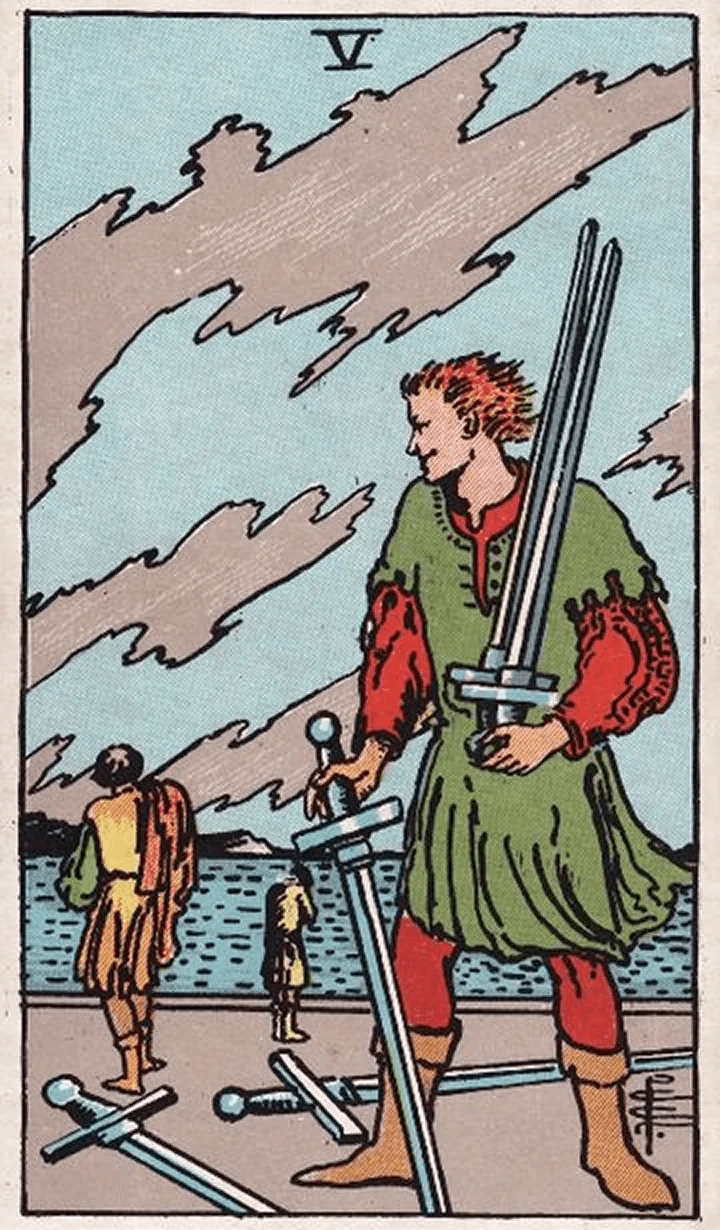
On the Arcana, the people in the boat are dejected (after all, they are leaving a situation where they got a good thrashing – see the Five of Swords, disarmed, stooped figures retreating towards the riverbank), they are enveloped in a cloak of sorrow, but with them is their treasure, their secret, their hope for the future – symbolized by the child. In Florence, in the Palazzo Vecchio, a painting by Jacopo del Sione (a very telling pseudonym) 'The Destruction of the Templar Order' is preserved. At least, so believes the authoritative historian Franco Cardini. He points to the 'Christian cryptography' characteristic of the Middle Ages, where behind an outwardly banal plot a narrative about something completely different is hidden, something that could not be declared openly (apparently, Leonardo's 'Last Supper' is not such an exception to the rule). Before the Virgin Mary, kneeling knights in white robes with crosses are depicted. The painting features broken weapons, banners lying on the ground, someone is leaving half-turned, in his arms a child (!), above the person – an angel. The angel accompanies the exile with his descendant (or relic, remains).
Here one can recall the carefully gathered remains of executed Templars, and a scene from the anonymous esoteric knightly romance 'Perlesvaus,' where a knight and a lady (the masculine and feminine Principles) collect the ashes of a torn beast (symbolically – the remains of the exterminated) into a cup (it's about rebirth, conception of offspring) and disappear. Defeat, exodus, treasure, heritage, mystery.... 'trace, imprint, remnant' (M. Greer). By the way, the word 'Remnant' itself has such a set of meanings in esoteric Christianity that it's better not to start. The imagination-stirring symbolism of the Six of Swords refers us to a whole cloud of mystifications on the motifs of history shrouded in secrets à la 'The Da Vinci Code'... but it should also be very alarming if the spread concerns a banal question of creditors and debtors; this is precisely the case when the debtor disappears in an unknown direction - and the money too.
In conclusion, it is worth noting that in the seemingly 'disparate' symbolism of the Six of Swords, a quite transparent historical reality is discernible: possessors of an excessively developed scientific mind and some progressive developments subjected their lives to serious danger. The emergence of one's own theories in hitherto unexplored areas, the transition from one set of ideas to another, new discoveries, insights, the exchange of ideas, obtaining interesting information, and other such 'Illuminati' activities were fraught with a suddenly arising necessity to make a hasty retreat.
Light and shadow (advice and warning)
Advice: learning is light! It's time to get enlightened. Any step in the direction of intellectual and spiritual development will be beneficial – a lecture, a cultural event, searching for information in books and online. Acquired knowledge will open excellent prospects. Also, the Six of Swords reminds one of a 19th-century doctor who prescribed a 'change of scenery' for all ills (and not without results!). This can also be a spiritual journey, broadening one's horizons, immersion in a new field of knowledge. One should open up to new life experience and stop clinging to the past. One short anecdote comes to mind: 'Dad, is America far?' – 'Shut up and row!' This 'Shut up and row' is another piece of advice from the Six of Swords, very well suited to students and degree seekers. Work, search, think, reason – success will come. Warning: distrust, intellectual posturing, and highbrow skepticism of the 'to verify harmony with algebra' type are out of place now. And flight would be an altogether shameful affair.
card_six_of_swords_deeperLevel_14
Sufficiency (or at least availability) of information for making correct decisions in these matters. But the very nature of this information and these decisions under the Six of Swords is rarely rosy. Business people, even completely unfamiliar with Tarot, looking at this card, as one, utter sadly, 'It's sailing away!' Sometimes things 'float into your hands,' but here it's more like 'slipping through your fingers' (or the situation is 'we're in deep water').
Renunciation of one's rights, concession, transfer of them to another. Deferment of payments. Evasion of financial obligations (at least for a time). This could be the need to think about working in more profitable areas.
In perhaps the most unpleasant sense, the card speaks of fleeing from debts and creditors. This is a situation where things have seriously gone wrong due to erroneous decisions, no improvement is in sight, and the person makes a hasty retreat. Moving, change of life circumstances, place of residence, environment.
Ah, the river is wide... Sometimes the card literally symbolizes the distance separating people. Under it goes sudden departure, farewell, departure, flight, disappearance without explanation (in reversed position – with explanations and confessions). The necessity to retreat, withdraw (or detachment deep in the soul). In combination with the Ten of Swords, naturally – termination of relationship; with the Eight of Cups – separation.
On a subtle level, the Six of Swords relates to the experience of family past. The shrouded, faceless figures in the boat are interpreted as 'shadows of forgotten ancestors,' keeping some family secret or secrets (symbolized by the six swords in the boat... again – trace, imprint, remnant, ancestral heritage). Generally, this card reflects family connections, relationships with family members. In practice, there are cases where it fell for people actively immersing themselves in family systemic therapy (Sixes in general imply communication, 3+3 hints at connection between generations, additionally points to family past).
Interestingly, the man's soul is alive, but the souls of the woman and child seem dead. However, the child symbolizes potential possibilities during the transition of consciousness to a new level. In any case, the card can be an indicator of a family psychotherapist (or the need to turn to one). In an unfavorable environment or as an indicator of the past, it can reflect destructive family influences.
Under this card, a person can both disentangle themselves from old relationships and bind themselves with new ties (although regarding the latter, the person is not particularly enthusiastic). Often the card is one of the significators of a marital union, but usually with some strange underlying motive... like, didn't really want to, but it turned out that way, nothing to be done. Sometimes here a feeling of powerlessness arises and the person feels like a pawn in someone else's game. It happens that the card indicates liberation from an unpleasant connection, that someone will 'save' and ferry to the other shore (in a practical sense – one man helps a woman divorce another and moves her to himself). Here it is worth reminding again that under the Six of Swords goes renunciation of one's rights, concession, transfer of them to another.
Traditionally it is believed that any Six speaks of happiness and harmony; it is the number of balance and beauty. In this case, it is a somewhat cold beauty and not particularly cozy balance, but still under this card serious disagreements rarely occur. The more positively partners perceive their relationship, the better it will actually be – this card emphasizes the significance of thoughts and words spoken about the relationship ('as you name the ship, so it will sail').
Under it go frank conversations, correspondence, communication of kindred souls (and with a lack of communication, people begin to distance themselves more and more from each other). Resolution of old conflicts, clarification of ambiguities, overcoming disagreements, finding compromise solutions. In the worst case, under this card goes burdening the family with professional problems brought home, which are 'chewed over' with excessive detail at dinner, spoiling everyone's mood and digestion. In general, this card foretells harmoniously developing relationships with people, the appearance of new friends and like-minded individuals.
Ancient interpretation of this card includes 'declaration of love' (in all probability, in written form), an offer of sincere devotion, sometimes – a proposal of marriage. Actually, the card quite often falls in connection with a resumed equilibrium in marriage after difficulties. The Six of Swords esoterically can be interpreted as the Star of David, the mutual penetration of masculine and feminine principles, earthly and spiritual worlds, an internal striving for wholeness of perception and conclusion of a union.
Traditionally the card is associated with healing (especially as a result of a change of place, travel, moving). Nevertheless, the image remains alarming in terms of death, a person's departure to the other world, therefore interpretation requires intuition and knowledge of the context of the situation.
In reversed position, it can speak of agoraphobia – fear of open spaces, unwillingness to leave home, as well as phenomena of asphyxia, for example, a cough with a sensation of suffocation.
Traditionally – the impossibility of finding a way out of a situation. Being at a dead end – literally or figuratively. Insolubility of problems. This could be both an inability to reach an agreement in the family, and an unfavorable outcome of legal proceedings (up to imprisonment, as old interpretations warn), and simply the circumstance that arising problems are not solved but put off indefinitely.
Traditionally it is considered that the card indicates a risky enterprise that may turn out in the most pitiful way and shackle one to something for a long time, put one in a hopeless position. Unwillingness to move – again literally or figuratively, resistance to new prospects (for example, lack of resolve to begin studies, refusal of a trip, resistance to moving). The card says that the person clings to the shore and 'paddles in shallow water.'
It is believed that this card indicates that a wrong step was taken and it is time to return to the starting positions, if possible. The journey is not thought through, not prepared, and most likely will not take place (and if it does, rest is unlikely). The chance of luck is negligible. The card is also interpreted similarly to the reversed Chariot – as a warning against leaving home or traveling due to the threat of a serious accident (doubly so for travel by water). Delays, changes of plans, problems with transport, troubles at customs, with baggage inspection (in any case, nothing can be smuggled secretly). Troubles connected with water, floods, drownings.
There is an opinion that in reversed position, the Six of Swords gives Virgo in its low manifestation: egoism, a tendency to use others (to take advantage), 'self-sacrifice in reverse,' renunciation of one's principles.
In the reversed Six of Swords, there is an element of exposing something secret, concealed (maybe the person themselves decides on this). In a communicative sense, traditional interpretations emphasize confession, admission, a love proposal, and unlike the upright position – unexpected, sudden. Generally, unexpected exposure, possibly even public self-exposure like coming out, when a person admits to a non-traditional sexual orientation, or reveals a fact of infidelity or improper behavior. Traditional meanings – declaration, confession, public statement with consequences, sudden discovery changing plans. Receiving a disease diagnosis, clarification.
The Six of Swords can also describe a return from a trip, and, as Mary Greer notes, in a state of culture shock, or simply a tiring journey (precisely the case when after a vacation people return to their usual work almost with relief).
With Strength – making a firm decision to change one's life
With the Star – disappearance on the road
With the Three of Wands – broadening horizons, changing perception, intensive study, receiving new information
With the Four of Wands – an excellent opportunity to rest
With the Eight of Wands – travel
With the Ten of Wands – 'struggle in solitude' (the person passes by the opportunity to shed the burden, ease their situation).
Reversed with the Ten of Wands – delay in explaining the matter (from an old interpretation book).
With the Three of Cups – rest, opportunity to relax
With the Four of Cups – depression, apathy, sadness, indifference
With the Eight of Cups – travel
The Philosopher's Stone
Tabula Smaragdina, the Emerald Tablet, on which Hermes Trismegistus recorded his teachings.
"Fate leads the willing and drags the unwilling"
The archetype of the wandering knight. From the Goliards, 12th century (abridged)
In the land of France, on an alien planet, I am to study at the university. How I long, and - cannot say in words... Cry then, dear friends, with bitter tears. At parting we'll shake each other's hands, and the martyr of science will leave his father's house. So be always alive and well! I believe the day will come when we meet again. I will gather you all together, if abroad I do not chance to die from my Latin. Here I stand, holding an oar - in a moment I'll depart. My poor heart is clenched with sorrow and sadness. The water quietly splashes, a blue ribbon... Remember sometimes your student.
Cards from the same group
Ace of Swords
Two of Swords
Three of Swords
Four of Swords
Five of Swords
Seven of Swords
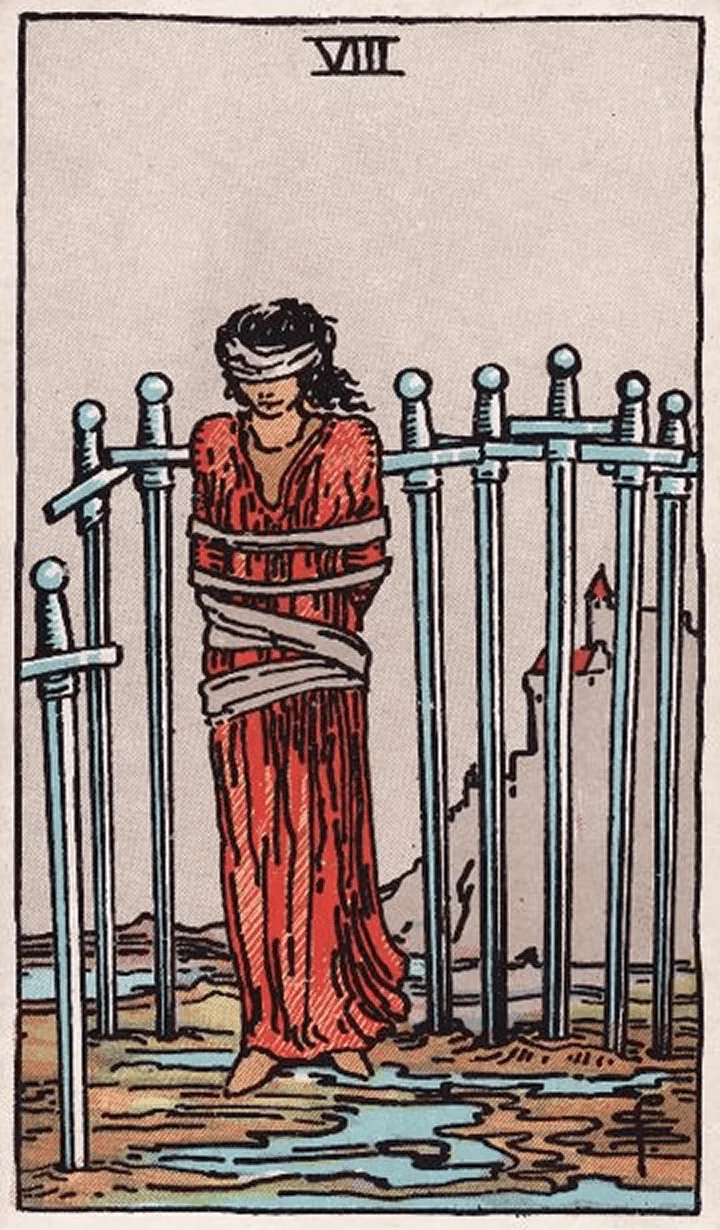
Eight of Swords
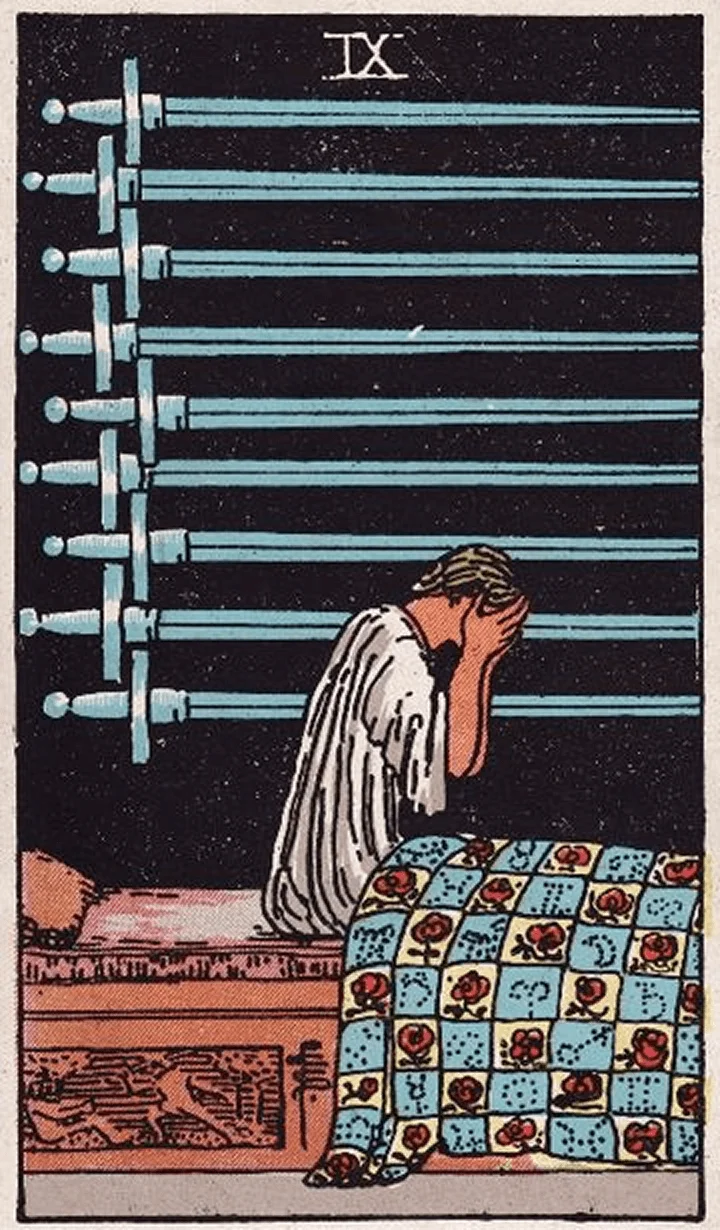
Nine of Swords
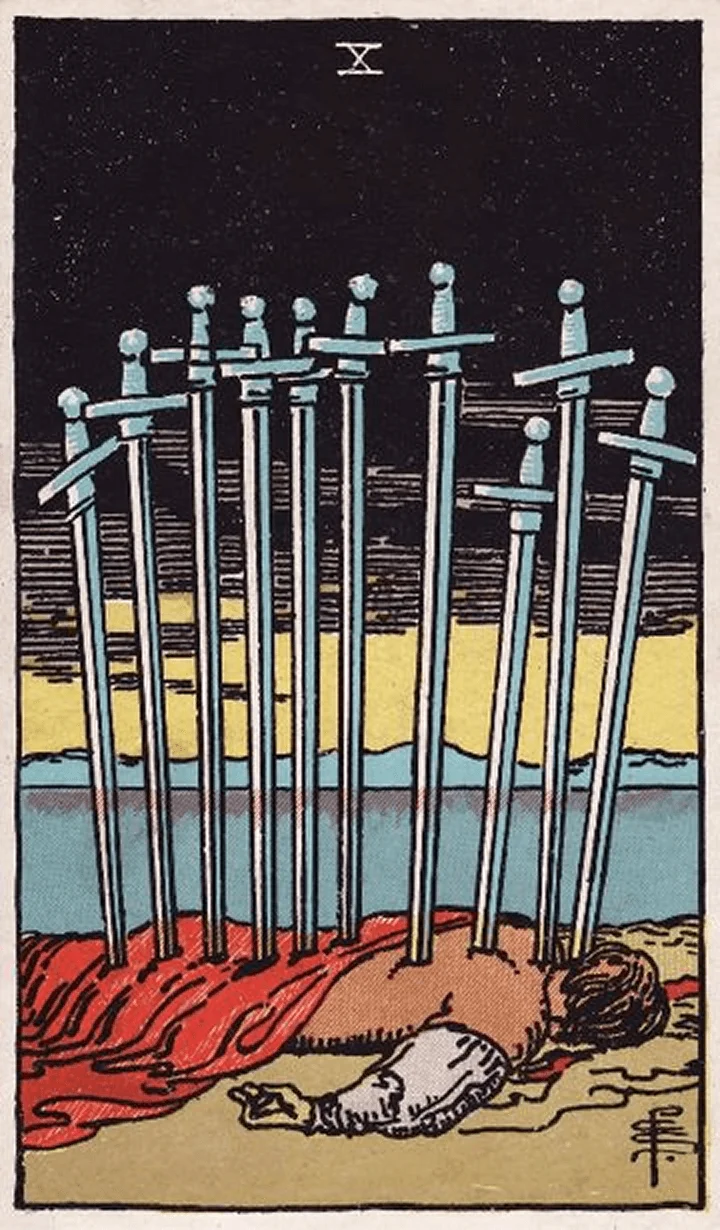
Ten of Swords
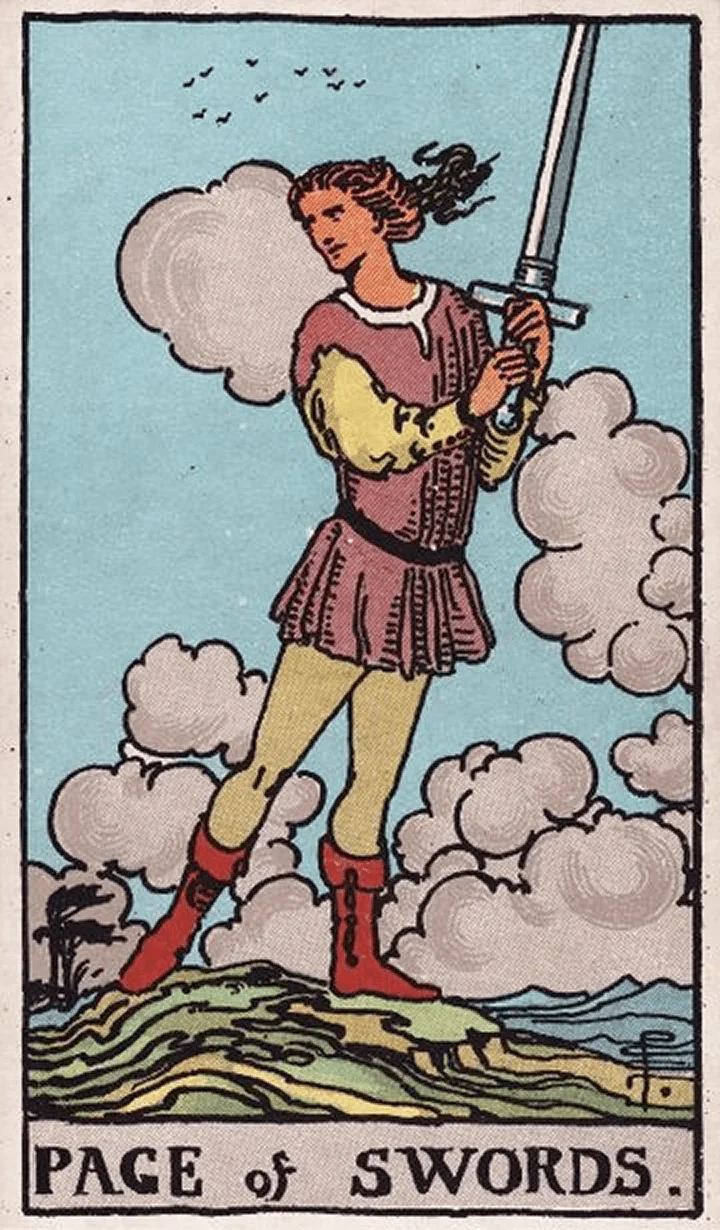
Page of Swords
Knight of Swords
Queen of Swords