Temperance
Temperance is a card of beauty, joy, silence, and harmony. It is a powerful image of light and restoration.
Temperance is a card of beauty, joy, silence, and harmony. It is a powerful image of light and restoration.
It is considered a fortunate omen (one of the traditional meanings is 'true outcome') and brings a beneficial influence into the spread.
Temperance brings a softening of disagreements and a reduction of tension, although at the same time it usually indicates that the person is undergoing some trial. A promise that the situation will calm down and clarify. A way out of the dead end will be found; a seemingly insoluble problem will be overcome; resistance will be exhausted.
Under this card, what seemed impossible happens without noise and dust. Appearing in a spread, it says that the desired can be achieved with patience and self-control. Under the jurisdiction of this card are adaptation, compromise, a neutral and even line of behavior. Humility and submission (or, as written in old interpretation books, 'combination of ideas creating a moral and righteous life').
Harmonization of all sides of being, a period of stable development ('plateau'), an ideal state, union with oneself and the world. Joy of existence, virtuous and measured life without tension. Harmony as the most important thing in life, when everything breathes peace, agreement, and expediency, and is kept within reasonable limits without much effort. Under Temperance, contrasts blur, wounds heal, sore issues are resolved, and strength is restored.
Prognostically, it means stabilization in affairs and successes, and also that victory awaits in the struggle with the vicissitudes of fate (with virtuous, wise, and correct behavior in accordance with the meaning of the Arcana). Obstacles will be conquered as water wears away stone. Temperance indicates a favorable outcome of events, however warns not to hope for a forced solution – the matter will progress unhurriedly, but without special obstacles. Temperance reminds that one cannot go far on passion alone; steam will quickly run out and the pursuit of some mega-goal will end with you simply exhausting yourself and falling. This is the necessity to economize strength and not scatter oneself, in order to reach the goal, and to show endurance. As a significator of a question, Temperance says that the person strives to act in the best way and is looking for the correct solution to the issue.
Temperance is sympathetic and merciful. In the company of unfavorable cards, it softens their negative meaning.
Zen-like imperturbable and peaceful.
We are at peace with ourselves and calmly perceive what is happening. This card corresponds to that happy state when a person feels good, loves themselves, and is in harmonious balance with the surrounding world. This card corresponds to peace of mind. The serenity of Temperance frees from pain, anxiety, fear.
Overall, this is the ability, wisely restraining one's behavior and not falling into extremes, to live a well-balanced, harmonious, quiet, and wise life, which has everything necessary and nothing superfluous. The experience of peaceful, serene, calm existence, absence of attachment to superficial sides of life. The ability to live lightly, modestly, and joyfully, to manage with little, and yet to be in peace and harmony with oneself and all surroundings. The experience of silence and serenity, maintaining balance and peace at the very center of one's being. Overcoming contradictions, healing from them, deepening into oneself.
No aggressiveness or bitterness.
This is the precious experience of 'inner maneuvering' without unnecessary movements, the art of maintaining and preserving balance in the soul at the most problematic moment of life, in a heated stressful situation, when one can lose the remnants of health, nerve cells, and common sense. Huge internal discipline, restraint, very precise behavior. Unhurriedness, imperturbability, and self-control. Nothing knocks one off course, no tossing from one extreme to another, the ability to keep within reasonable limits in everything. Calm and confidence in one's strength, self-possession, wisdom, restraint. The ability to limit one's impulses, absence of sharp, unbridled reactions ('the ability to limit oneself in irritation, passion, desire').
Equilibrium and peace as the main imperative in solving moral issues and choosing the correct course of action.
The patience of Temperance differs from the patience of the Hanged Man. Under the Hanged Man, there are times when it seems that nothing is happening in life, stagnation sets in, which cannot be done anything about, or we are forced to sacrifice something. Temperance is rather patience in danger, in a heated situation. 'Patience in danger is victory.' To the impatient, moderation is boring, and calm and impartiality are impossible. There is some similarity with the Seven of Pentacles – you cannot speed up the growth of a tree or the ripening of fruits. As Hollander writes, 'simply time must pass for the bread to bake.' The forces you set in motion are working. Only patience is needed. While you wait, everything progresses at its own pace, and if you rush from corner to corner, the matter will not speed up at all. This time can and should be lived calmly and usefully. In this life, we are accustomed to constantly doing something and fighting something, but Temperance says – there are times without war. Times when you do not have to do anything special. Events develop according to natural laws and will yield results in due time. They need not be pushed.
'One must only learn to wait, be calm and stubborn.' Temperance advises staying in a quiet backwater for some time before plunging back into the whirlpool.
The person described by Temperance is a self-sufficient personality in the best sense of the word. They are not capricious or flighty, manage their moods, and are not subject to the influence of others' emotions. People are drawn to them willingly because usually they are in a clear and friendly state of mind. Sometimes Temperance is reproached for mediocrity, ordinariness, colorlessness ('a personality lacking expressiveness'). In fact, rather it is attractiveness and at the same time modesty, absence of showing off. This person's beauty lies in their colossal endurance and self-control. They have perfectly understood that fixation on one ('correct') point of view will lead to nothing good, and one must be able to look at any question from different sides, then the solution comes by itself according to the principle 'morning is wiser than evening.'
This is a person without particular inclinations, well-liked and highly valued. They are flexible, changeable, know how to adapt to the flow of life, and avoid excessive attachments completely instinctively. Their proportionality, beauty, and subtlety must be seen and appreciated. People are mostly unobservant, do not look closely at their surroundings, and notice only what catches the eye. A person of Temperance does not catch the eye, but once you have discerned them, you will not stop quietly admiring them. They are characterized by harmony of mind, body, and soul; they have managed to come to terms with themselves and learned 'simply to live wisely.' They have a light hand. If they sincerely wish you luck, luck will not delay – their words work like a blessing.
Allegorically, Temperance corresponds to one of the seven virtues – temperance.
It is associated with the ancient custom of diluting wine with water. This is a symbol of the 'right measure,' just as the Devil speaks of the absence of measure. Temperance describes that elusive alchemy that is constantly taking place in the Universe.
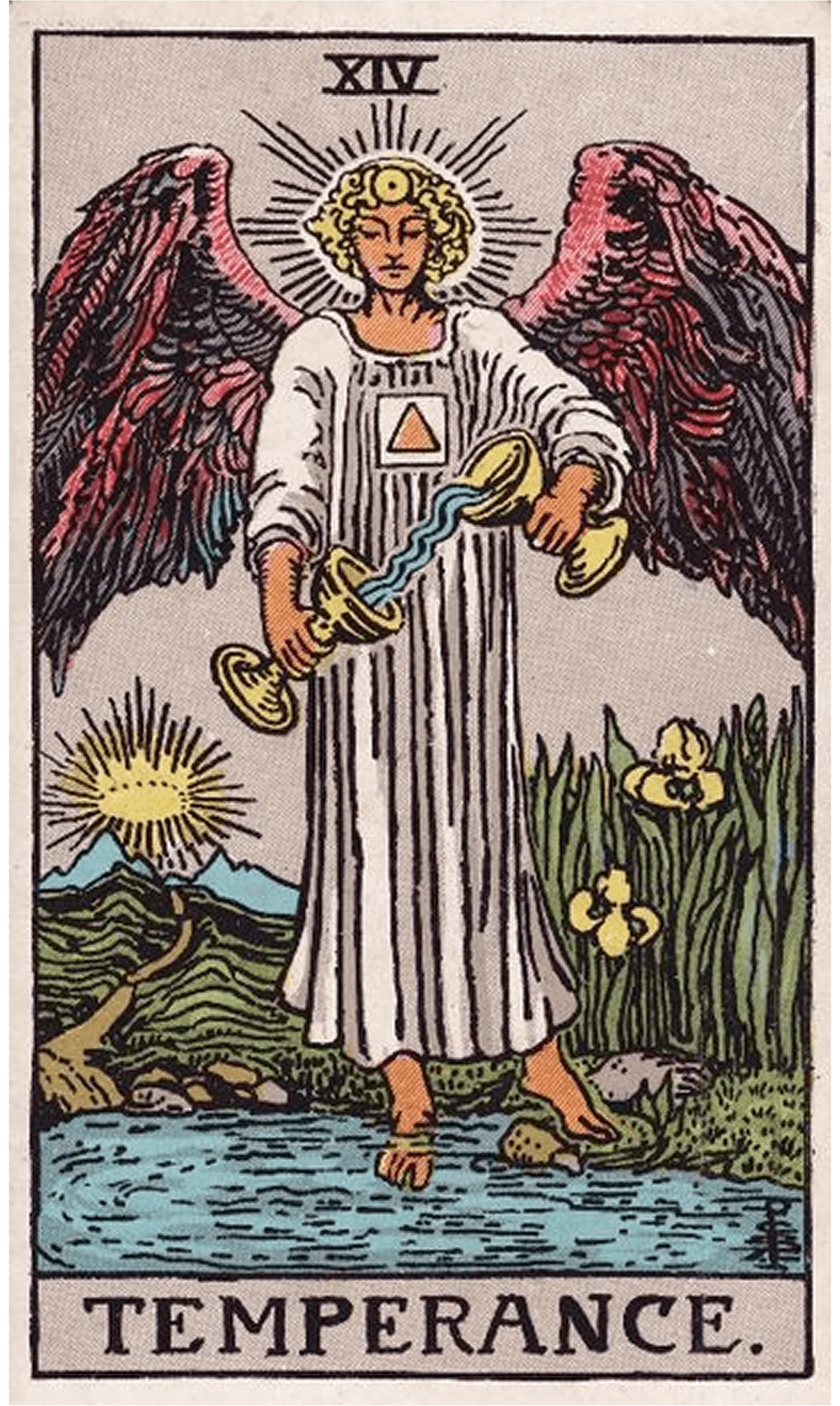
The Arcana depicts an Angel with two cups in hand, the contents of which are constantly poured from one cup to the other, as the upper vessel, filling up, changes places with the lower one. Thus, life pours from the visible into the invisible and back. The sun (or a beam of light) on the angel's forehead controls the flow of water, which, being raised by the sun's rays into the air, returns to earth as rain, to be raised again, and so on ad infinitum.
The interpretation of this card is connected with the form of a circle, which symbolizes a constant closed creative process within itself, leading to the transformation of the world and redistribution of resources in it in their new quality. This is a constant flow of vital forces in nature and the necessity for Life of mixing elements.
This is the card of higher alchemy, Magnum Opus; it corresponds to the principle solve et coagula – dissolution and combination, reunification on a new level of what was disunited. A state where material and spiritual, worldly and heavenly combine naturally and harmoniously, and nothing is suppressed. The meaning of life flows from one vessel to another, the contents of the soul – from body to body, from incarnation to incarnation, symbolizing the flow of past through present into future. Successfully connecting past and present, unlimited possibilities can be realized. This is also the softening of the soul. It must truly become like a beautiful blade, combining flexibility and firmness. Successful combination of past and present experience into a beautiful whole, dissolution of the heavenly in the worldly and the worldly in the heavenly, androgynous union of masculine and feminine principles, successful combination of opposites. The impossible is easily given; liberation from unbearable tension comes.
Temperance urges us to listen to signs to feel our true path and not allow public opinion to govern us. The angel is a mediator and messenger of God's will; from a psychological point of view – that part of the personality that connects us with our own innermost essence, helps to understand it. Filadoro writes that the angel's wings are the impulse that frees us from routine, allowing us to understand the needs of the spirit and yield to them. Under Temperance go the search for one's 'center,' the very foundations of being, the nucleus of creation, the inner 'stone of the temple.' This is the Great Work of alchemists, work on oneself, transformation of the psyche, Transfiguration, alchemical transformation of the soul.
This is the skill of balancing earthly needs and the needs of the unconscious (standing with one foot on earth and the other in water). Sacrificing one for the other, a person loses wholeness, becomes one-sided and barren. Transformation of 'base material' into something elevated and special. Through Temperance, synergy of 'two cups,' two sides of life is established so that one can enjoy it.
This is also subtle alchemical interaction with the mystical beloved, Anima or Animus, a deep experience of intimacy. The inner impulse – reunification on a new level of what was disunited, combination of opposites at a higher level. The card indicates the necessity to activate certain sides of the personality that have so far been hidden, suppressed, or neglected, to restore balance and consciously supplement one's actions with something opposite, and the spectrum of internal perception – with a new point of view. To come to terms with oneself, to enter into resonance with the Cosmos (this means that the lesson of the Hanged Man, which forced one to look at what is happening differently, has been learned). Achieving this is impossible without constant work on one's personality and deep (simultaneously rational and intuitive) understanding of one's own behavior.
The androgynous nature of Temperance corresponds to the 'alchemical wedding' of the Lovers – fire and water become one whole; moreover, they become 'each other,' i.e., total mutual exchange is realized. Even simply drawing in imagination a portrait of an ideal partner, the inner feminine emotionality discovers its masculine outlines, and the masculine – feminine.
The meaning of this Arcana connects the Sun and the Moon (masculine and feminine, conscious and unconscious spheres) – the clear daytime reason of the Sun and the lyrical emotions of the Moon. On the card, this idea is symbolized by two cups – golden and silver: a stream from the first pours into the second. The gold of the Sun, representing spirit, transforms into the silver of the Moon, personifying soul. An idea from the spiritual sphere passes into the soulful, and a flow of emotions promotes further embodiment of thought. The fluid flowing between the vessels is the nectar of immortality or living water.
In many decks, the Arcana of Temperance depicts a cauldron, reminiscent of the magic cauldron from fairy tales, from which heroes emerged transformed, young, beautiful, invulnerable. Such changes do not occur without pain – all egocentric and empty must boil away and be washed away, and only after this proper 'bath' will the person be reborn, like a phoenix. In its depths, Temperance is as strong as steel. The arrow, also often depicted on this Arcana, points to the search for the spirit hidden in matter and symbolizes the internal process of awareness occurring as a result of the Great Work. The rising sun in the background, shaped like a crown – a symbol of spiritual rebirth, dawn of consciousness, the Mystery of Eternal Life. A road leads to it from the reservoir where the Angel stands – the path of Temperance. Blooming irises are considered the Western equivalent of the lotus, water lily. This is a symbol of non-identification with anything and refusal of illusory belonging to any one world. The lotus reminds that everything in this world proceeds from one another and alchemically connects all elements: roots rest in the earth, stem is in water, leaves are open to air, and the flower reaches for the sun. Stones also carry semantic load. They are connected with the Earth, which gives strength and a point of support, and are endowed with powerful healing power.
Harmonization of one's ideas, previously seeming impossible, overcoming total contradictions, removal of internal resistance, exit from an insoluble situation, healing from extremes of antagonism. This is great creativity and a decisive step on the path to karmic healing (while one must not cling to banal truths and social attitudes – everything is a bit subtler and deeper).
This seems somewhat doubtful, but there is an opinion that Temperance astrologically correlates with the sign of Sagittarius, 'affirming a high worldview in the world, and with the concept of human genius, effecting progress. Sagittarius, as a conductor of Heavenly will on Earth, reveals the idea of evolution (descending movement of development): - this is the path of an idea to earthly reality. Since Sagittarius is a rational sign, it can also be compared with that circle of mental knowledge drawn around oneself by the Magician, to protect from unclean forces those entities that he calls forth with his psychic activity and communication with which is fraught with surprises.' Sagittarius is an ideological sign; it promotes high spiritual achievements.
In a deep sense, reversed Temperance is the river of time flowing backward, allowing one to return to the past and enter the stream of life not from where one exited. The Angel's actions indicate the cycle of life in which the spirit is purified. But, of course, this occult meaning rarely manifests, besides, it has its price (risk of losing balance).
Occult and spiritual meaning
This is a stage in personal development that symbolically follows 'Death.' By and large, it occurs when a person has already suffered and learned so much that they have 'died' for the mundane world and come alive for the heavenly, and therefore can find genuine peace. Using an angel as the primary figure symbolizes the idea that we are capable of rising to an angelic level if we manage to learn this lesson. Sometimes this literally means a cardinal spiritual transformation through faith, conscious election of 'angelic living' (monasticism) and loss of interest in worldly goals. But it is not necessarily connected with turning to the church. People emerge from intensive care wards in approximately the same holy and quiet state, having almost lost their lives and thoroughly revised their values.
In reality, we are terribly tenacious, and the 'murderous' events symbolized by the thirteenth Arcana repeat in life repeatedly and very diversely. They can look like shaken health, loss of a job, end of a relationship... After we have been 'killed' by some очередной of our Deaths (XIII), we always choose with whom to continue our path – with the Angel (XIV) or with the Devil (XV). At this point in the deck, the path branches. The Angel offers the path of humility, wise acceptance, calming, forgiveness, and release. The Devil – the path of rebellion, passions, a 'scorched road,' following which a person strives to find their happiness in struggle, but in essence gives their soul to be torn apart by lower astral entities (becomes a slave to instincts) and degrades. If we choose the path of the Devil, retribution finds us faster, hence the next Arcana is the Tower. Angelic retribution delays longer; it is carried by the Star. If Temperance falls after a problematic card, it is victory over the vicissitudes of fate and an exit onto the path of correct actions (this is well known to all whom a merciful guardian angel has somehow led 'out of the abyss,' from where they already did not hope to escape).
On the Arcana, essentially, a Spiritual guide is depicted, the precise inner voice that says what is good and what is not, and where in everything is the measure. This is a guide on the road of life, a Guardian Angel, instilling confidence and leading precisely along the path one must move.
Despite its seeming simplicity, Temperance is one of the most complex Arcana. It seems to personify calm and smoothness, but the paradox is that its true meaning can be comprehended only in the very thick of a harsh test of strength, when it seems that all reserves of this very strength have long been exhausted. The figure of this Angel is discernible not so much in itself as against the background of hellish glow, incinerating life, or some part of it. To discern it against the background of everyday life is the highest skill, a precious skill acquired at a rather high price.
Temperance describes the basic processes of inner learning and growth, or rather – that moment not subject to will, when a mass of disparate skills merges into a single whole and... we have learned! Finally, what we struggled with, tormented ourselves over, thought about for a long time, suddenly becomes illuminated by light, folds into a single new understanding.
An imperceptible transition from quantity to quality occurs, and it is not for nothing that Temperance is the card of alchemy and transformation of the psyche. The inner transformation according to Temperance is externally barely perceptible; it is intimate. This is primarily the resolution of some internal conflict, the calming of insoluble internal resistance, an exit from a vice. Through Temperance, genuine harmony is established between desires, feelings, thoughts; the process of personality integration, restoration of wholeness occurs; an optimal wise line of behavior is developed, largely related to self-control. Generally, a sense of measure is a wonderful antidote to many physical and spiritual problems, the power of which we usually underestimate. In fairness, it must be said that this Major Arcana is also often underestimated among others.
Temperance embodies both law and miracle simultaneously. No problem can be truly solved at the level of thinking (with that 'approach') that generated it. To achieve a solution, one must rise above obvious and superficial concepts, reach a qualitatively new level of understanding. Only in this way is liberation from tension achievable; only this becomes a step towards healing. Temperance often falls to people in whose life, until very recently, turbulent changes occurred, some cardinal restructuring was underway, and events replaced each other at such speed that there was no time to analyze what was happening. But now, after all these life storms and troubles, a stage has come when life flows evenly and unhurriedly. And this change of rhythm, of course, has affected consciousness and perception of the surroundings. Appearing in a spread, Temperance says that patience, reflection, and calmness are required from the querent in any case.
The value of cooperation, the ability to usefully perceive another's point of view. Respectful and friendly relationships. Stepping back from selfish disputes, struggle for power, from bustle and chaos, resolution of conflicts. The necessity to compromise, removal of contradictions and resistance.
A true 'alchemical' team, where everyone complements each other and actualizes their own and others' potential to the maximum. By the way, the team itself may be engaged in activity more associated with the Tower than a quiet backwater – this could be a team of surgeons, a fire brigade, or a sabotage group behind enemy lines. But the ability to perfectly coordinate one's actions goes precisely under Temperance. It helps to optimally employ all available resources to achieve a positive result. Sometimes, under this card, a merger of organizations into a single new whole occurs.
A profession requiring calmness, self-possession, the ability to behave precisely and cautiously (what is called 'by protocol'), or very precise coordination in movements (sometimes truly jeweler-like). This could be a microsurgeon, a scout, or a graphic artist. A profession related to establishing proportions and correspondences (e.g., pharmacist, homeopath, aromatherapist), with relaxation and healing (SPA). Of course, healers fall under Temperance. Also, people who know about 'mixing products' – cooks, chefs.
Mediators, peacemakers, 'team builders' – specialists in establishing team cooperation, casting specialists, personnel selection.
Teacher, guru. Teaching talent.
Since Temperance is connected with the 'right measure,' it can involve activity related to calculation, evaluation, compensations, and the like.
Balance between work and rest. No extremes. Peaceful, serene, easy, and calm execution of tasks previously solved in a regime of terrible tension and stress. No division into important and 'extra' tasks (capable of leading to a nervous breakdown when 'extra' tasks seemingly prevent one from proceeding to important ones) – every task is important and worthy of being done well.
'Rich is not he who has much, but he who has enough.'
Temperance hints at a regime of economy in finances and rarely pleases those dreaming of great wealth. However, it is understood, felt, and valued by those who have experienced losing financial balance, usually due to their own carelessness and intemperance.
Having tasted the bitter consequences of extravagance, having experienced fear and the impossibility of making ends meet, a person welcomes acquired thrift, self-control, and prudence as best friends.
Temperance gives the ability to live, having needs corresponding to the current position. It puts an end to self-indulgence and gives a start to the leveling of money matters after shocks. Economy, reasonable housekeeping.
Balance between earnings and expenses. Willingness to help others.
May mean successful contacts abroad: trips, business relationships, or even relocation ('mixing of cultures').
Temperance seems dispassionate, meek, and submissive.
It describes a situation where balance, goodwill, and understanding reign between partners rather than 'African passion.' This may seem boring, but for those who are already fed up with African passions and torn to pieces by them, the soft light of Temperance is indeed like a gift from heaven. A merciful Angel has flown by, waved a wing over the battlefield, and peace has reigned. This is a card of healing mental wounds (sometimes practically mortal) that people managed to inflict on each other. Compromises, measured actions, and absence of rough unnecessary movements under Temperance usually come when people have already caused each other considerable acute pain. By the way, sometimes Temperance also speaks of blind adaptation, when partners desperately try to adjust to each other so as not to upset again (or one of them does this, but cannot understand what the other needs).
The main function of Temperance is maintaining a person's physical and spiritual life. Therefore, it is a most powerful card of healing and rebirth. If the question concerns health, mental or physical, then Temperance means good well-being or recovery.
Mental and physical health, the body as a temple of the soul (the question is how much you respect the soul), hence a sense of measure and a healthy lifestyle. Moderation in everything, the ability to be sober, to keep a diet, to deny oneself a tasty morsel of incorrect behavior. This is not cruelty and asceticism, but the ability to wisely handle one's own body. The image refers to the ancient tradition of diluting wine with water (at that time it was believed that undiluted wine was drunk exclusively by intemperate people, drunkards).
This card describes the restoration of lost connections with the body, the possibility to hear it again, to understand. Meditation, merging with the flow, silence and serenity, when nothing knocks one off course. Rest and purification of the body and soul. Renewal of spiritual and physical strength. Softening, relaxation, restoration. Healing reflection, concentration and contemplation, evaluation, reflection, and abstinence from unnecessary actions.
By and large, Temperance is a highly healthy and healing card, and in a diseased context, it can be interpreted rather if it fell to an obviously unhealthy person as the source of illness. It can speak of stagnant phenomena in the body, metabolic disorders. Most literally, Temperance corresponds to the kidneys and everything connected with them (two 'cups' and pouring 'water').
Temperance is psychosomatic – as the state of the body affects the soul, so the mental state is reflected in the body. Temperance often falls to people who have shaken their health by disgraceful treatment of it, whose life looks like one continuous extreme situation.
May indicate a recovery period, postoperative, when a person must observe not only dietary restrictions but also care and caution even in movements (e.g., so that stitches do not come apart). Reversed Temperance is considered one of the indicators of infertility (in an astrological sense – something like a debilitation of Proserpina, disruption of 'internal alchemy' processes). In the upright position, it sometimes relates to conception and reproductive abilities. The fluid in the jugs symbolizes the vital fluid, liberated from the bodily shell.
Lack of harmony, inability to integrate, disunion or unsuccessful alliances (e.g., socially unacceptable partnership, problematic marriage, rupture of relationship, destruction of family). Here, by the way, it's not far to other 'bad excesses.' Ill-considered actions, a tendency to excess. Prodigality, excessive expenditure of strength and means, unbridledness. Energy imbalance. Reversed Temperance says that the person has completely lost balance and must somehow restore it.
A large number of tasks at once, which cannot be combined in any way, resulting in stalemate situations where any harmony (at least in the sense of a healthy lifestyle) is out of the question. An unpassed test. A warning that strength will not be enough to reach the goal.
Disagreements, discord, conflict of interests, breakdown of agreements.
Wrong views on life and wrong approach to people. Excessive emotionality, irascibility, sharp change of mood, unreasonable and unpredictable actions, too sharp reactions. Conflictness, flightiness, capriciousness, imbalance. Hostility, incompatibility, inability to adapt and work together with others. Impatience, frustration, disappointments. Fanaticism, stubbornness in one's point of view, ability to see only one side of the coin. Also here – difficulties in study, mastering new views or skills.
As was once wisely noted, reversed Temperance is 'asceticism based on wealth': the case when a person has money, but lifestyle (thanks to which this money, in general, appears) does not allow using them and deriving some good from them for oneself. This is a variant of the 'Order of Poor Knights,' where nothing personally belongs to anyone (and sometimes sways from fatigue and exhaustion), but the organization as a whole amasses unprecedented wealth. Or a powerful person who, in theory, can afford everything, but the position they occupy leaves them no such opportunity.
Under reversed Temperance, various regulating systems can fail, both purely technical and procedural (e.g., financial).
With the Fool – advice to think through actions so as not to repeat previous mistakes
With the Empress – improving relationships, sexual harmony, successful birth of a child. Sometimes – romantic travel.
With the Emperor – the need to show flexibility in communication with people and 'look at questions more broadly.' To reach the goal in a soft way.
With the Lovers – advice not to take the matter too close to heart, to show calm and patience
With the Tower – extremes, ruptures; the action of Temperance is weakened
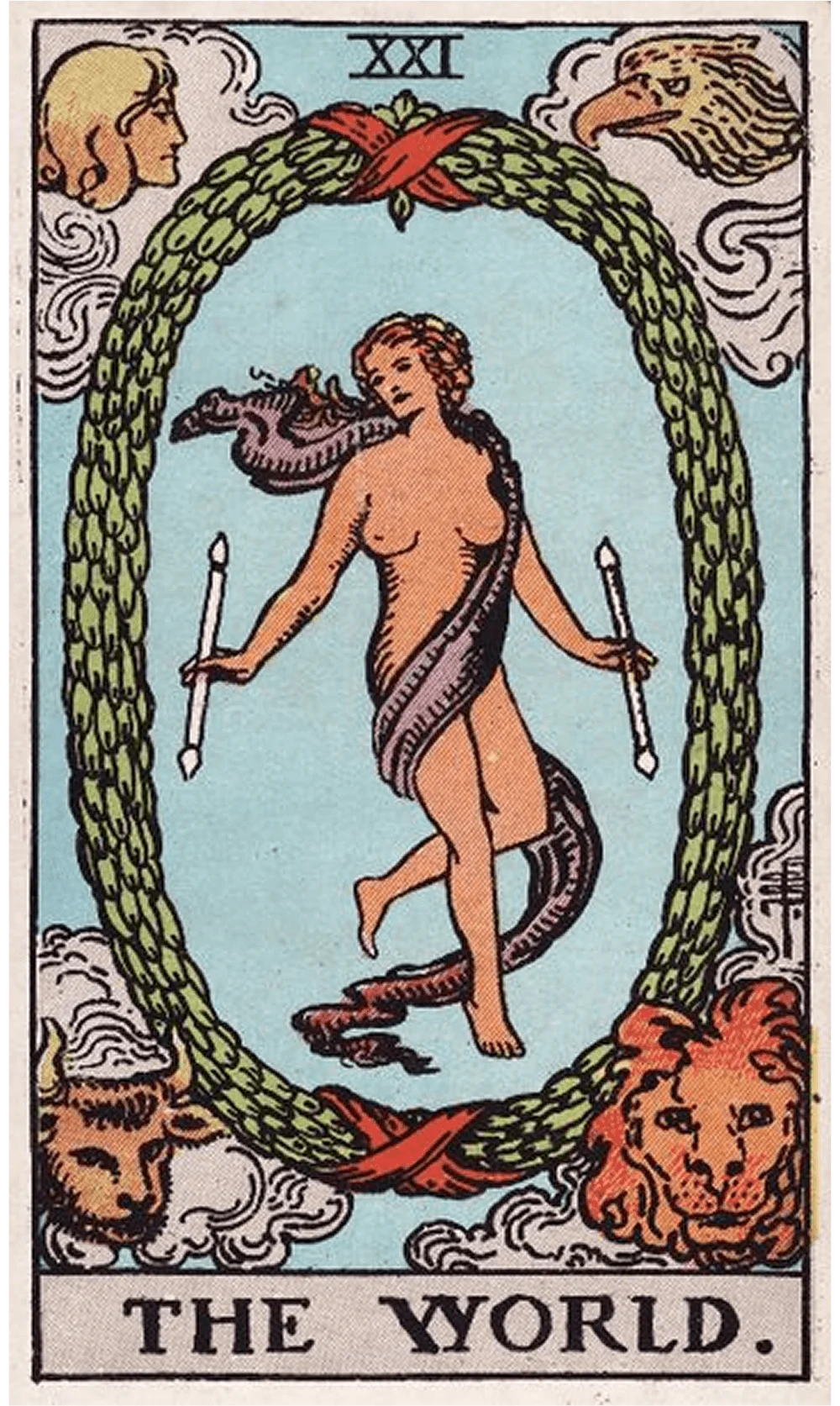
With the World – union, synthesis, healing; a very strong combination
With the Five of Wands – disagreement, rivalry, imbalance; the action of Temperance is weakened
With the Five of Swords – falling out of the general tone, team, disharmony in relationships
With the Ace of Cups – abstinence, diet, sobriety, fasting.
With the Two of Cups – connection, relationships, joint work; the cards mutually reinforce each other
With the Two of Pentacles – finding a harmonious combination; the cards mutually reinforce each other
With the Three of Pentacles – teamwork; the action of Temperance is enhanced
The Philosopher's Stone
Stoic philosophy
Visita interiora terrae rectificando invenies occultum lapidem (saying: 'Visit the interior of the earth, purify yourself, and you will find the hidden stone' – essentially referring to that aspect of the Grail known precisely as the 'stone').
'Test and measure your strengths, but not to retreat before a task, but to overcome obstacles.'
'Physician, heal thyself.'
Archangel Michael
Ariadne (and all allies of the opposite sex who accompanied heroes/heroines on their dangerous path)
Temperance largely corresponds to the appearance and manner of action of 'Johan Weiss' from the film 'Shield and Sword.'
Cards from the same group
The Fool
The Magician
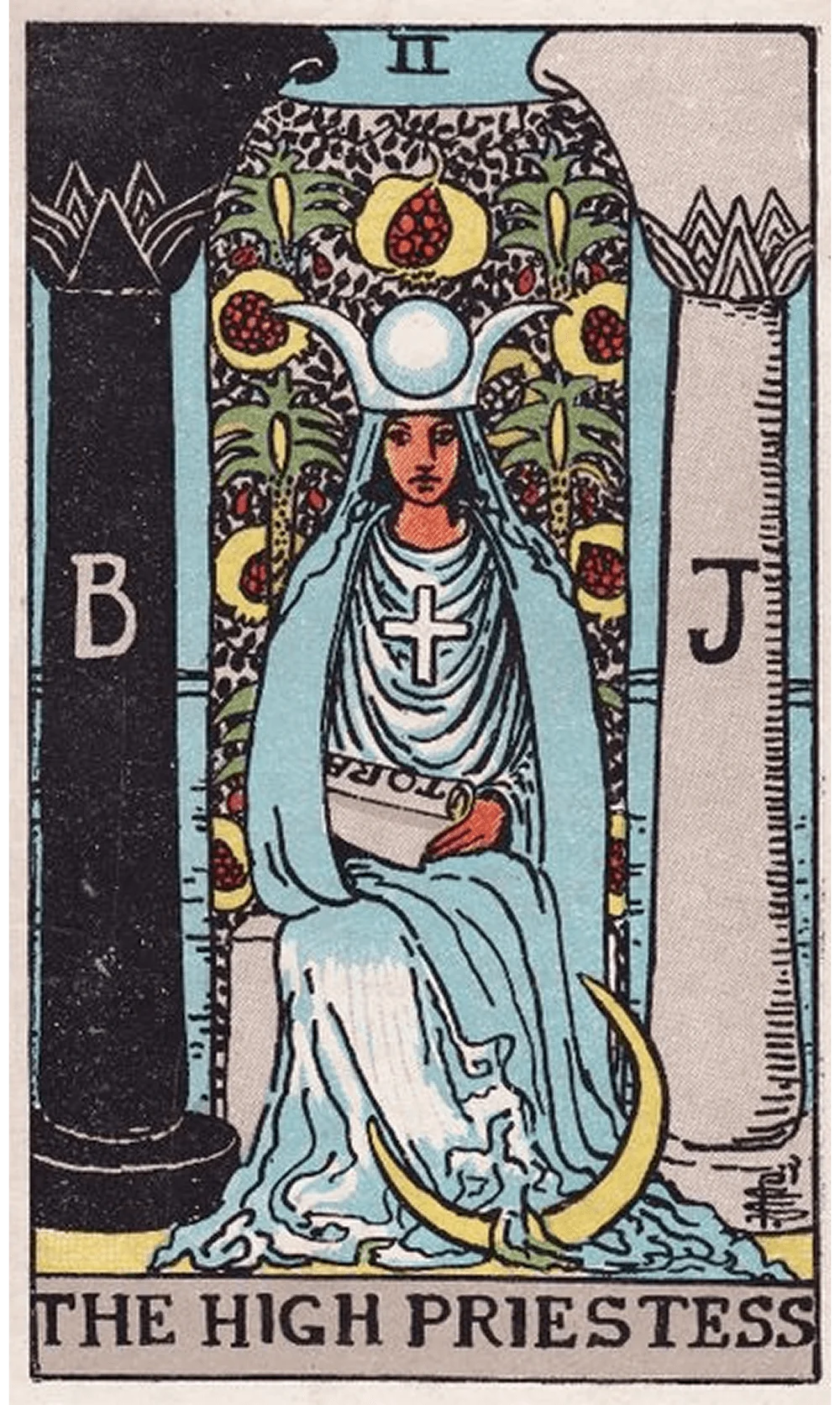
The High Priestess
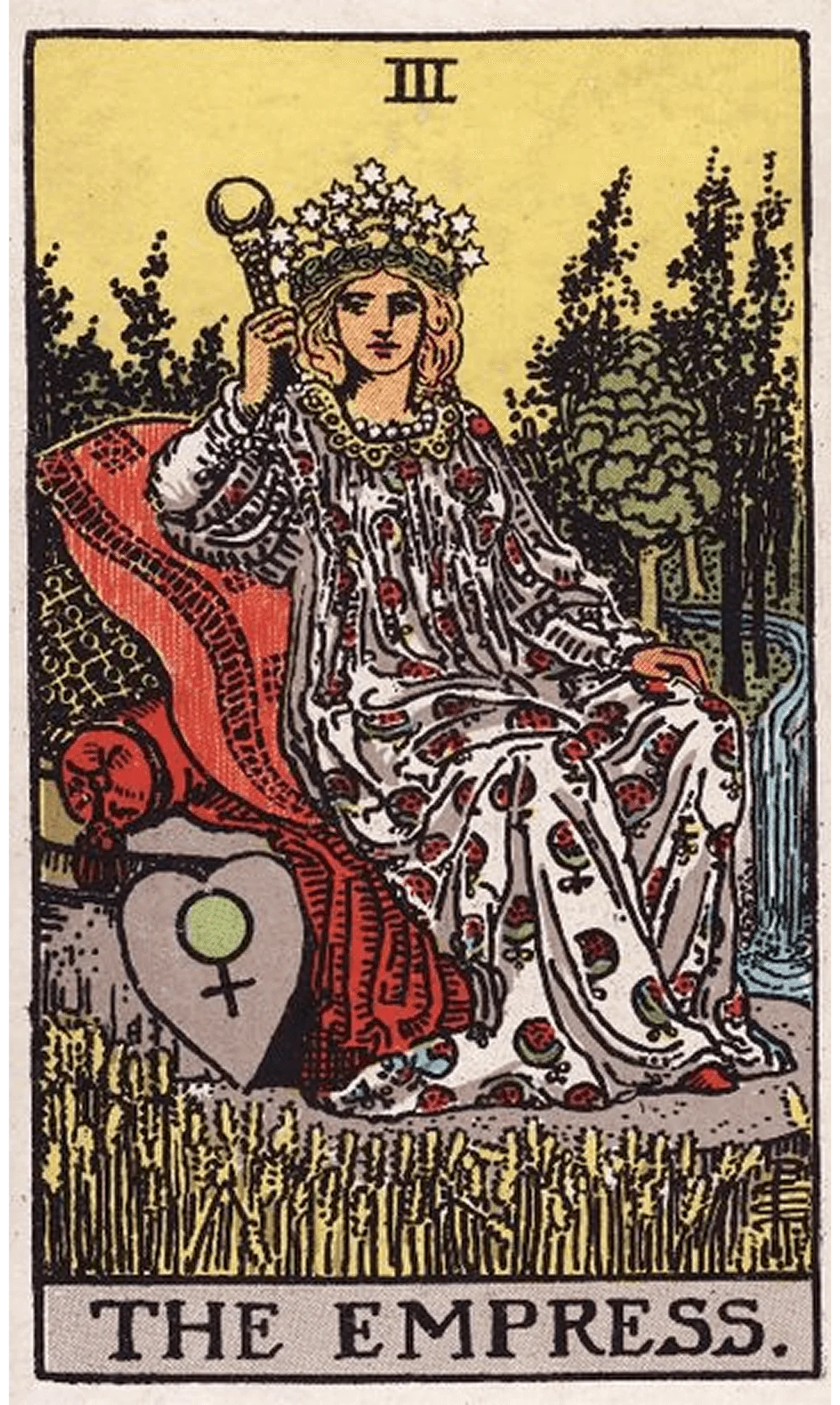
The Empress
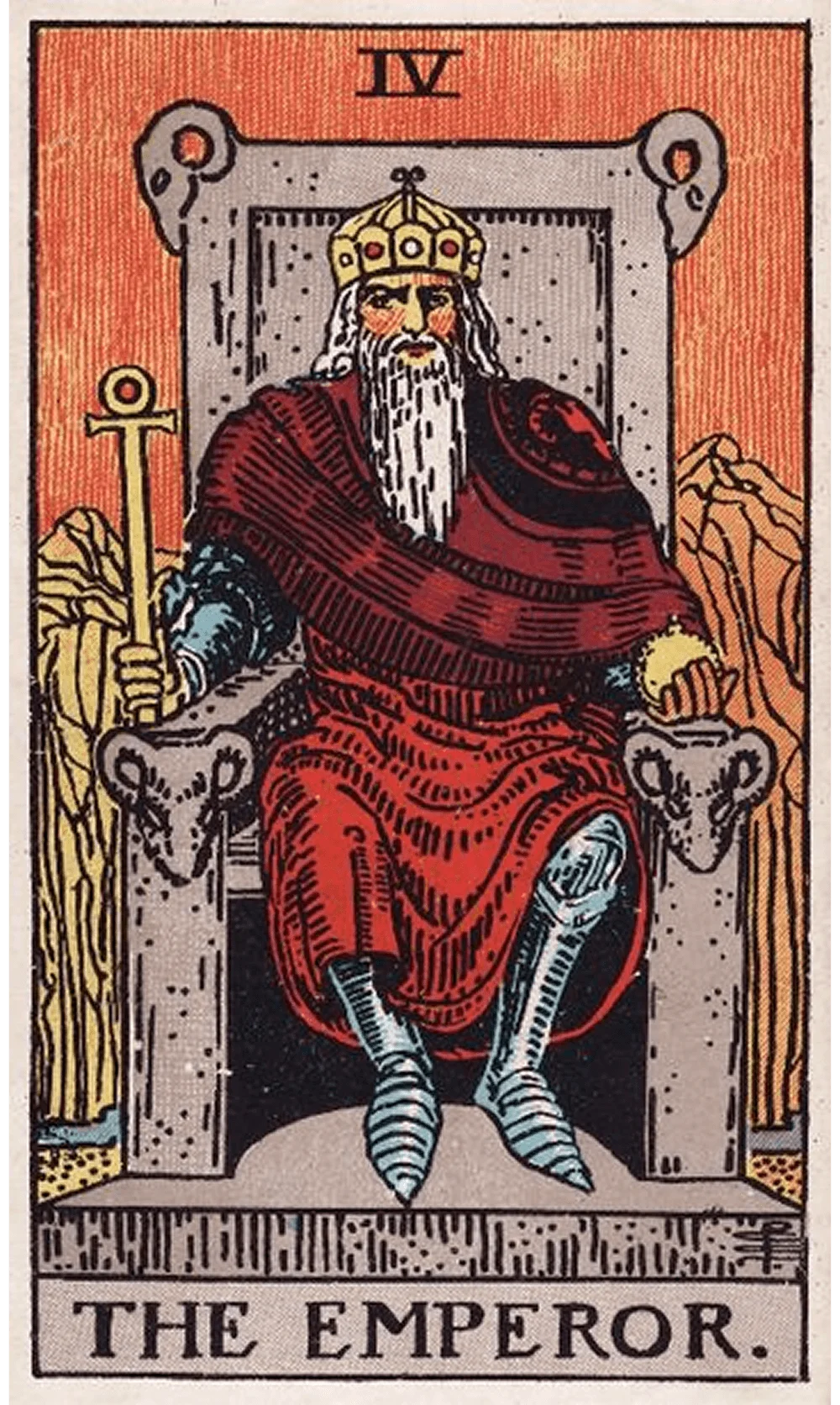
The Emperor
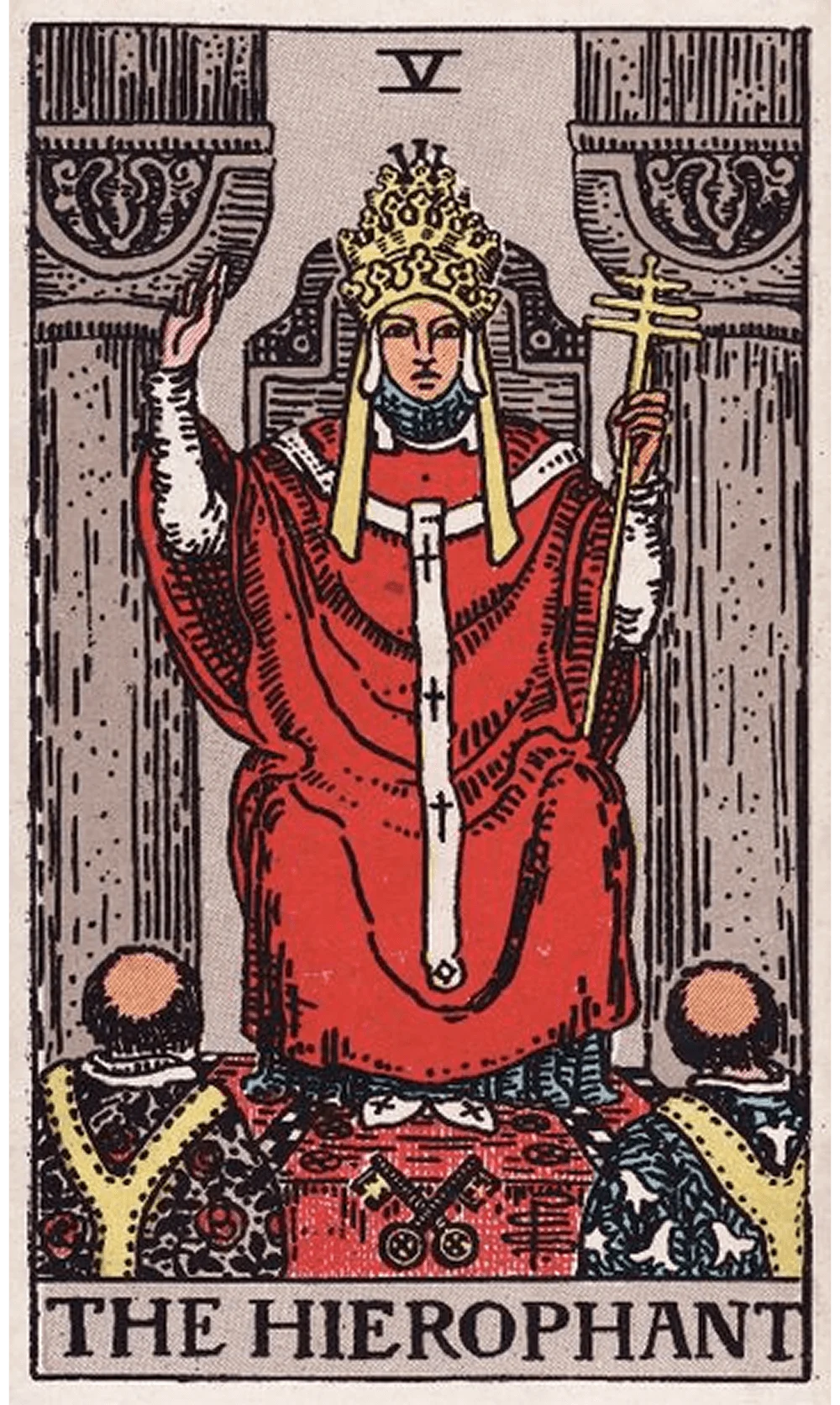
The Hierophant
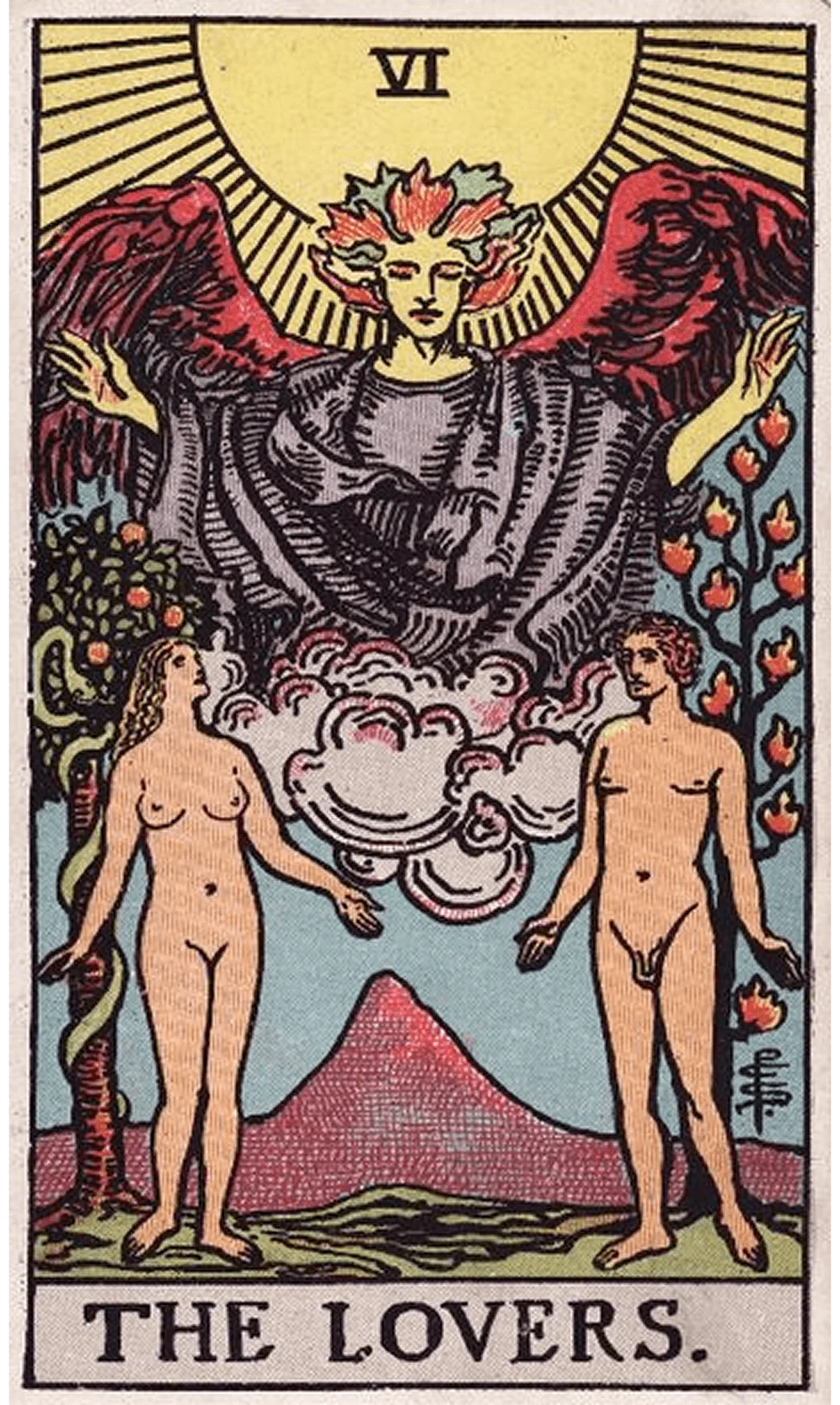
The Lovers
The Chariot
Strength
The Hermit
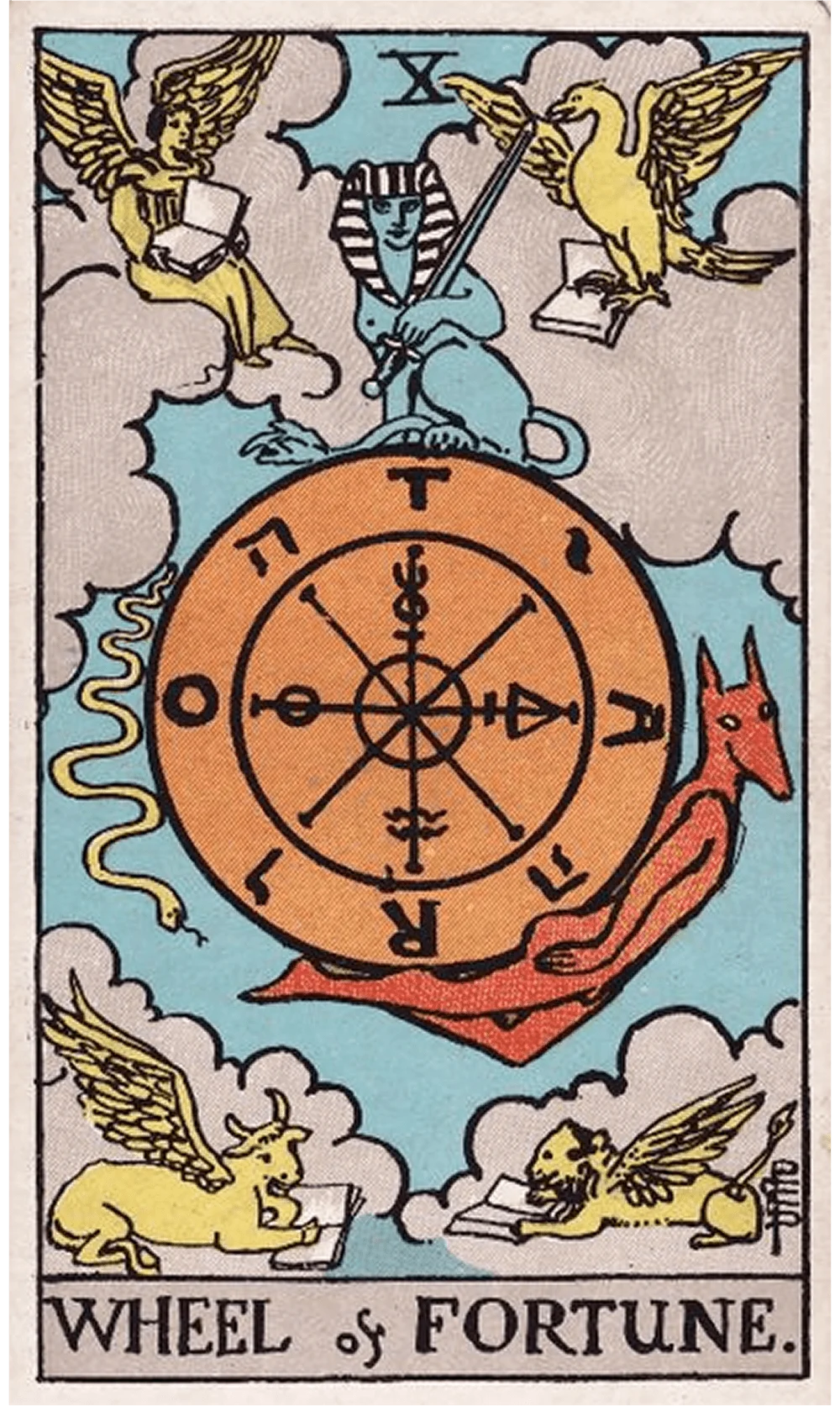
Wheel of Fortune
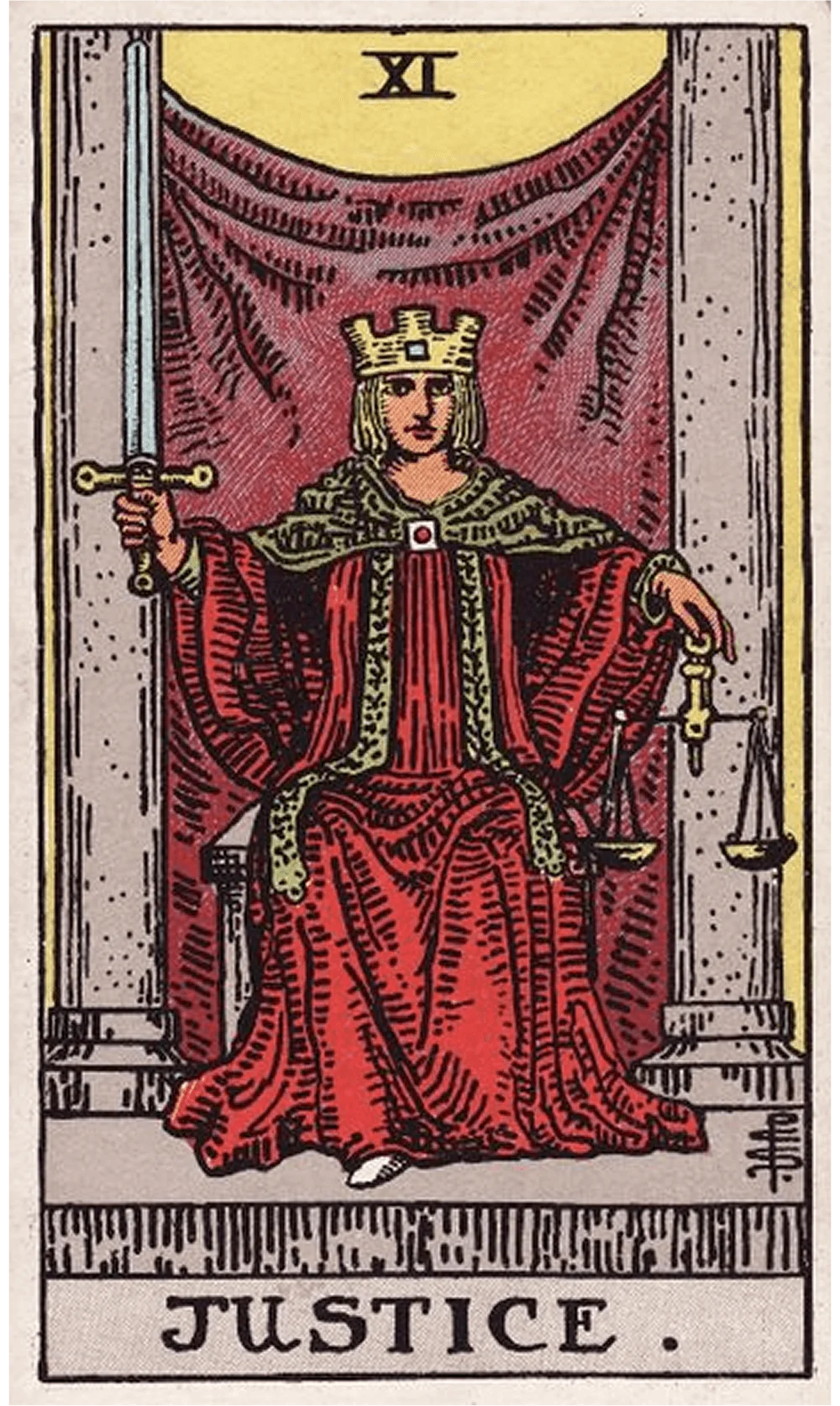
Justice
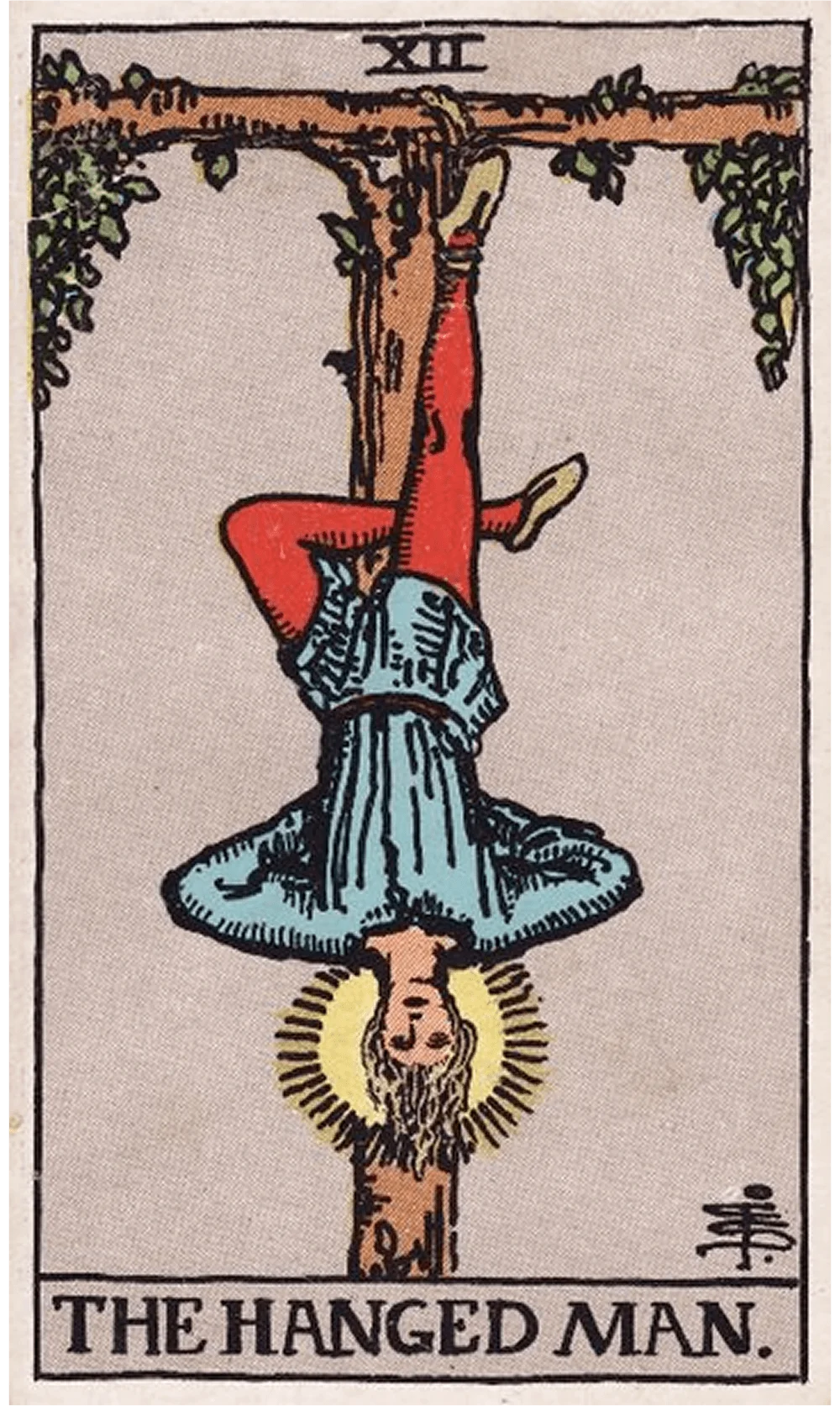
The Hanged Man
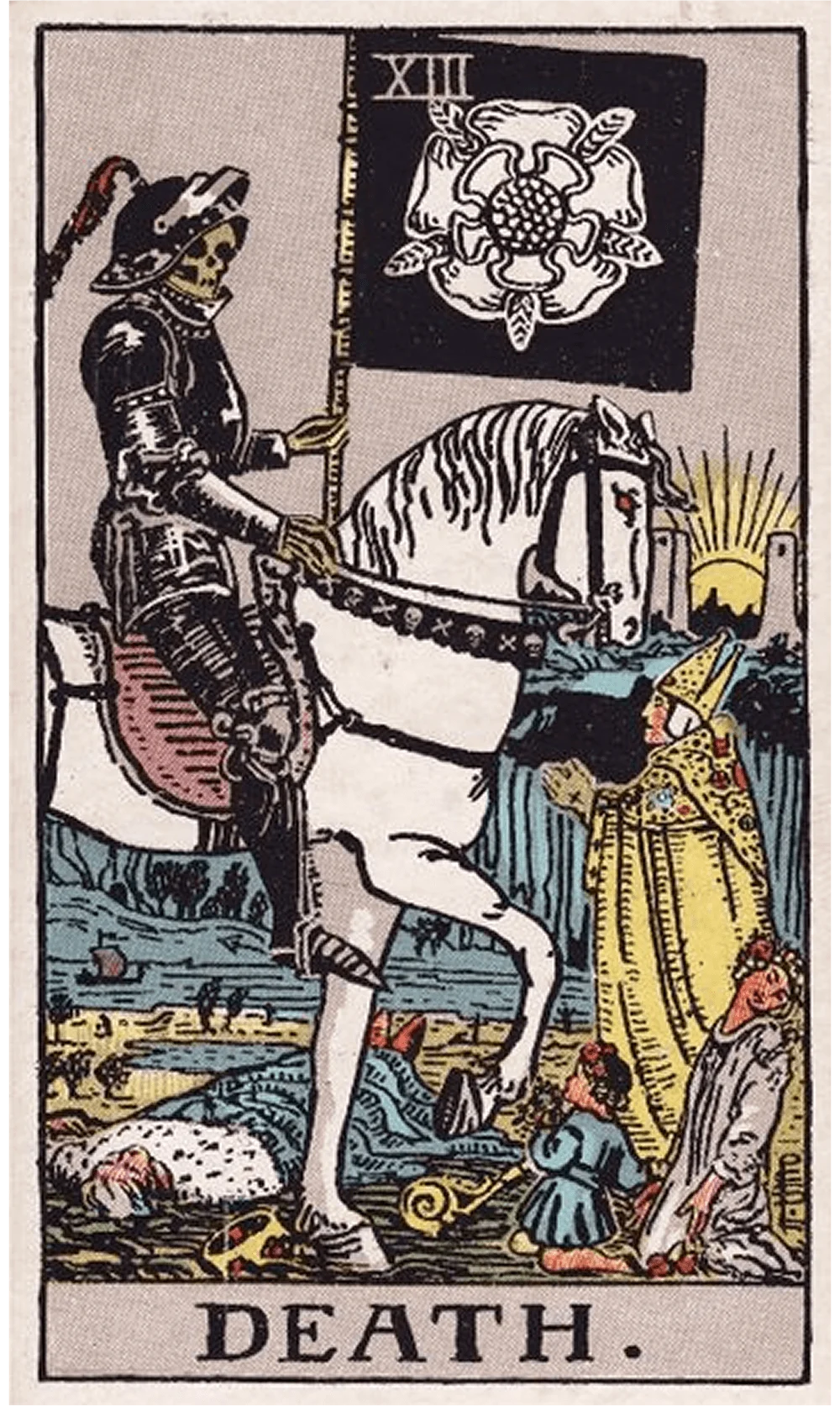
Death
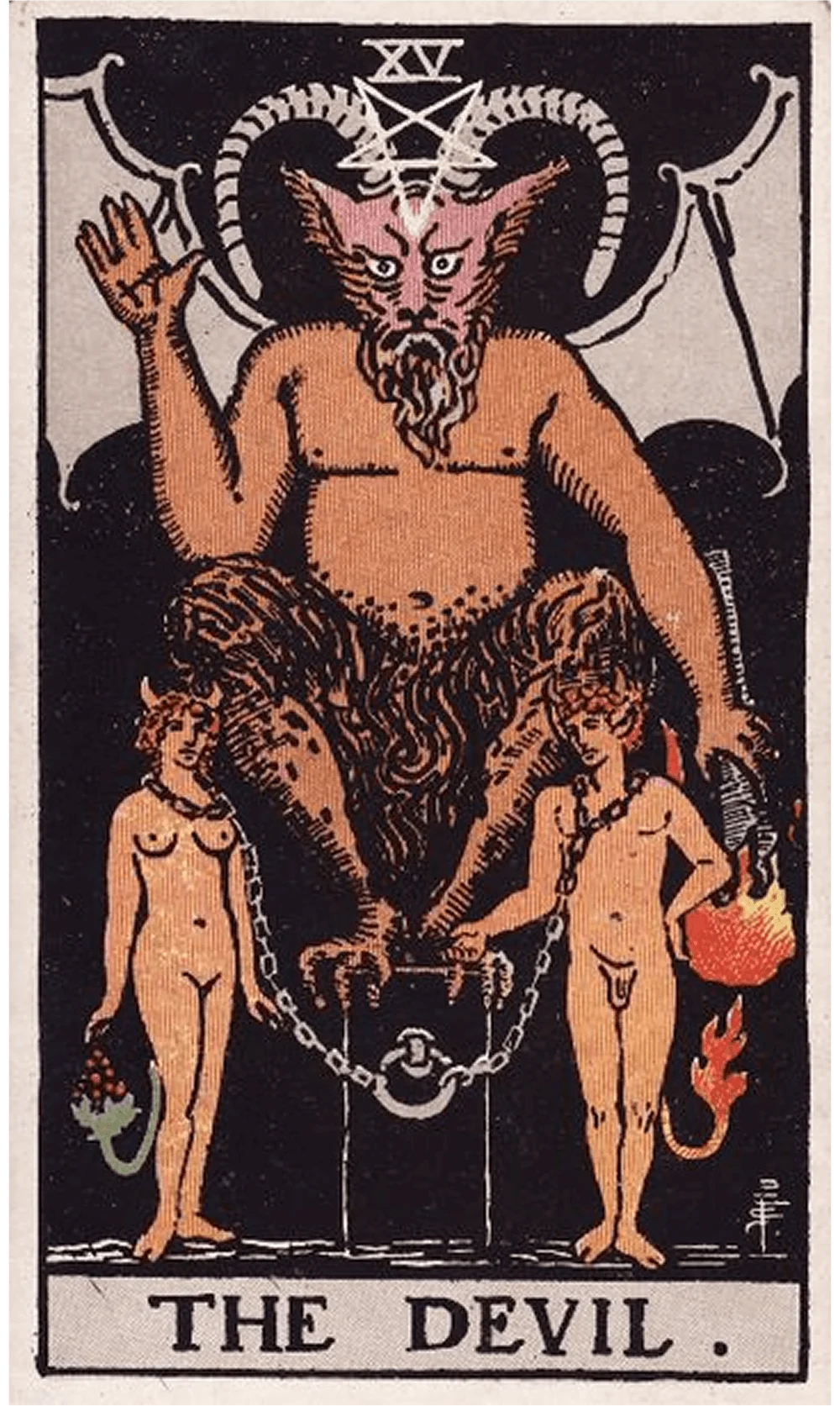
The Devil
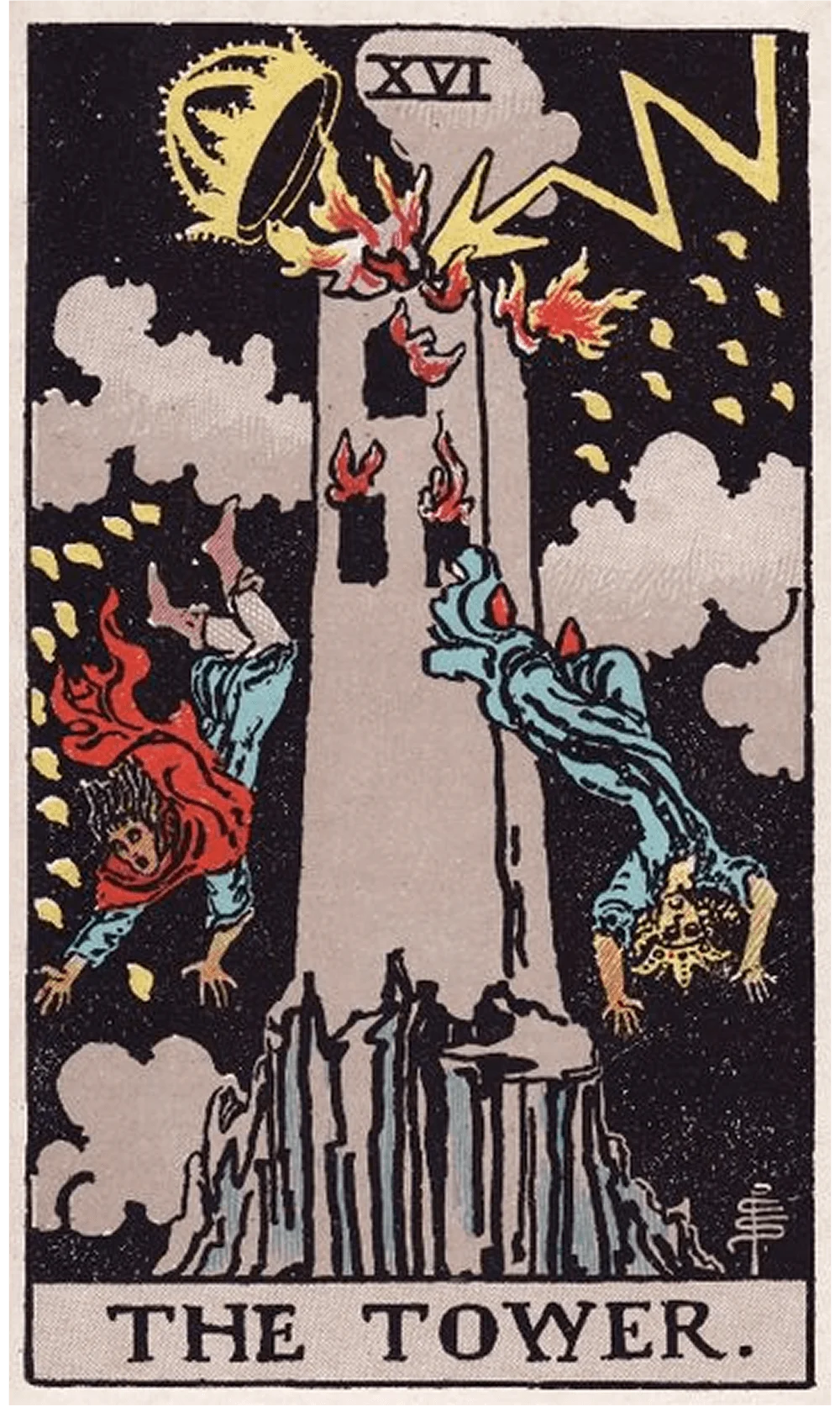
The Tower
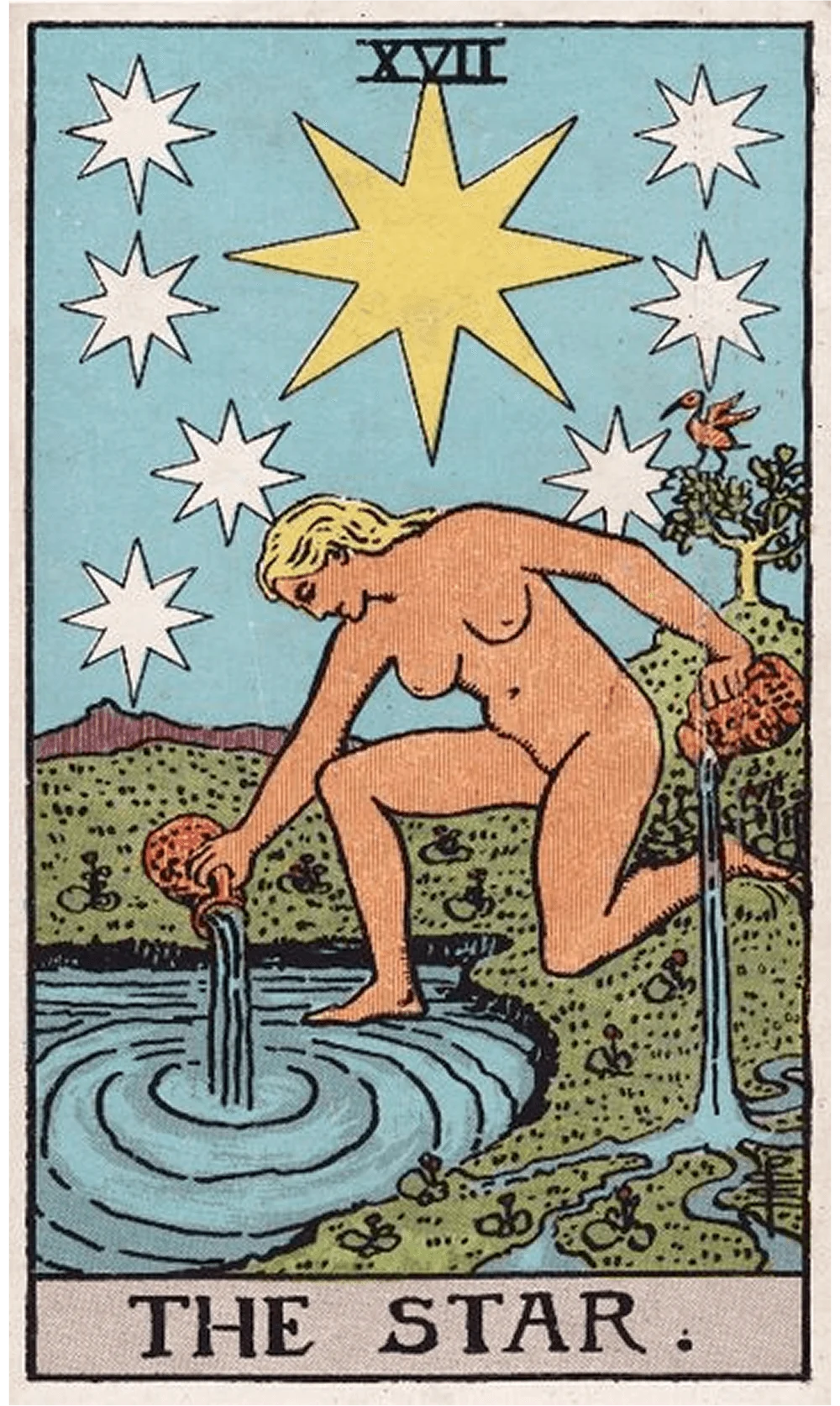
The Star
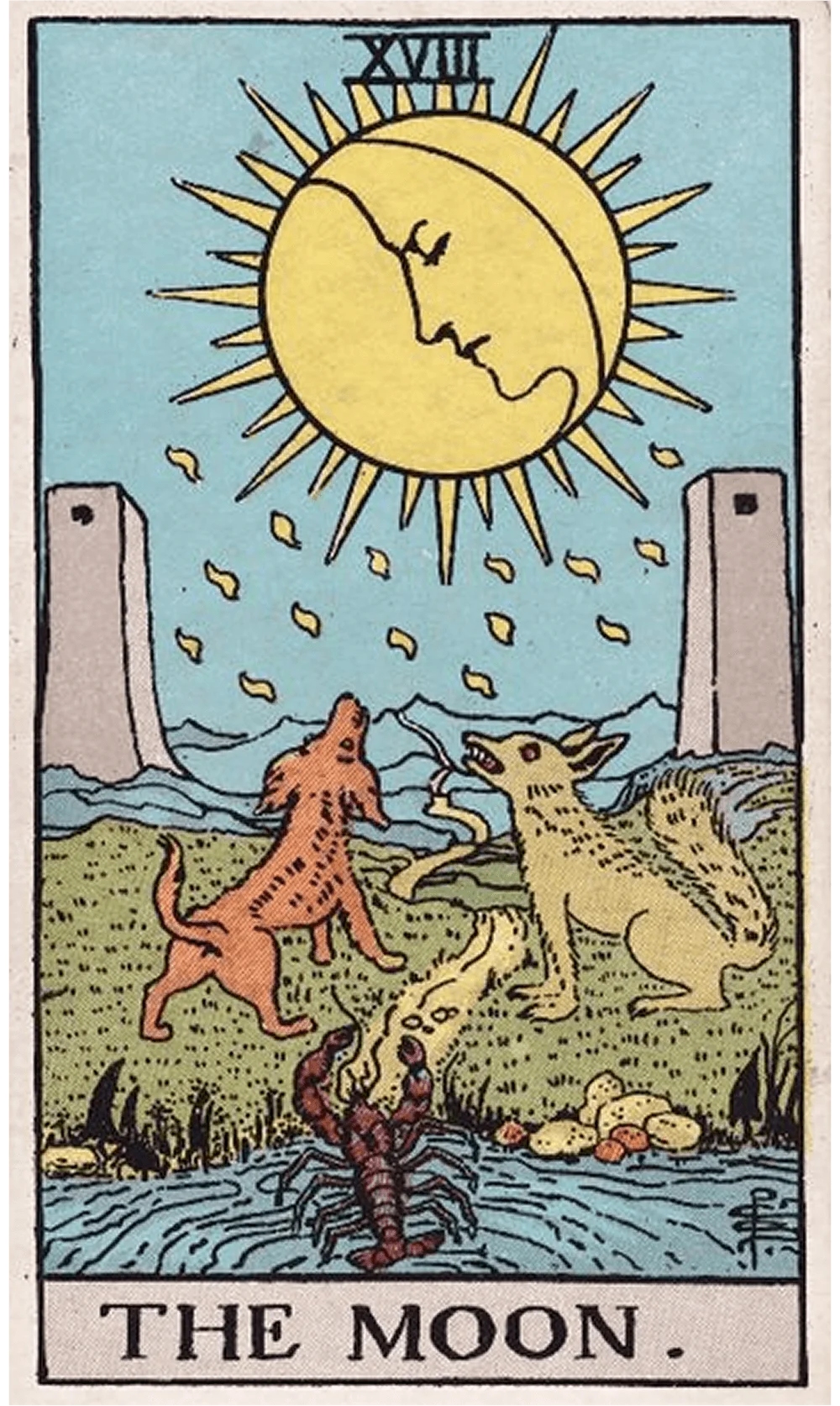
The Moon
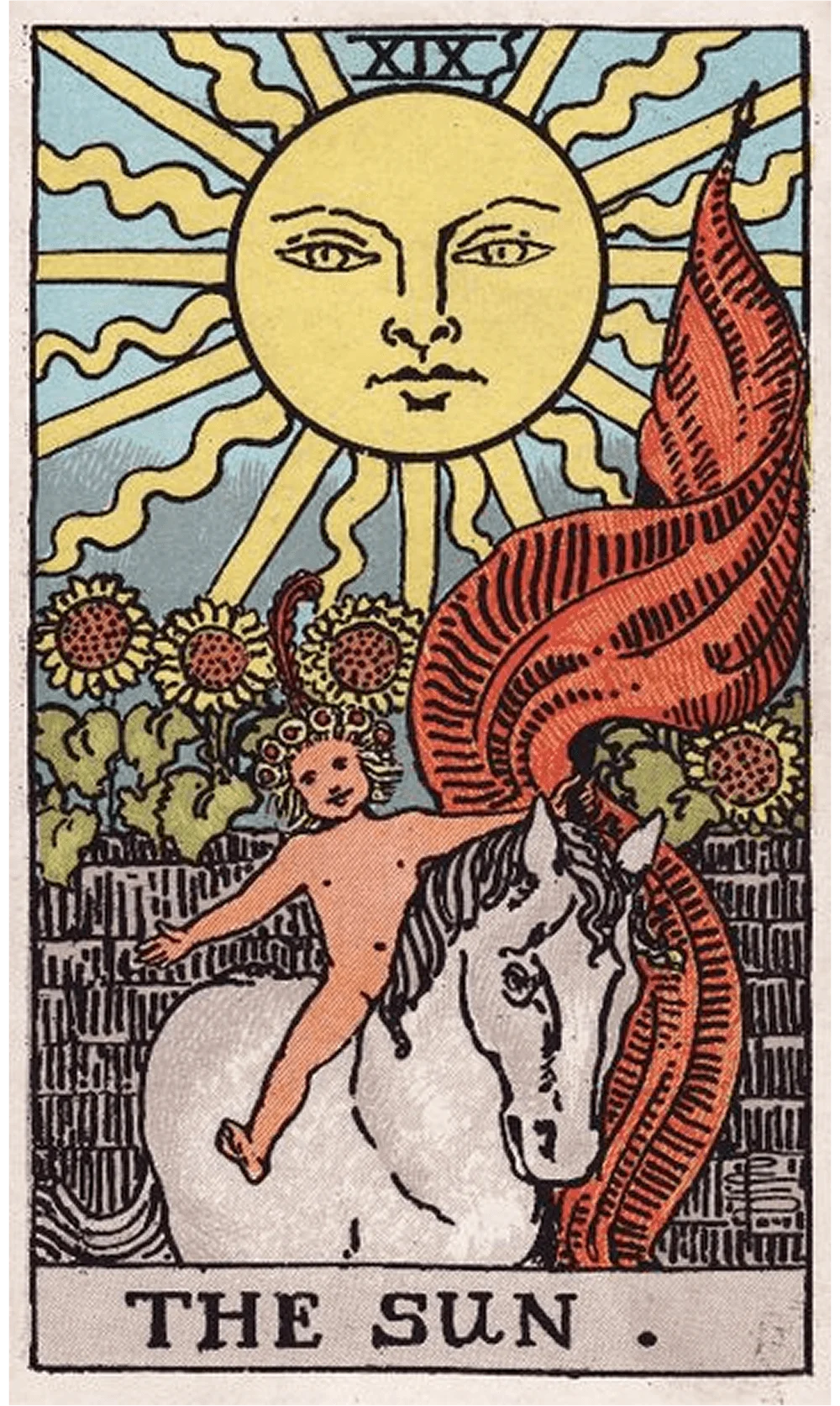
The Sun
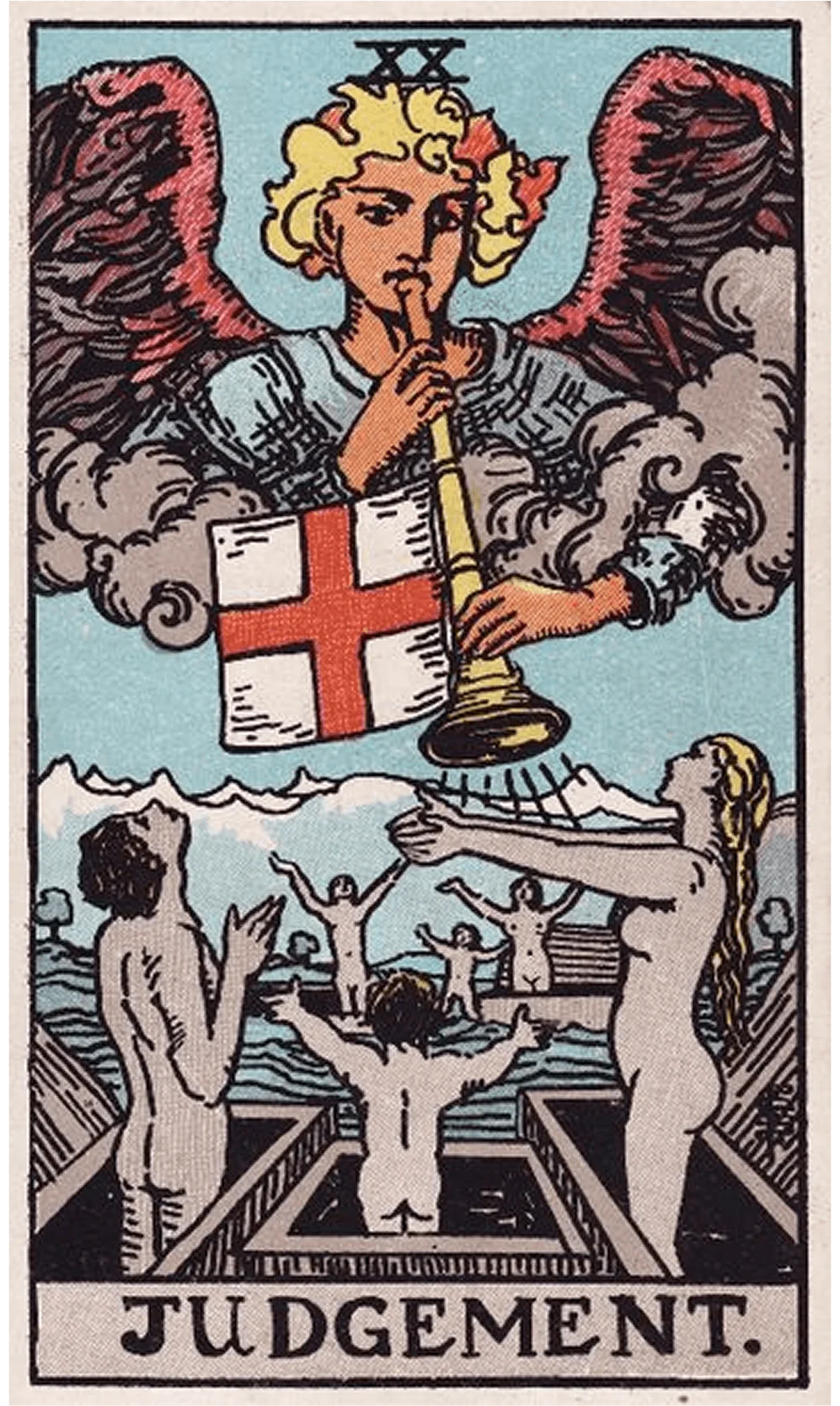
Judgement