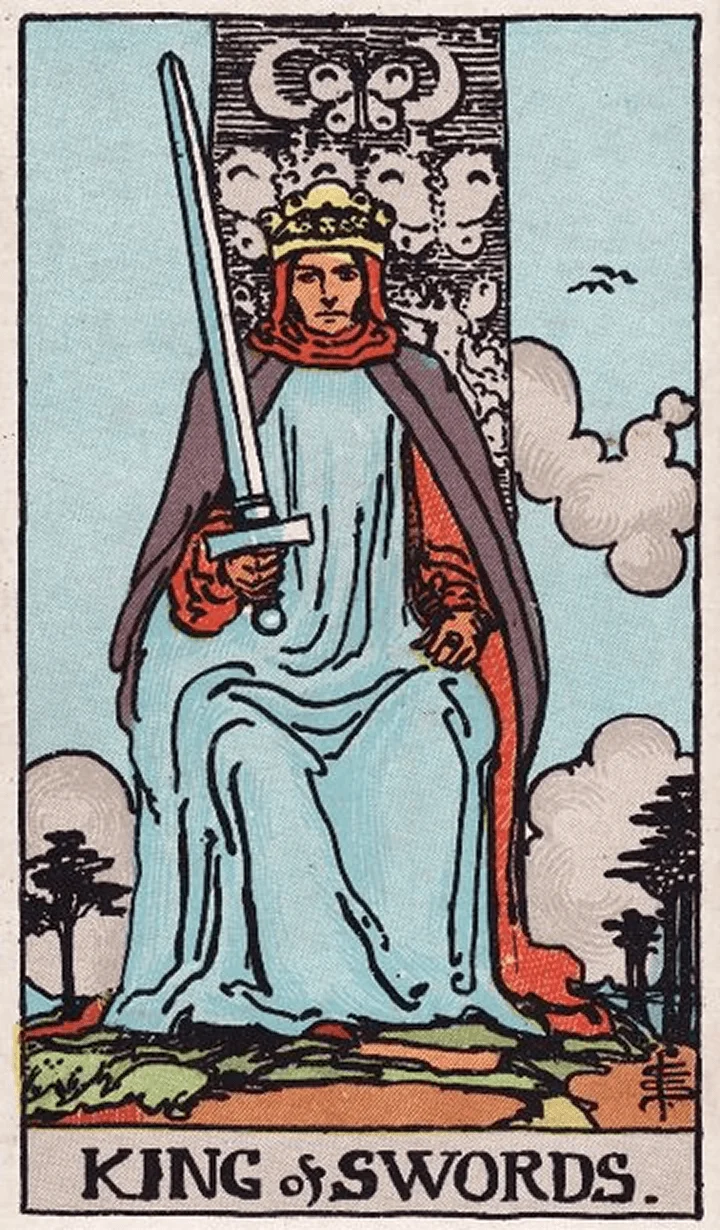
Ten of Swords
Traditionally, the Ten of Swords is considered 'the most terrible card.' Why? Mainly because other unfavorable Arcana can mean blows that can be survived, pain that can be overcome, problems and difficulties that can be fought, but here... FINITA! All is meaningless.
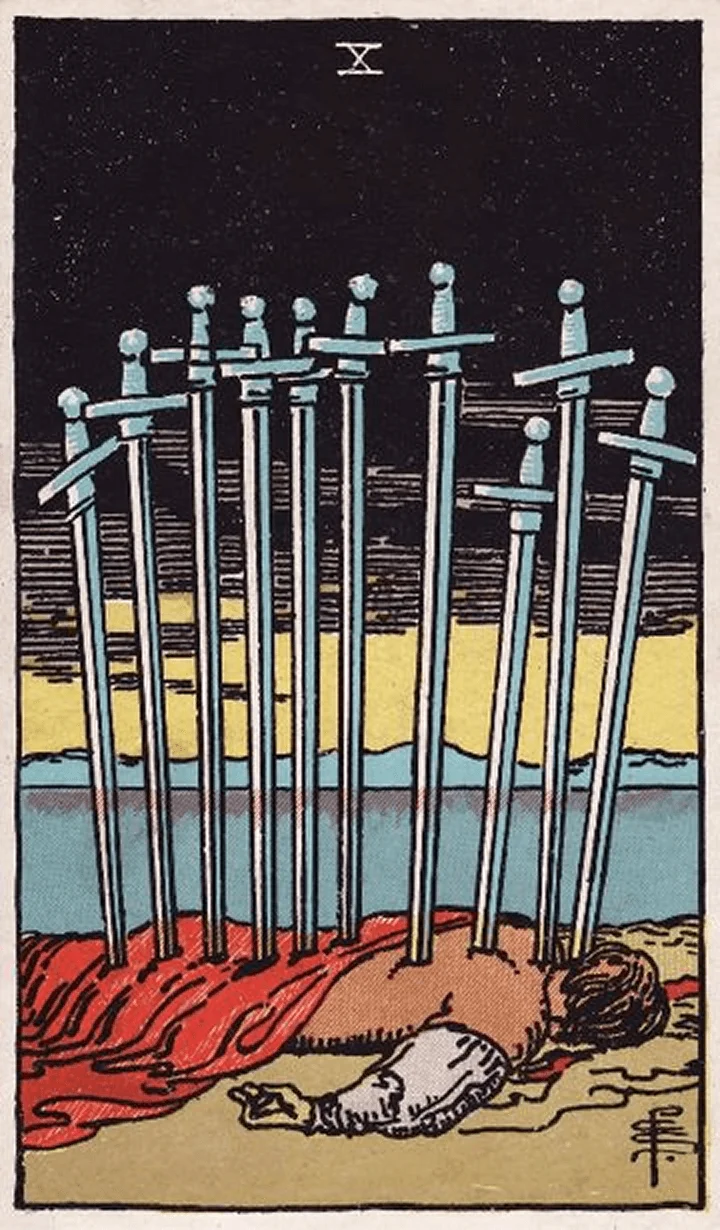
Traditionally, the Ten of Swords is considered 'the most terrible card.' Why? Mainly because other unfavorable Arcana can mean blows that can be survived, pain that can be overcome, problems and difficulties that can be fought, but here... FINITA! All is meaningless.
Fate has so decreed. Actions are useless (and often nothing can be done anyway). This is the end, and it's doubtful if it's a happy one. The Ten of Swords predicts complete failure. Or a complete mess (for example, at work)... Or a complete collapse (of a business or relationship)... Or a complete crash (in the financial market)... The essence is clear, and it doesn't make it any easier. This is a card of pain, failure, and devastation. At best, it cancels luck, and at worst – it aggravates the failure predicted by other cards. Improvements will be short-lived, plans will end in failure, and a catastrophic outcome can undermine self-confidence. If everything is good, this card predicts a clash with difficult circumstances, and if everything is bad – the end of troubles. The person has already grown accustomed to them – and they are over.
Like the Death card, the Ten of Swords personifies completion, the end of some difficult period, the end of something, disintegration, separation. The difference is that Death means a natural and expected completion, while the Ten of Swords means an artificial, forced, sometimes violent end, or one that comes 'at the wrong time.' And, although such an end is often accompanied by heavy, painful experiences, it's not necessarily so: simply, this multitude of swords symbolizes the mighty power of Reason, which has decided to 'draw a line' under something. These could have been important attachments and life circumstances, but they could also have been unpleasant situations, bad habits, or a difficult, unfavorable period.
One way or another, this is a moment of parting with someone or something. What feeling arises from this – the pain of tragic loss or relief, as after a surgical operation, can only be determined by context. Similarly, whether such intervention was needed or not, whether it was timely or not, will be told only by the other cards in the spread. This can be an unexpected brutal action, or some decisive act that helps one feel freedom and, as it were, sums up previous events.
The best thing the Ten of Swords communicates is the end of some difficult and dark period. The past is over, it won't get worse. But now (traditional meanings) – grief, sorrow, pain, tears, suffering, despair.
The card can describe a very complex person with their own notions, capable of the most sudden and sharp actions towards both themselves and others. This personality is characterized by determination. Like all swords, this is a very passionate and very cold person. They are often guided by the principle 'all or nothing' and know how to be one against the whole world. They are accustomed to solving problems in the most radical way, to operate with an unwavering hand, even if everything inside trembles. They are secretive, withdrawn, and proud, and deep down are sure of their own infallibility. Therefore, their judgments and decisions are peremptory, they inform no one, it doesn't even occur to them that their one-sided point of view is not the only correct one.
At the moment, they are most likely concerned with the need to extricate themselves from some situation, and they will spare no cost. Having said 'Enough!', they are capable of giving up even what they consider very valuable. Under certain circumstances, destructive energies can seize them so much that they may be capable of ending their own life.
As for the state... Emptiness. Devastation. Drained to the dregs. Fatigue after a battle – in all senses. Complete exhaustion due to colossal previous overloads, a demobilization reaction after the end of some tense period from the series 'there is always room for heroism in life.'
This is a kind of 'old age,' the self-perception of an impotent veteran (after very stormy previous adventures), an inability to undertake anything anymore because all the gunpowder has been shot. This is not a question of age – Alexander the Great could well have felt this way at 32.
The Ten of Swords governs negative thinking, heavy thoughts, and the conflict has been brought to an absurdity, to an extreme (to kill, one sword is enough, but in the card, ten are plunged into a person!). The use of excessive weaponry speaks of a disproportionately sharp reaction to some situation. The state of Robert Caplan from Priestley's play 'Dangerous Corner' comes to mind – an absurd liberation from illusions ends with the suicide of the main character, and it seems completely unjustified in the eyes of others who have gone through the same painful path.
'Why then did you scream and demand the truth all night?' Here, the clear thinking of the Ace of Swords gives way to panic. At the same time, in the Waite card, the water remains calm, and under the black cloud, the light of a new day is already visible. All is not as terrible as it seems now! But that's the trouble – in the state of the Ten of Swords, a person thinks in extremes.
The Arcana of the Ten of Swords presents the next step after the Nine of Swords. There a person was tormented and anguished from fear of impending heavy events – here they have met these events face to face, and their state has changed. If the Nine of Swords is the night before execution, then the Ten – is dawn and the block. It's all over. Freedom. They have crossed the line.
The step from the Nine to the Ten of Swords is taken with a very definite purpose. Before stepping into the sunlight (it is already dawning in the Ten of Swords), a person descends into the darkest abyss of their life, walks their via dolorosa. Having lived through the sufferings of the Nine of Swords, they decide to put an end to it – better to meet it all face to face than to languish so hopelessly from ignorance and fear. With this inner 'kamikaze heroism,' a person proves to the fate that leads them that they are worthy of a better lot, although externally everything may look pitiful and tormented. But fate is farsighted and knows how to admire inner rebellion.
The profound lesson of this Arcana - a thought that brings DEATH to the obsolete for the sake of a different existence. The last decan of Gemini symbolizes the transformative work of thought in concrete reality. Gathering information about everything and actively engaging in pressing everyday issues, consciousness comprehends its involvement in a huge world. Life and thought are two sides of a single whole, and the classic phrase 'being determines consciousness' can be understood in two ways: our thinking reflects the world, but thought also influences life. A person tends to 'catch themselves thinking,' and yet sometimes their hidden thoughts materialize in life before they have time to realize the consequences.
Spirit proves destructive for inert matter. This force lies within the person themselves and often destroys them, disregarding the vessel. In the card – a fallen person: ten swords pierce his body along the spine. They spread white light around the figure, dispelling the darkness. The Arcana symbolically depicts the descent of spirit into matter, which destroys everything perishable so that the eternal may be revealed. But this is also the nailing of thought itself to the earth: spirit in matter finds its death. Overcoming external vanity and comprehending deeper values gives the opportunity to find one's concrete path of life creation and move from the airy element of thought to the dense matter of earth. The Ten of Swords brings purification through pain and understanding of its redemptive meaning. Special Note
The example of Alexander the Great is mentioned not by chance. The Ten of Swords has a very interesting peculiarity – this card manifests strongly precisely in people 'with great ambition.' The more large-scale and ambitious the personality, the brighter this card plays out. It fully embodies the sign of Capricorn (just as the Ten of Cups – the opposite sign Cancer). Capricorn is connected with heights and trials. On a social level, this is a difficult trial by power, honor, popularity. One can ascend very high and fall very deep. In the life of a person who sets high goals for themselves, trials can be stronger than in the life of one who is satisfied with little. At the level of the Ten of Swords, a division occurs of what is called the 'middle path,' the 'upper,' and the 'lower.' This card contains a dilemma: here, before you is an obstacle, you can try to overcome it, or you may not overcome it, but pitch your tents before it and settle there. You have come far enough not to be ashamed of such a decision and not to lose your habitual life for something unknown. So the Ten of Swords is the gate to the upper, transcendent world. At the same time, overcoming the obstacles symbolized by this card opens the gate to a new level and elevates (or returns) to the Ace of Pentacles. In theory, of course, this height should be taken, but daring to take such a step, we accept full responsibility for the consequences. Do we have enough strength to leap across the abyss? However, Alexander the Great did not reflect, he leapt. And he leapt far! And paid the price, of course... This is the mystery of the Ten of Swords. One may note that the suit of swords as a whole describes something akin to the history of the Knights Templar, who were, as we know, also guys with ambition. The sequence of events that began with triumph ended in grief, death, and loss, a kind of apocalypse of consciousness. It was a collapse, an absurd, grotesque catastrophe, a brutal demise. But the Ten of Swords reminds that flesh is merely a vessel, a temporary refuge for the spirit, which prevails over any bodily torments. To break the vessel of bondage does not necessarily mean something terrible. It can also be the final stage of liberation. There is no way back, you cannot step into the same river twice, but posthumous fame under Capricorn proves to be age-old, despite their Saturnian modesty: Non nobis, Domine, non nobis, sed nomini Tuo da gloriam (Not unto us, O Lord, not unto us, but unto thy name give glory).
Light and Shadow (Advice and Warning)
Advice: to put an end to something, to leave the game or to escalate passions to a stalemate state, peak experience. In a more or less normative situation, this is advice to finally part with what has become tiresome, to cut ties, to clean out closets and memory. This is advice to say goodbye to your old 'self' and leave the past behind. This is much easier said than done. Depending on the situation, this experience may turn out to be one of the most difficult and traumatic in a person's entire life (and be dimly recalled even across incarnations). Fortunately, sometimes the card serves mainly as a projection of a person's fears. Then they are advised first to acknowledge their fear of catastrophe, and second – to try to understand what lies behind this fear, to ask themselves: what would the complete destruction of my life look like? Warning: think before acting rashly. Not the time to stop something, even with the best intentions. Furthermore, the card may draw the querent's attention to the fact that they are delightedly playing the role of martyr and victim ('everyone is against me') and mourning a 'terrible and unfair' life, greatly overestimating their problems. 'And to this person I gave my best years!' – something like that. Also, the card can warn that some project is doomed to fail.
A situation where one must do the impossible at any cost, or the state after it has already been done... fear and exhaustion, the desire to embrace the infinite, leading to a stalemate of overexertion. This is the card of professional burnout. Its hero is a hounded worker, a 'squeezed-out lemon,' a victim of stress, looking fearfully at the mountain of work awaiting him (or already 'torn apart' by these tasks). On the level of the mind – mental exhaustion, 'intellectual impotence,' the inability to undertake anything (a typical state after a sleepless night of the Nine of Swords, nothing more can be squeezed out of the brain).
This can also be unexpected dismissal, complete collapse of business projects, loss of a prestigious position, refusal of work, painful breakup of relationships, realization that something must be ended. Sometimes the card describes a 'this is our final and decisive battle' situation. In this battle, one can still surprise someone (at least oneself) with one's selflessness and heroism, but the war is already lost anyway. It's impossible to squeeze anything more out of this situation or radically change it.
For some reason, it is also believed that the card has a special relation to enlightenment, education. Perhaps because swords are an intellectual suit, and here it is presented to the maximum. But as a rule, this maximum is 'too much,' the action of the mind acquires some unhealthy character, so the Ten of Swords can govern 'organizational madness,' paranoid behavior of a mass of workers, a general loss of a balanced and realistic view of things (usually the source of this contagious phenomenon is the management).
Depression – that is the word that describes the meaning of the Ten of Swords in this sense. Collapse. Crisis. What it means is probably familiar to everyone.
Temporary financial constraints. Depletion of monetary resources. Ruin.
Lost court cases.
A fairly typical card for moving and/or renovation – another 'It is finished!' An end has been put to the former state, it's drawing a line, undertaken by the command of reason; people have decided on destruction, ruin, and desolation in their home. The card symbolizes despair, a situation where things couldn't be worse, and enlightenment seems never to come, and that's exactly how it often is during renovations, moves, and major remodeling. It seems this mess will never end, normal life will never come, and strength is running out – well, the darkest hour, as we know, is just before the dawn.
The Ten of Swords governs the cessation of relationships. A break with the past. Traditional meanings - misfortune, grief, disappointment in love. Relationships that have outlived themselves. Reaching some turning point. Ending an unbearable situation. Divorce. Brutal events. A breakup like a bolt from the blue, possibly without explanation. It's all over, nothing can be fixed. From now on, everyone will have to live by new rules.
The Ten of Swords also governs a 'frozen' heart, a killed-off ability to feel as a result of past dramas. The person has forbidden themselves from entering into any relationships in the future, and their determination seems unyielding. Their motto is 'not to get involved,' they think they have drawn a line under it all forever. Of course, if it were only a matter of the person's own will, that's how it would be. But in life, often forces far more significant come into play.
Physical exhaustion and the necessity of the most fundamental care for health restoration. The person is completely worn out. This card can play out as fever, inflammation, high temperature.
Psychologically – depression, anergy, apathy, loss of strength.
The Ten of Swords is closely related to the spine, issues of traumatology and orthopedics, as well as acupuncture, acupressure. This card also has a special relation to gynecology and bleeding – the red cloth below the waist is very symbolic. It governs various, primarily female, micro and macro traumas below the waist – abortion and loss of virginity, difficult childbirth and hemorrhaging. This is also a typical card for menstruation. 'It is finished!' – relief, albeit with pain. Demobilization reaction and obvious impotence, inability to take active action due to such a condition.
The card can concern the male sexual sphere, describe inflammations and hypothermia, sexual exhaustion, phimosis, condition after circumcision and vasectomy.
Sometimes the card can point to quite serious things – acquired immunodeficiency syndrome (the body's defense systems are 'killed'), negative consequences of antibiotic use or systemic skin lesions. If a person is truly suffering greatly, the card says it won't get worse. In the best case – the crisis has passed, and now the situation will begin to improve. In the worst – the sufferings are over, because a lethal outcome has occurred. As with interpreting any card when answering any question, one should proceed from the context of the real situation.
In a reversed position – 'not the end yet,' some distress is still to come, but it will be the last, and after it a bright period will still come. In a reversed position, the Ten of Swords can give a lack of results, but at the same time, it is also the impossibility of further progress, and the obstacle may lie not only in a barrier but also in success.
There is reason to think that in a reversed position, Cancer (the sign opposite Capricorn) plays out in the Ten of Swords, hence 'lunar' manifestations are evident: love, attachments, home, return to origins, under protection, into one's 'shell,' a peaceful way of life (Cancer). There can also be 'Jupiterian' (the second ruler of Cancer) phenomena: benefit, gain, reward, profit, gift, success, authority, and at the same time a reluctance to go further – resting on one's laurels. Sometimes the momentary nature of the state, its temporary, transient character is emphasized.
Some authors consider the reversed Ten of Swords a very encouraging card! Values such as joy of recovery from illness, gaining strength and power, luck and profit are associated with it. Gaining patronage, advantage. Profit, success. Defeat of evil forces. A reasonable and balanced view of things (although the person feels as if they miraculously survived, and not in vain). Some authors believe the card indicates a transitory and fleeting improvement, and profit and success will not be permanent, but rather, what's important here is that it's still too early to jump. There is still a risk of worsening, relapse, as often happens at the beginning of recovery, and one should behave very cautiously, not overestimating one's condition.
With The Empress – a serious quarrel.
With The Chariot – self-assertion and strength, the card largely neutralizes the Ten of Swords.
With The Hanged Man – 'sacrifice,' can even point to suicide, death
With Death – death in the house, a very heavy indicator.
With Two of Wands – strength and self-confidence, the card weakens the negative meaning of the Ten of Swords.
With Six of Wands – great conceit, but also truly stunning success
With Two of Cups – dissatisfaction with the existing state of affairs
With Nine of Cups – fears are in vain, all will be well
With Eight of Swords – suspiciousness, powerlessness, a very difficult psychological state
With Two of Pentacles – lack of strength
With Four of Pentacles – distress from a gift (from an old divination book).
Crucifixion. 'And there was darkness over all the earth from the sixth hour until the ninth hour'...
The demise of Atlantis.
Armageddon, the end of the world.
Cards from the same group
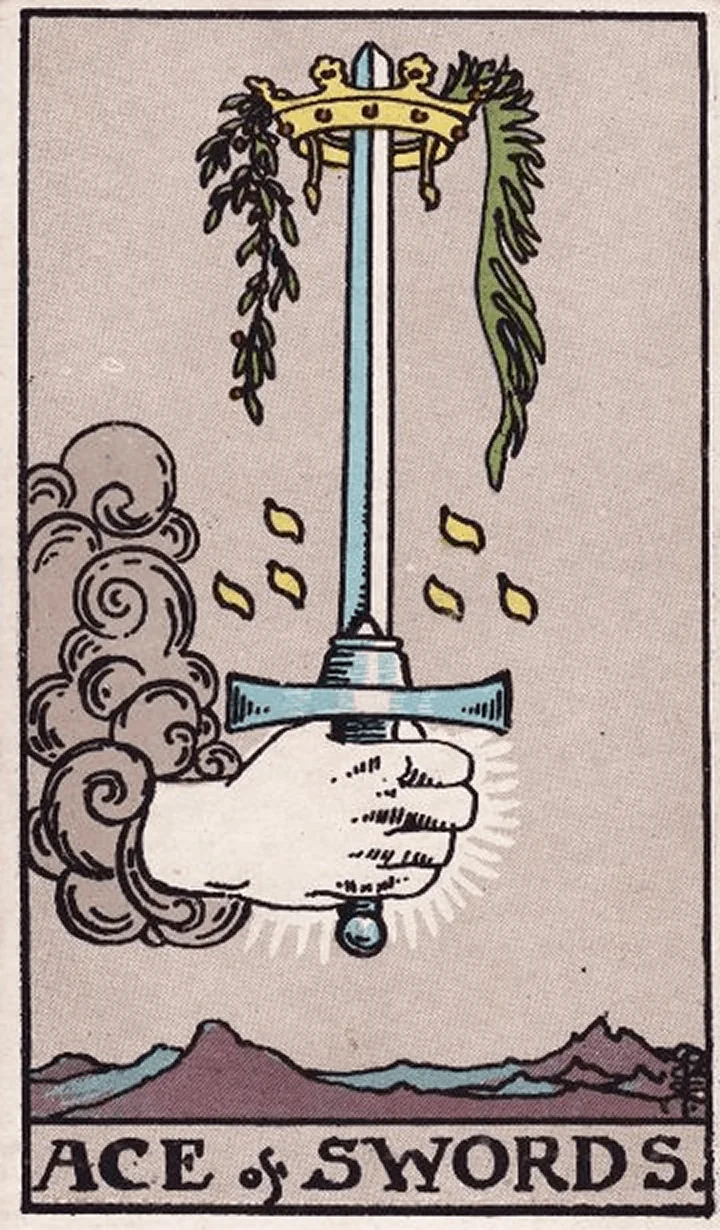
Ace of Swords
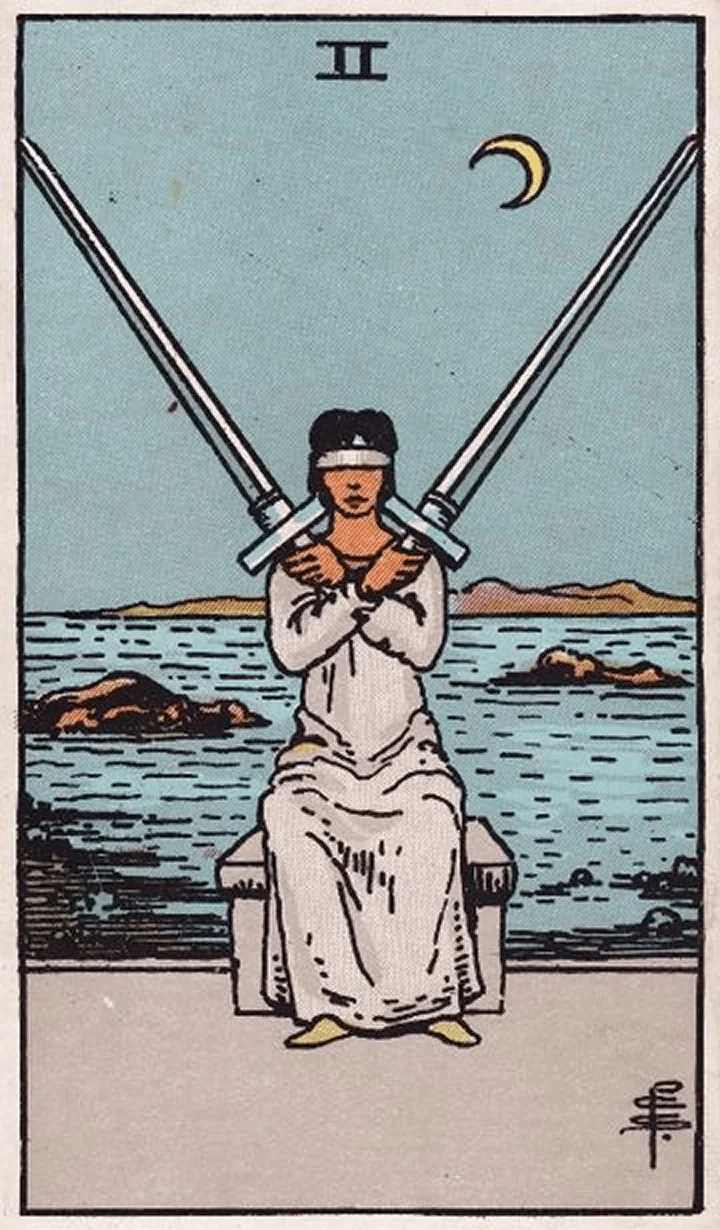
Two of Swords
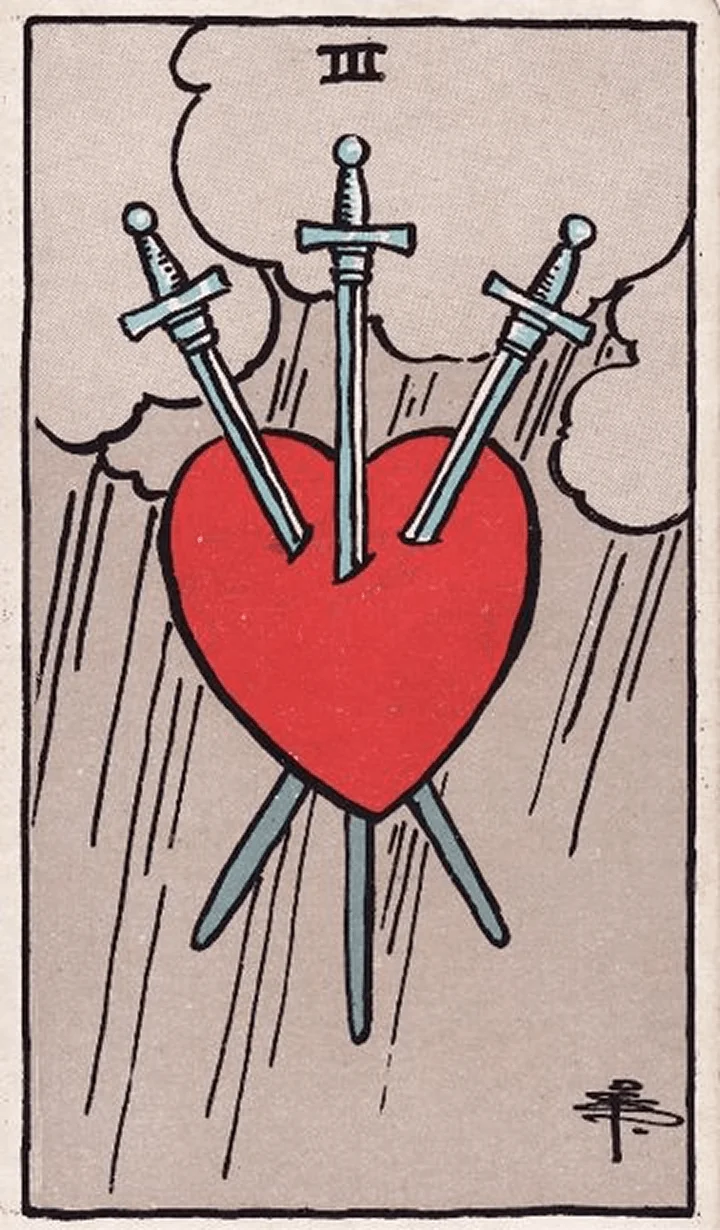
Three of Swords
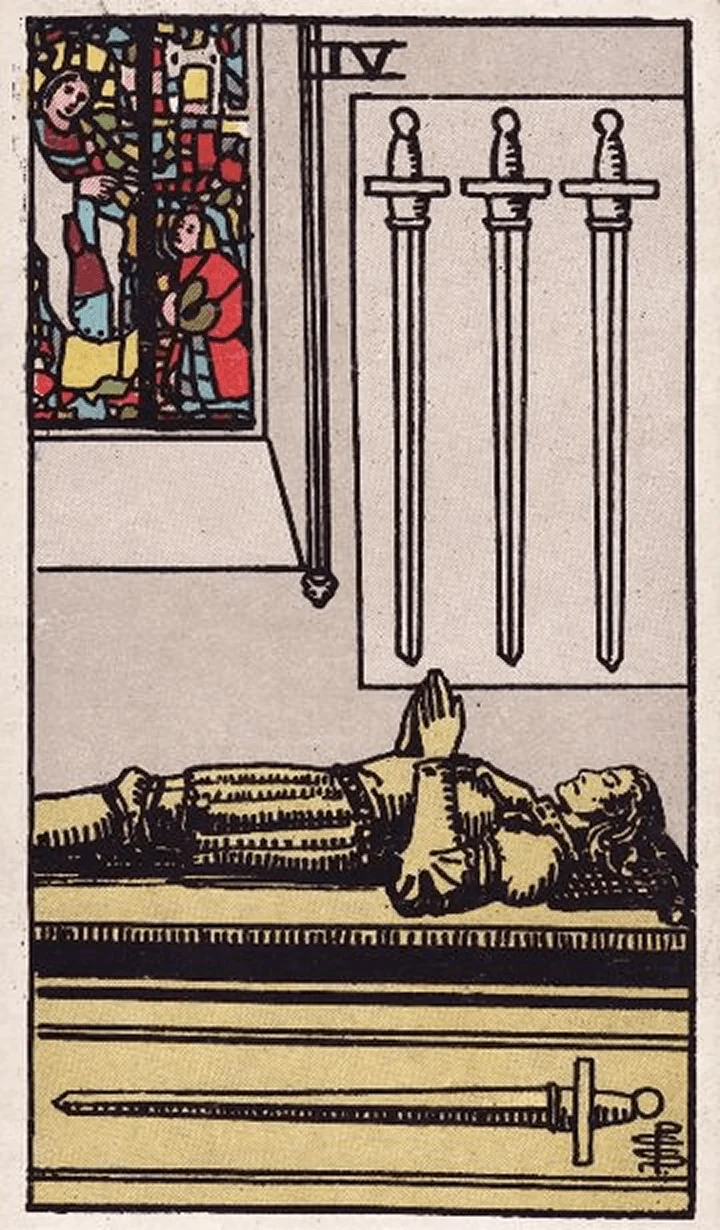
Four of Swords
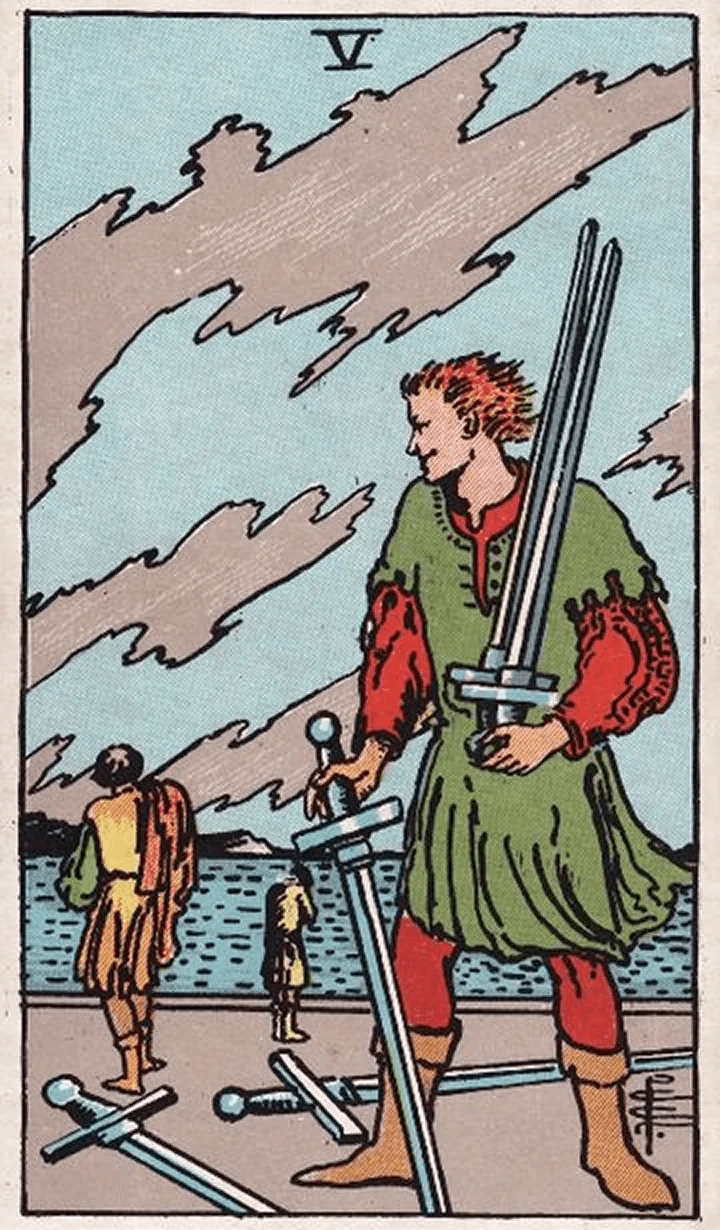
Five of Swords
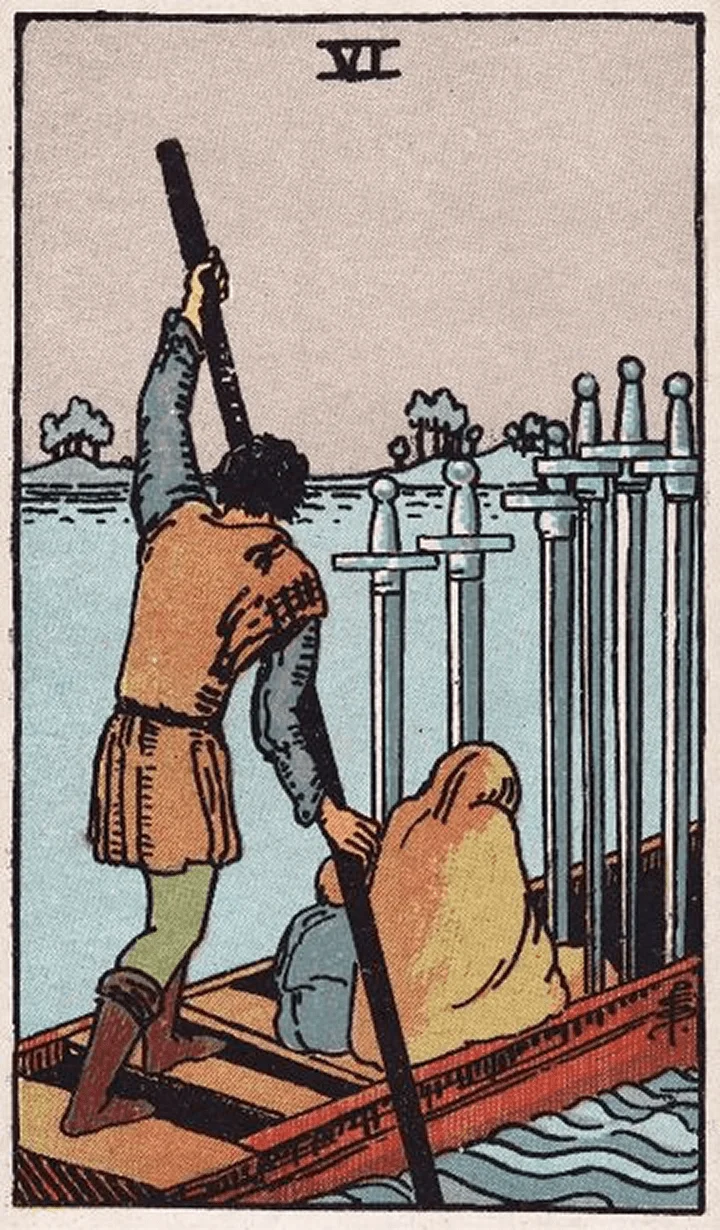
Six of Swords
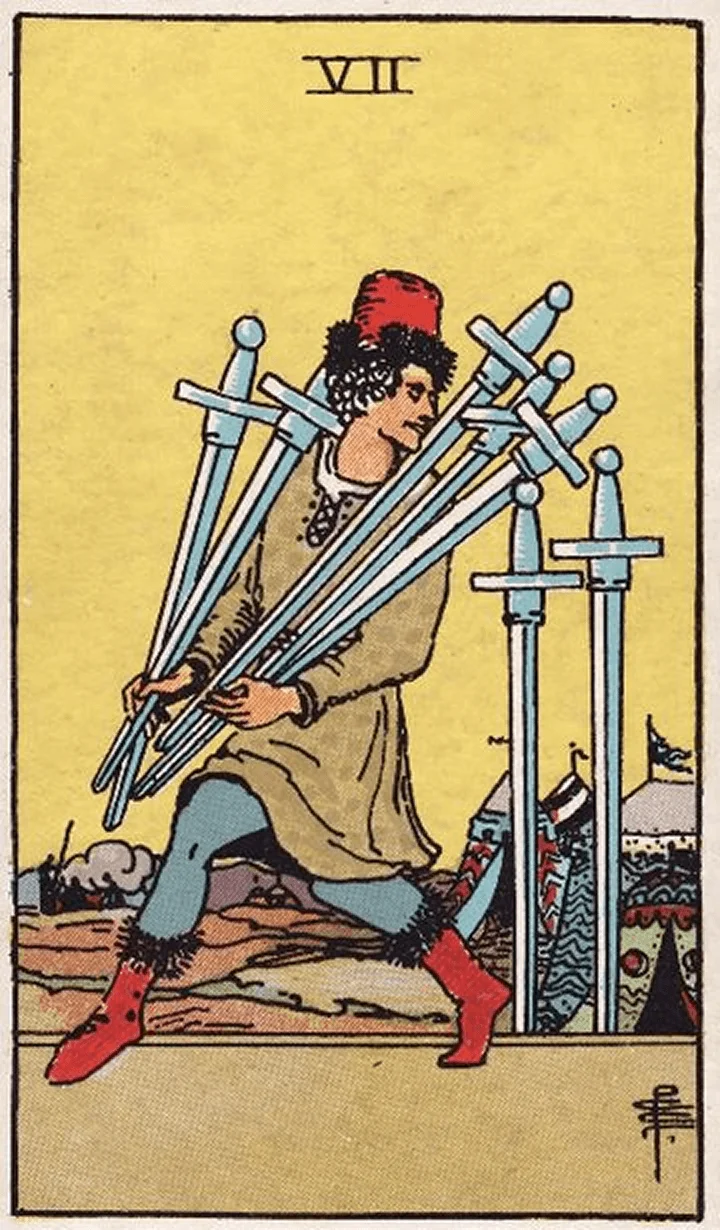
Seven of Swords
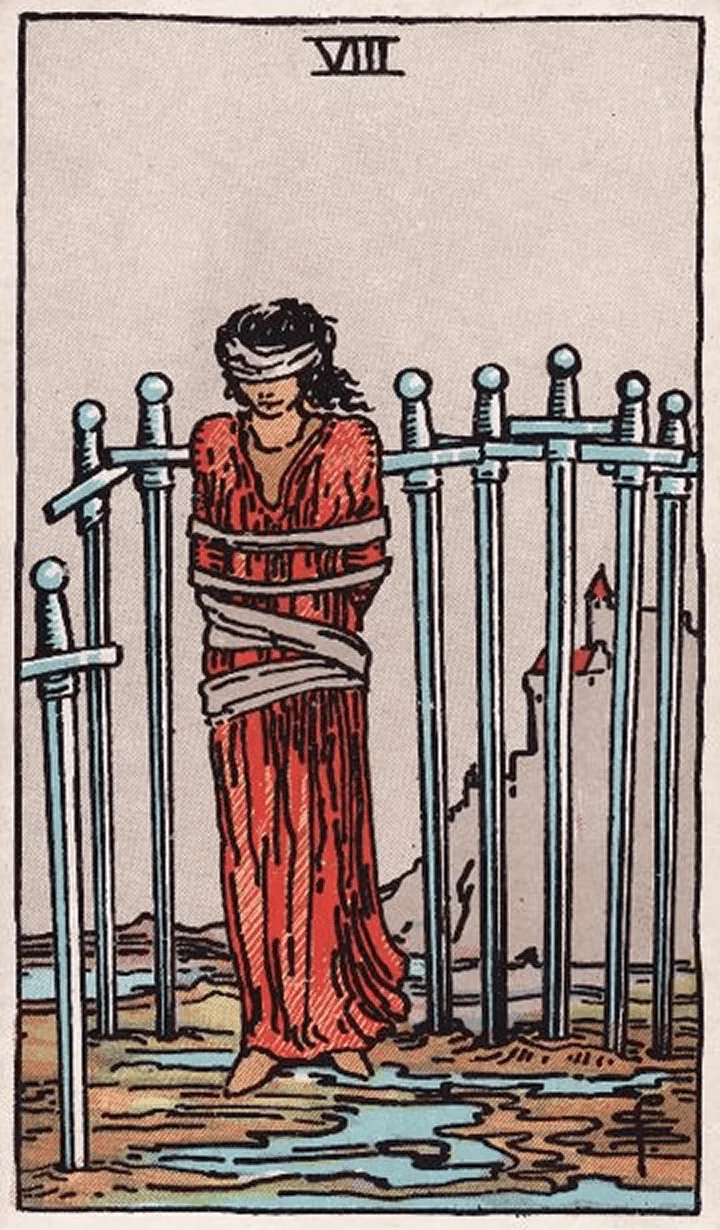
Eight of Swords
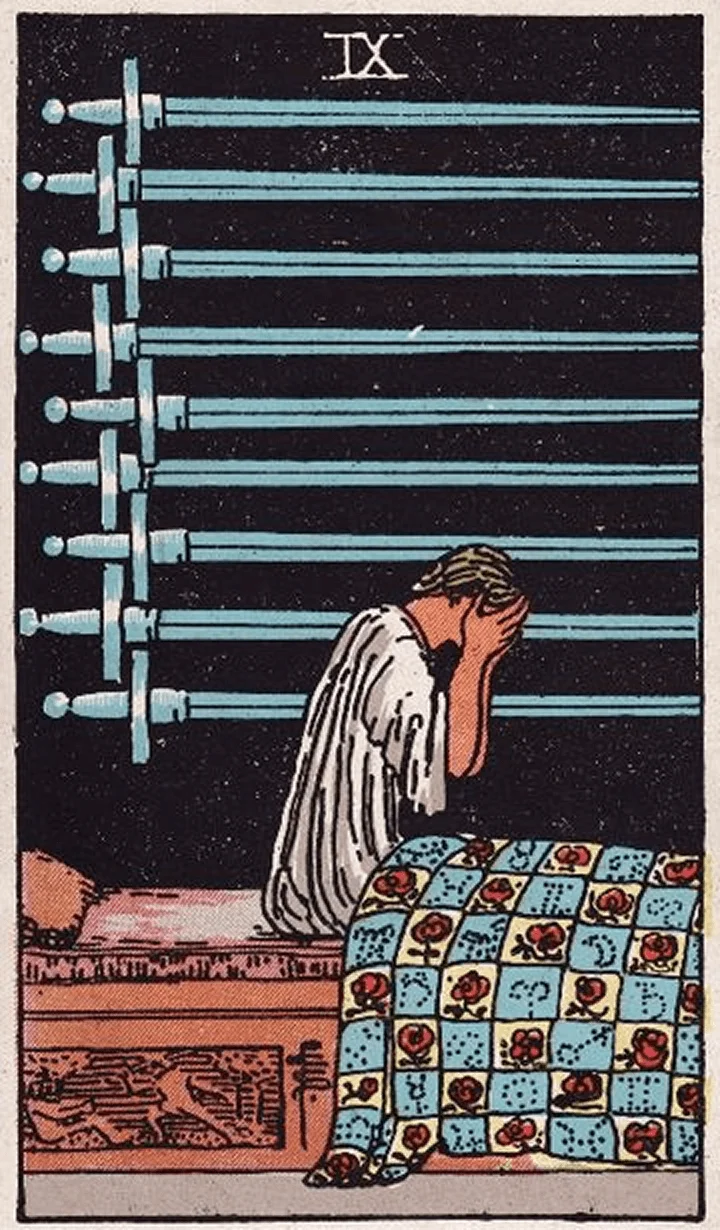
Nine of Swords
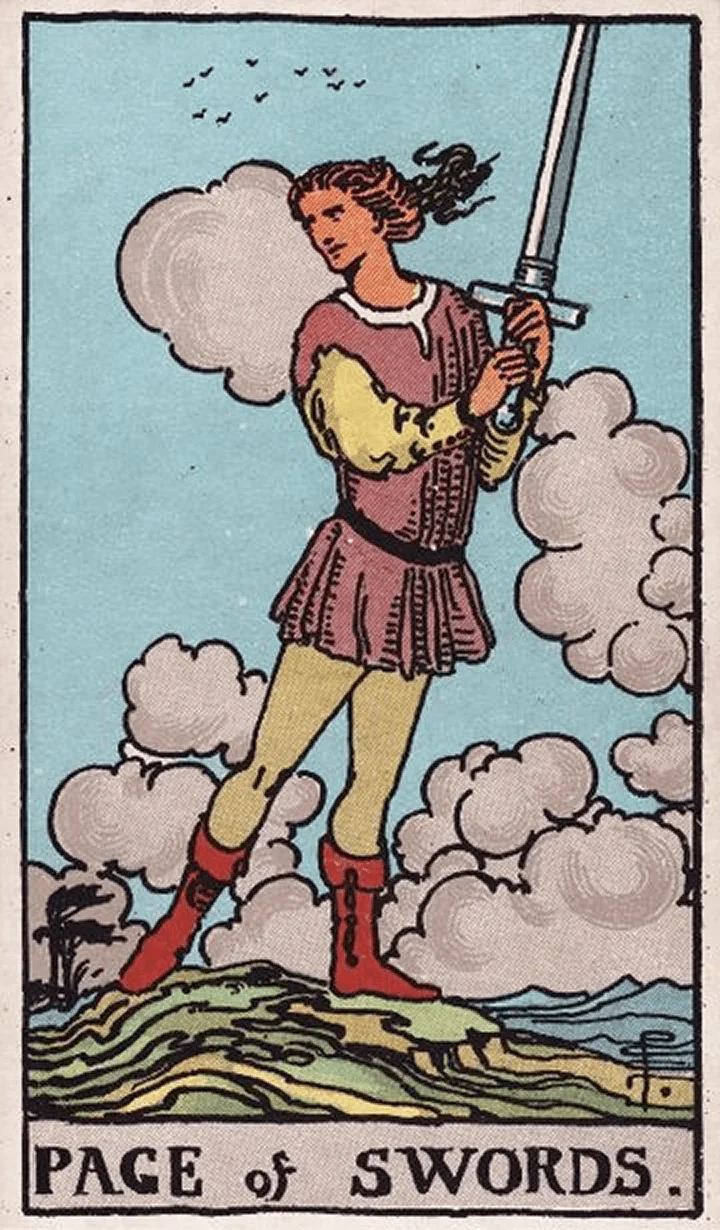
Page of Swords
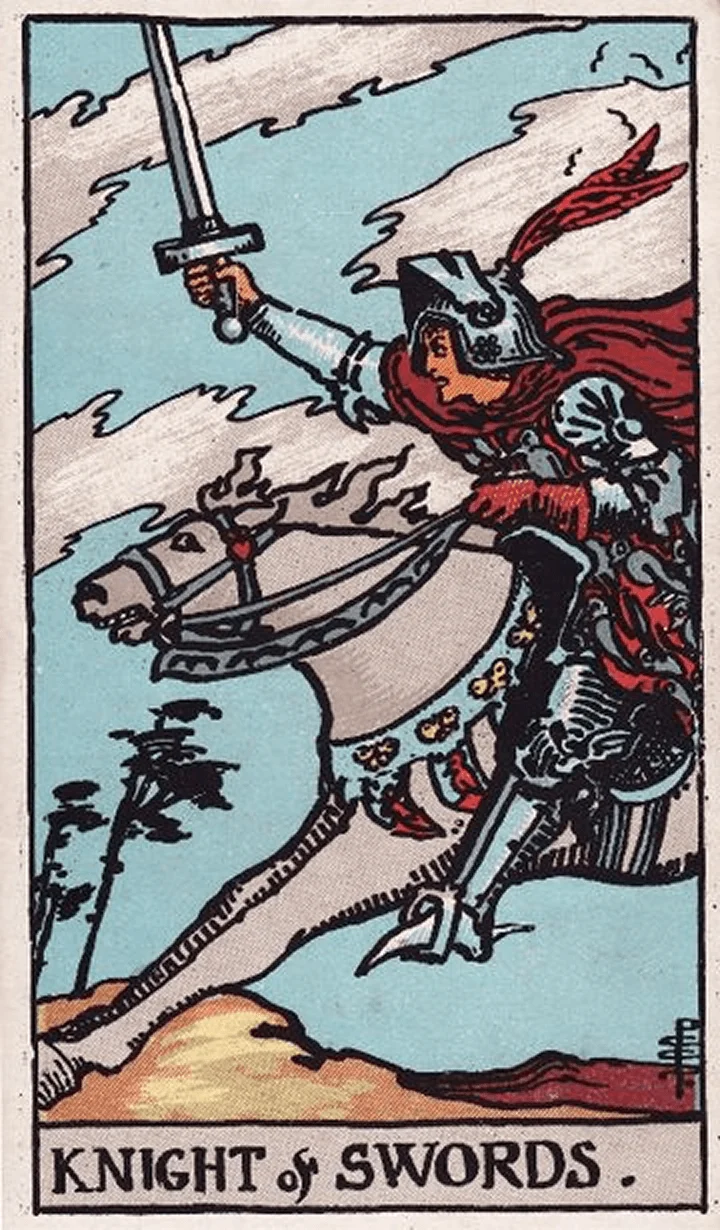
Knight of Swords
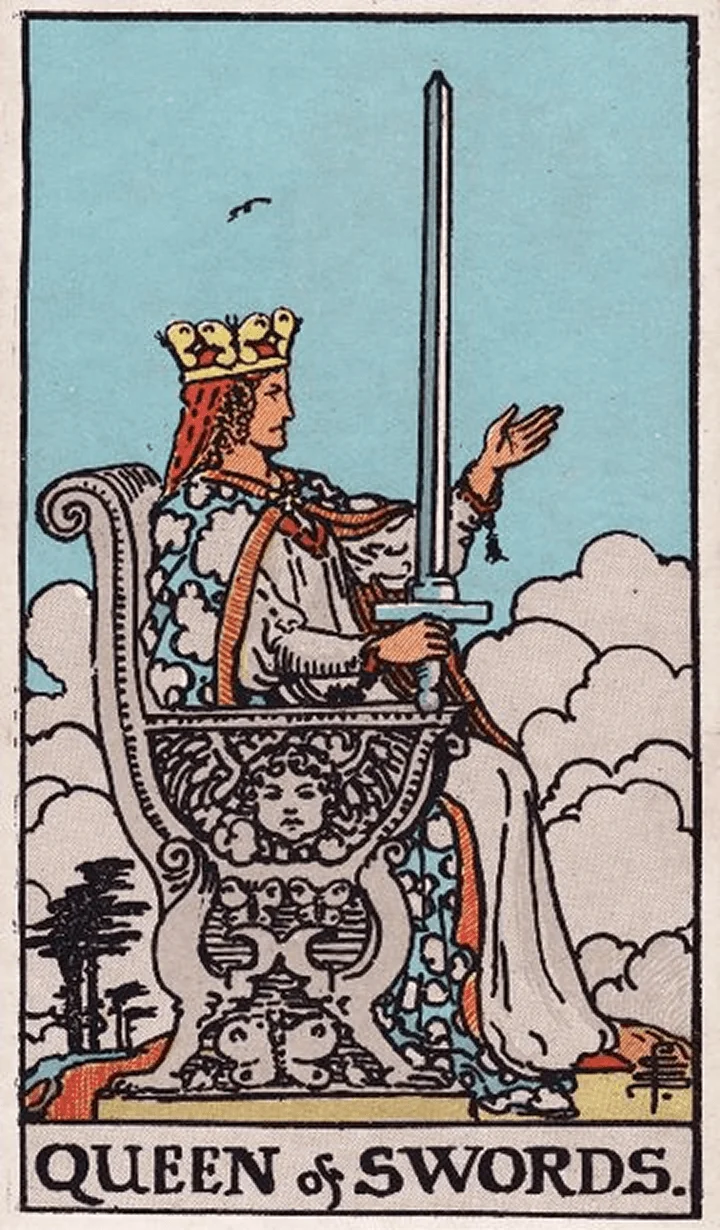
Queen of Swords