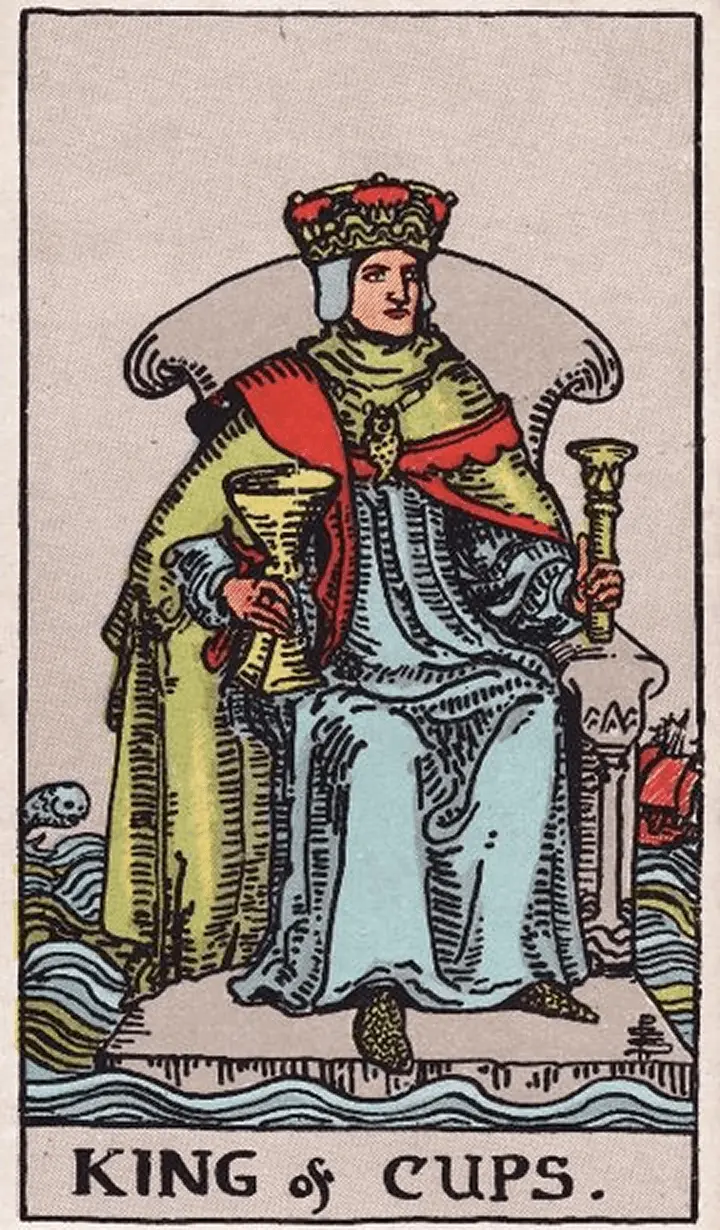
Two of Cups
The meaning of this card is clear even to those seeing Tarot for the first time—harmonious relations between two people or their growing interest in each other. Heartfelt unity, romantic rapprochement.
The meaning of this card is clear even to those seeing Tarot for the first time—harmonious relations between two people or their growing interest in each other. Heartfelt unity, romantic rapprochement.
Traditional interpretations: courtship, partnership, alliance, attraction, infatuation, friendship, mutual love, passion, intimacy, affection, harmony of feelings, mutual exchange. This can be a new acquaintance, reconciliation with a former lover, manifestation of the best feelings in an already established union. The meaning of this card touches primarily the deeply personal, intimate sphere, whether it's about sympathy, light flirting, sudden falling in love, a date after a long separation, or the beginning of new friendly or romantic relations.
Most often—the development of feelings between two people. This card very much favors lovers and often appears in spreads precisely during the period of bright romantic infatuation. It serves as a kind of indicator that the person is ready to open up to the love coming to them, to be filled with it and to share it. With it, what separates people loses its significance—what attracts and unites them becomes much more important.
This is also a good offer (in the most traditional sense—of marriage, but it can be something no less interesting). The Two of Cups describes a favorable acquaintance, cooperation, and establishment of connections that help open up new favorable prospects. Even if it doesn't concern romance, this card describes benevolent interaction, harmonious relations, mutual sympathy, agreement, attentiveness, and kindness. Its important meaning is the ability to trust and act in concert.
Joyful meeting, warm reception, hospitality. Unity and concord. Forgiveness and reconciliation. Also, the Two of Cups is the main indicator of a date, a pleasant meeting.
The card has always been considered good and, if the question did not concern love, foretold success, honor, wealth, and entertainment. Only in comparison with higher Cups cards, for example, the Nine or Ten, did it mean relatively small success compared to possible greater ones.
It gives a positive forecast and foretells not only a favorable outcome of the matter but also often the emergence of some new quality, a new direction of development.
In love.
The Two of Cups is clear evidence that solitude has ended; now all feelings and intentions, willy-nilly, are correlated with another person, even if the romance is still in a secret and platonic phase (not to mention obvious and formed relationships).
In any case, isolation has at the moment given way to an inner union of two loving people, a 'sixth sense.' Under the Two of Cups, a person feels an emotional connection with someone, a flow of heart energy, a merging of souls. They clearly care now. Considering that the heart chakra is generally rather little engaged in our lives (most interactions occur through manipura and svadhisthana, not anahata), its strong activation is experienced as a holiday and a revelation.
A bright sign of the heart chakra's activation is the experience of love for life in general accompanying falling in love with another person ('how beautiful this world is!'), and a special poetic perception of reality, that indescribable 'phase shift' that is both praised and cursed, and praised again. If this sensation is absent—we 'fell in love' with some other place, which could equally well be above or below the heart. But if everything happens according to the Two of Cups—the soul sings, beauty is noticed where we never saw it before, creative and artistic interests come alive. And the old maxim about the elevating and healing power of love becomes completely evident.
Strictly speaking, the card can fall to anyone who has fallen in love, but there is also a type of person about whom one can say—this is a Two of Cups person. They are pleasant, attractive, sociable, and kind. Friendliness, benevolence, softness, and courtesy emanate from them. They blossom in a warm atmosphere and highly value love, friendship, and good professional relations. They are sensitive, tactful, and attentive to others. They possess a subtle ability to give and take. Their smile and kind word can act on others therapeutically, loosening up and inspiring trust. Also, it often happens that they have an increased curiosity about other people, a sincere interest in them without any special reasons (less often—in self-knowledge). This person enjoys reading various psychological notes and applying them in practice.
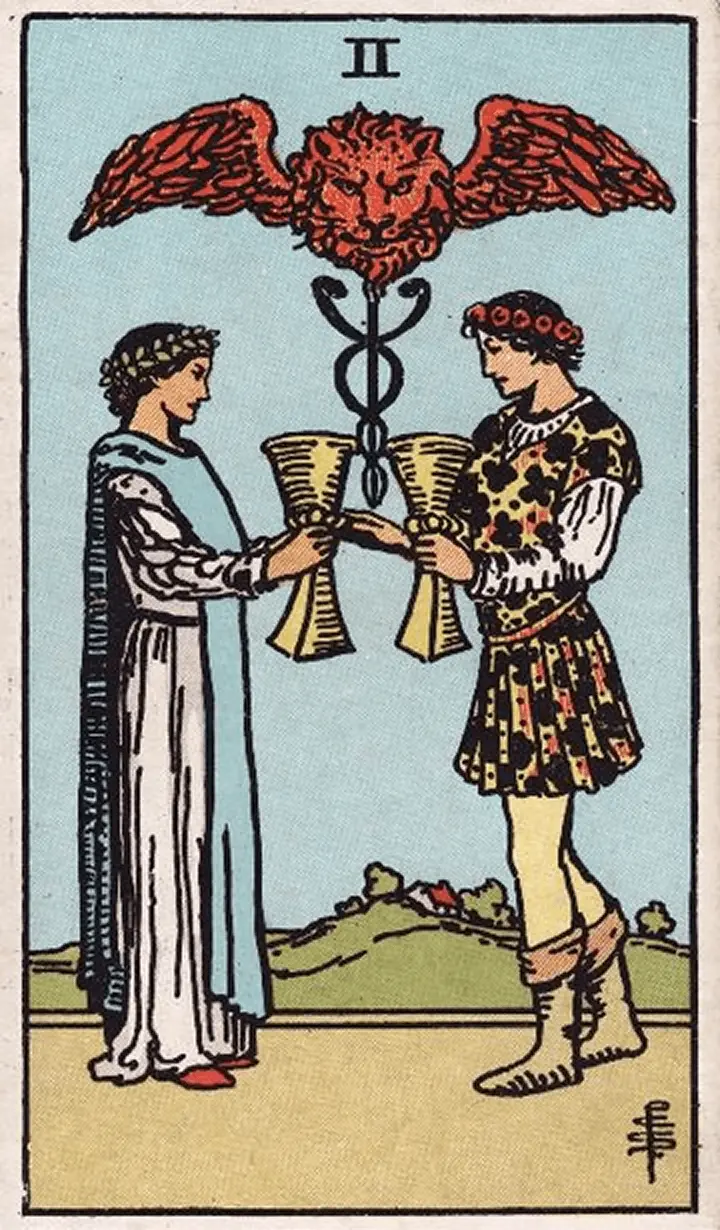
The card depicts a man and a woman exchanging cups, symbolizing the two fundamental principles upon which creation is based and the attractive force of opposites. The woman's blue and white clothing symbolizes the element of Water and the purity of the subconscious impulse; the man's red-yellow suit symbolizes consciousness and the element of Fire. They are overshadowed by a scarlet winged lion, a symbol of desire but also potential spiritualization of passions.
Above the cups also rises the magical caduceus of Hermes or Hymen, considered the patron of newlyweds (and well reflected in the Latvian word for 'family'—ģimene). There is an opinion that the winged lion and the snake-entwined caduceus symbolize male and female reproductive organs. The paired meditation indicated by the Two, in this case, sharply enhances intuition, sensitivity; therefore, another meaning of the card is heightened perception, acute sensing of beauty. Hermes's rod, entwined by two snakes, says that together they possess higher knowledge and are capable of transmitting it to others. This is a true evolutionary union, promoting the growth of both sides. The house in the background expresses the idea of human creativity based on the harmony of love. Love in the highest sense is a force that creates the world through the happy union of opposites, like the double helix of DNA.
Archetypally, the card depicts the 'ideal pair.' If the question was about relationships, then this is 'the union that is meant to be.' The soul of the androgyne (Ace of Cups) divided in two in the external world (Two of Cups) and now strives for reunion 'like immortal streams of eternity.' This is not only a physical but also a spiritual striving, since it is about a lost part of oneself. Alchemically, this is coagula, the process of conjunction.
This is the situation when alchemical energy mixes two simple elements and ennobles them. Therefore, the Two of Cups can describe any kind of marriage, including intellectual and creative ones, situations of cooperation and co-authorship, where the union of forces gives an excellent result. It can also be a harmonious exchange of energy between the 'yang' and 'yin' sides of the soul. In a mystical sense, it depicts the spiritual marriage of the male and female components of the consciousness of the initiated Hero. Many decks emphasize in the Two of Cups, first and foremost, the theme of self-acceptance, gradual self-knowledge, building a relationship with oneself. The contradiction with the traditional meaning here is only apparent.
On a deeper level, the Arcanum describes that fundamental circumstance that how others treat us actually reflects our own attitude towards ourselves. Receptivity to oneself prepares us for the ability to perceive someone else and give ourselves to them.
Regarding astrological correspondences: 'The first decan of Cancer symbolizes the first, unmotivated impulse of feeling, childishly indefinite and carefree, passive, tender, and affectionate. It is an intimate atmosphere, the family hearth and coziness, in which the subtlest sensations awaken. This decan is patronized by the Moon according to the Eastern system, and by Venus according to the European system. Venus in Cancer—in the Moon's domain—and this is precisely the case when beauty ennobles the soul.
This is the novelty of emotions and their reflection in the sensual sphere, which give an impetus to the revelation of the subconscious. At first, feelings manifest uncertainly and weakly: the shortcomings of this decan are lethargy, laziness, and a softened consciousness. Here, it is important to find harmony between conscious and subconscious processes: awareness of one's sensations will give greater strength and direction.' There is also an opinion that this card, of all the Minor Arcana, most corresponds to the sign of Libra.
In the Two of Cups, one can see winged passion, sublimated driving force, reminding us that everything we do, we do because we love something (someone). Behind the search for a 'soulmate' lie cosmic driving forces, a spiritual striving for completeness and wholeness.
In a mystical sense, this card corresponds to ritual sex change, sexual magic, meeting one's second self, giving the opportunity to see what a person does not accept and is not aware of in themselves.
Light and Shadow (Advice and Warning)
Advice: Bet on common interests and build relationships. Conclude an alliance, join forces with someone for a good cause. Take a step towards another, open up, cooperate, reconcile. Give and take. In the film 'Some Like It Hot,' Josephine gives Daphne the advice 'Pour on the charm!'—also in the spirit of the Two of Cups. Warning: One should not compromise principles for the sake of a 'bad peace' and try to please everyone. Excessive indulgence in feelings, idealization, the 'rose-colored glasses' effect are possible. One should not be overly frank; it makes sense to weigh one's words so as not to end up looking foolish. Another trap: uniting with someone for lower benefits (a marriage or other union of convenience).
Successful business partnership, effective cooperation, complete mutual understanding in partner relations and striving for a common goal.
Business partners can also be partners in life. Trusting relations in a team, respect and equality. A synergy situation, where together one can achieve much more than alone. A favorable work atmosphere (may be so favorable that it is almost not perceived as work—this is the case when it is precisely colleagues, not household members, who are perceived as a real family). Loyalty, collectivism, inspiration. Mutual assistance, the ability to rely on each other. Contractual relations, conclusion of a contract. Joint venture. Uniting for a higher common goal. Interest in cooperation, cooperation.
Successful negotiations. Good reception. Recognition and respect.
All professions requiring diplomacy and the ability to communicate productively. Sometimes the Two of Cups speaks of realization in the field of artistic creativity (good taste and aesthetic sense are part of this card's range of meanings).
Joint resources. Mutually beneficial relationships (the connections or capital of one partner are valuable to the other and vice versa). Pooling of funds, 'common pot.' Material security.
If the card appears precisely in the context of relationships and there are no unfavorable Arcana negating its meaning, then it can be asserted that feelings are mutual and the development of relations will be favorable and harmonious. Interestingly, old interpretations persistently repeat the thought that unfavorable cards can only delay the influence of the Two of Cups in time or create obstacles on the path of the people involved in the relationship, but even this negative influence cannot change the prediction—this is a union that is meant to be.
The partnership of the Two of Cups differs from others primarily in the absence of internal conflicts. There are no vacillations, doubts—should I or shouldn't I? Here, everything is clear and understandable; there is simply no place for these questions and protests; love is romantic and proper, giving it a taste of simplicity. Another feature of the Two of Cups—you can't make a secret out of it. At any rate, it's very difficult (as a rule, the couple doesn't even try).
Here, the connection is visible to the naked eye, tenderness shines through everything, and 'parting is worse than death.' People under the Two of Cups resemble communicating vessels; this concerns health, money, mood, and almost anything. What happens to them clearly has mutual connectedness, and the words 'the two shall become one flesh' take on new meaning. The intuition of both partners is heightened; sometimes they easily 'read' each other's thoughts and feelings, wherever they may be. Here, there is correspondence of views and characters, harmony and concord in feelings, full human joy.
This is a successful union of suitable partners, in which there is love and closeness, reciprocity and heartiness. Deep sympathy, strong attachment, the ability to see only the best in each other and forgive shortcomings. This is the 'honeymoon'—the first or another one. In general, idyll in relationships—emotional responsiveness, care, tenderness, respect, equality, openness, and sincerity (and all this is true even if the relationship is not purely romantic).
Strong attraction, passion, merging of two hearts, the ability to open up to another, declaration of love, a new quality in the relationship. Sexual compatibility, intuitive understanding of the partner's needs. In physical intimacy, conscious and unconscious strivings harmoniously combine, again leaving no room for internal conflicts. The Two of Cups indicates the fundamental possibility of having a child (this can be important when, for example, there is a suspicion of infertility).
This card covers both 'trivialities,' like successful romantic dates and significant gifts, and 'major events,' such as engagement and marriage. Therefore, if the question concerns concluding a union, some other marital significators in the spread are still desirable (e.g., Four of Wands or The Hierophant).
Renewal of an old friendship. Reconciliation. Forgiveness.
This card seems to develop the meaning inherent in the Ace of the same suit. The Two of Cups is a sign that the feeling which the Ace appearing in the spread only foretold is gradually but steadily gaining strength.
This is a card of good health. Also, it is a card of healing. Therefore, in health readings, it should be interpreted optimistically. As a significator of illness, the Two of Cups can speak of all sorts of infections transmitted from person to person, from respiratory to sexually transmitted.
Even reversed, the card indicates that the possibility for happiness, success, joy exists, only at present, for some reasons, it's difficult to realize. There is an opinion that in the reversed position, the Two of Cups retains the meaning of a union that is meant to be, but one will have to endure for it. This card postpones the event in time or describes obstacles on the path of the people involved in the relationship. Among other things, this card raises the theme of infidelity and jealousy. Appearing in a spread, it may indicate that attempts to unite with someone (or, for example, reconcile) are doomed to failure, at least for the present. Conflicts and disputes, inability to reach consensus.
In old interpretations, one finds such a definition as 'love that has grown stale.' Also, problematic, restless, unsatisfying relationships, 'a difficult romance' can pass through this card. These are all those cases where yesterday they discuss almost wedding details, today they kick you out with your things, and tomorrow they call screaming 'Come back!'—and those around watch the development of this Mexican soap opera philosophically for quite some time. Quarrels, storms in a teacup, and contradictory interactions of the 'but when the heart starts to blaze—the haughty ones cool it with chill' type, when it's completely unknown what to think.
In the upright card, what unites overcomes differences; with the reversed card, what separates two people, be it social status, personal traits, or anything else, tends to become stronger than their desire to be together. Hence such interpretations as rupture of union, divergence of people, divorce, living apart. Insincere friendship. Undermined trust. Confrontation, discord, misunderstanding.
Sexual incompatibility, dissatisfaction. There is an opinion that the card indicates 'perverted sensuality,' speaks of crudely manifested desire, unbridled lust without heart attraction. According to Mary Greer, it can be an indicator of a person who 'really wants to, but has no one.' But it can also be unwillingness to reconcile and meet halfway, rejection of someone's love, fading of feelings that were once very bright, and experiencing unrequited feeling, lack of reciprocity.
When interpreting, surrounding cards are important. If there is nothing particularly gloomy and eloquent in them, like the Three of Swords, then the reversed Two of Cups should not be interpreted dramatically. It can be a short separation from a loved one, simply being late for a date, a misunderstanding between lovers of the 'lovers' quarrels are but lovers' sport' type. After all, it's a good card! It can also foretell simply a situation of sorting things out. It may hint at a lack of tact and diplomacy in relationships, absence of taste and measure.
But in a business sense—this is a very alarming signal if it concerns concluding some kind of deal.
With The Lovers—the meaning indicating union, marriage, connection is noticeably enhanced.
With The Hermit—the action of the Two of Cups weakens; The Hermit's tendency to solitude overcomes the desire to communicate.
With Temperance—joint work, favorable relations.
With Five of Wands—hostility and disagreement in an alliance.
With Three of Swords—indifference, coldness.
With Ten of Swords—collective success (according to Guggenheim).
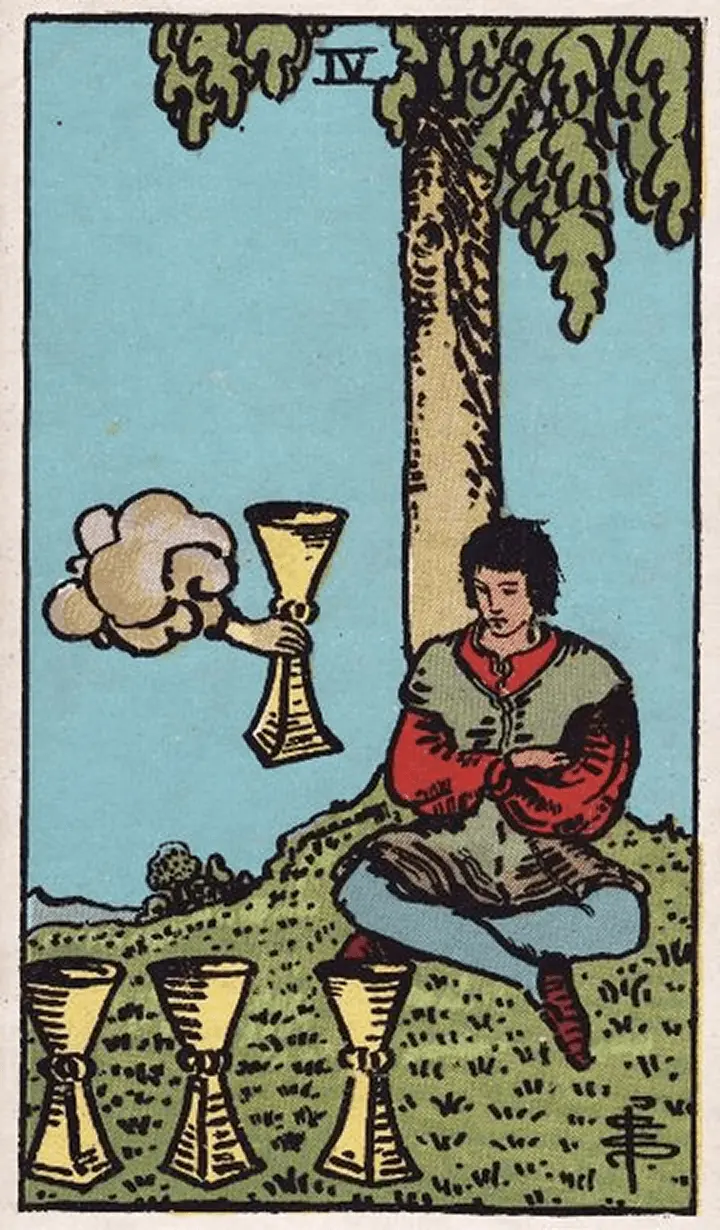
With Four of Cups—self-absorption and solitude harm relationships.
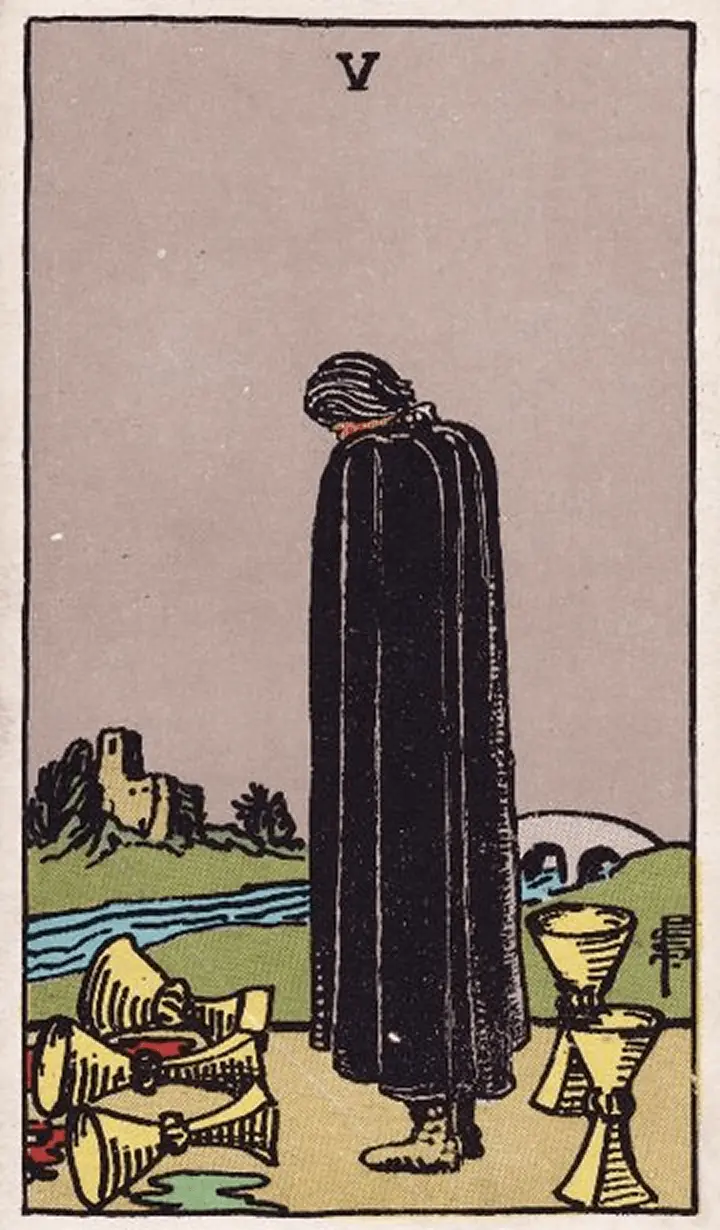
With Five of Cups—ruined relationships.
With Nine of Cups—meeting a loved one in company.
With Ten of Cups—family ties, kinship, blood relations.
Reversed with reversed Queen of Pentacles—vain hopes.
All sorts of mythological and legendary Pairs.
"What love has bound receives wings."
Cards from the same group
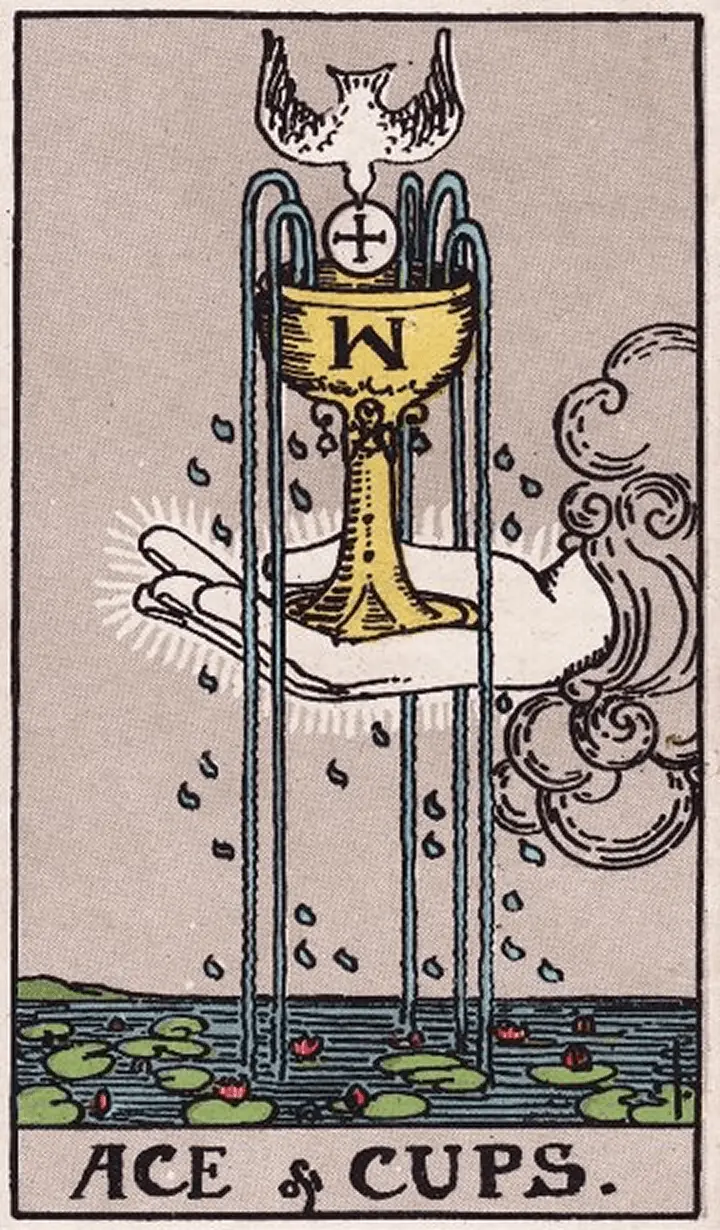
Ace of Cups
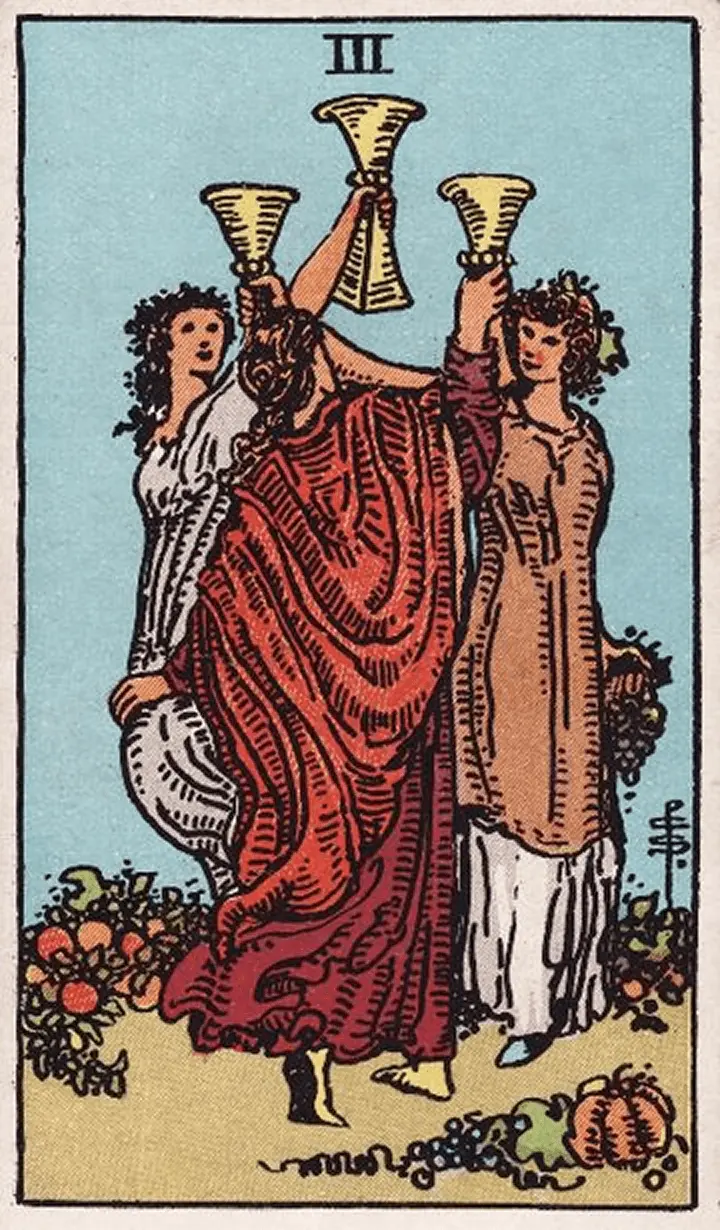
Three of Cups
Four of Cups
Five of Cups
Six of Cups
Seven of Cups
Eight of Cups
Nine of Cups
Ten of Cups
Page of Cups
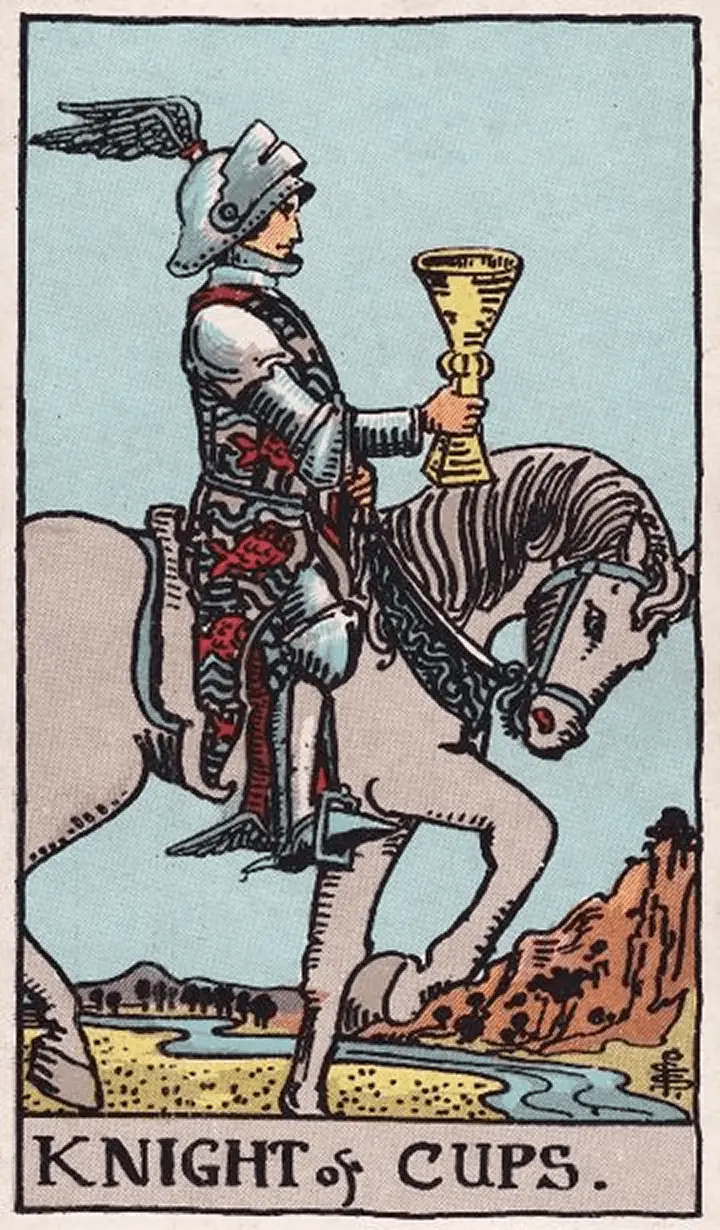
Knight of Cups
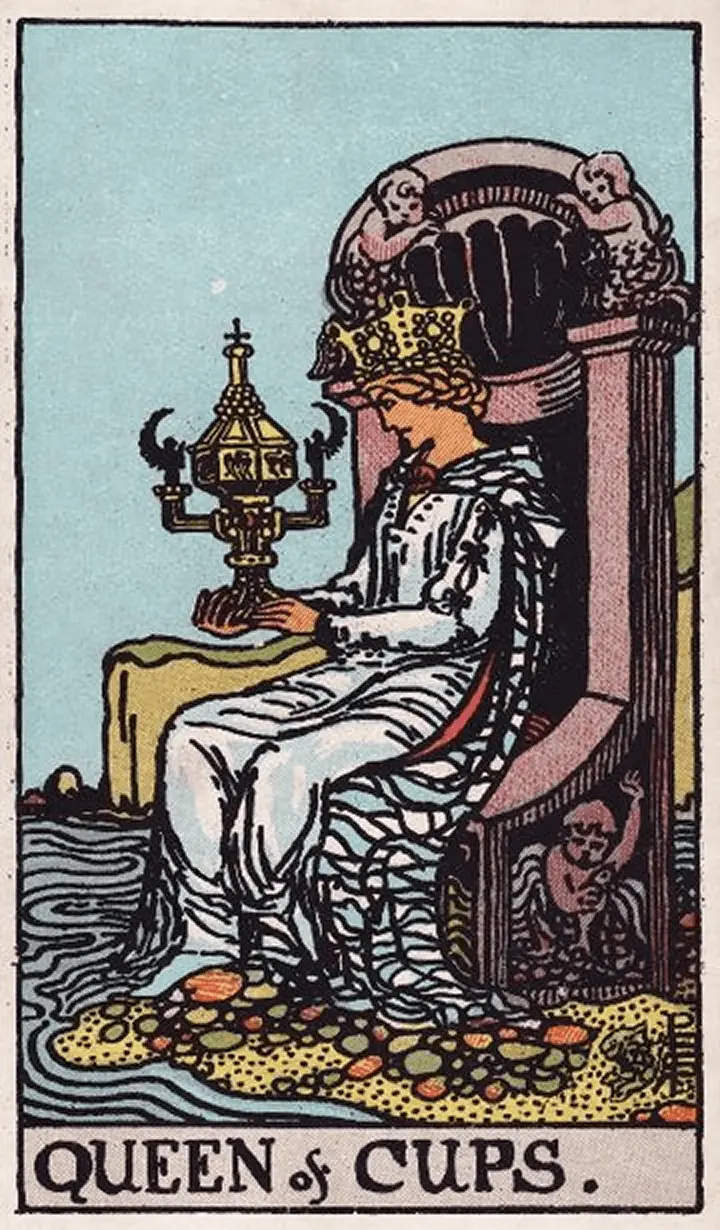
Queen of Cups